
Softgen
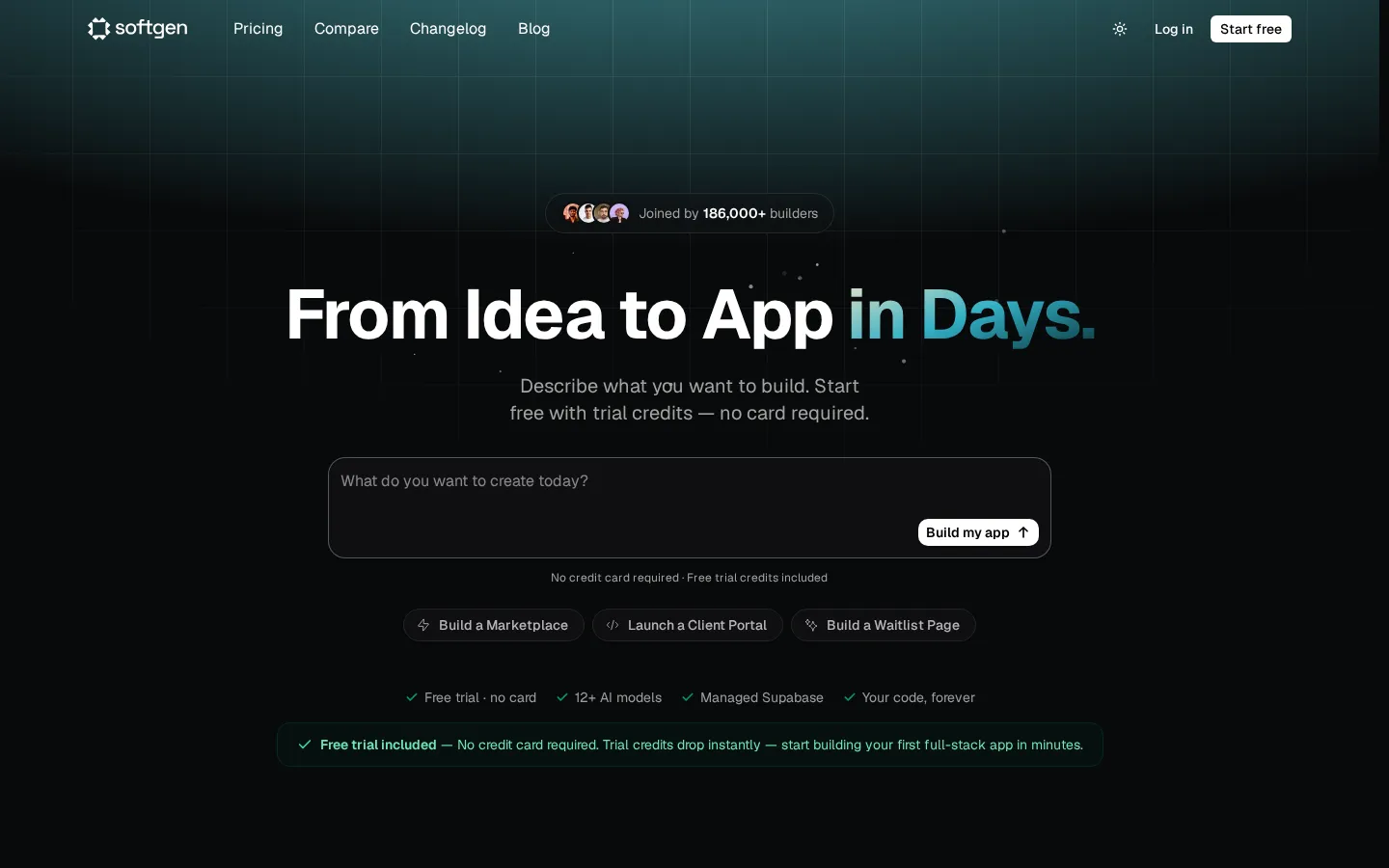
Softgen is an AI web app builder that turns a plain-English description into a working full-stack application. It generates Next.js applications with a managed Supabase database, authentication, payments and one-click integrations, then deploys them to Vercel. Builders can choose from 12+ AI models, export the code to their own GitHub repository, and keep full commercial ownership of everything they ship.
What is Softgen?
Softgen is an AI web app builder that converts natural-language descriptions into production-ready full-stack web applications. You describe what you want, for example a SaaS dashboard with Stripe billing and user authentication, and Softgen asks clarifying questions, creates a development plan in seconds, and then builds the frontend, backend, database and auth for you.
The generated stack is standard and portable: Next.js for the application, Supabase for the database and authentication, Vercel for hosting, and GitHub for source control. Softgen heavily emphasises ownership. Every project lives in a real GitHub repository the user owns on every plan. The code can be exported, imported, branched and merged like any normal repository, and opened in Cursor, VS Code or another IDE with zero proprietary magic to untangle. Hosting runs on the builder's own Vercel account, so the domain, SSL and uptime belong to them, and if a subscription is cancelled the app keeps running.
A managed Supabase database is included rather than charged as an expensive extra. On Starter it is platform-managed; Pro adds backups. Builders who prefer can connect their own Supabase instance, in which case their data never passes through Softgen.
Model choice is Softgen's headline differentiator. Rather than locking users to one model, it offers 12+ AI models including Claude 4.5, GPT-5.4, Gemini 3.1 Pro, Kimi K2.6 and Qwen. Starter includes GPT-5.1 and Gemini 3.1 Pro, while Pro unlocks the wider set including premium refactor options. Credits act as fuel: a monthly allocation spent only while actively building, never on failed attempts or background work. Published estimates run from about 3 credits for a quick edit to 40 for a complex build or full page, and 100 for a premium refactor; AI image generation costs roughly 5. Credits do not expire while subscribed, and Pro rolls unused credits over for one month. Top-up packs of 500, 1,000 and 2,500 credits are available at the same prices on both plans.
Everything needed to ship is built in: database, auth, payments, hosting, analytics, marketing pixels and support widgets. One-click integrations include Stripe, Resend, Google Analytics, GTM, PostHog, Hotjar, Microsoft Clarity, Mixpanel, Meta Pixel, X/Twitter, LinkedIn, TikTok, Pinterest, Intercom and Zendesk.
Softgen reports 186,000+ builders and showcases live businesses built on it across real estate, education, nonprofit, B2B SaaS and entertainment. Commercial rights stay fully with the builder, with no revenue share and no attribution required.
Softgen Core Features
Natural-language app generation turns plain-English descriptions into full-stack, production-ready Next.js applications automatically
Choice of 12+ AI models including Claude 4.5, GPT-5.4, Gemini 3.1 Pro, Kimi K2.6 and Qwen
Managed Supabase database and authentication included, with automated backups added on the Pro plan
GitHub export on every plan, with real repositories you own, branch, merge and import
One-click Vercel deployment to your own account, your domain, your SSL and your uptime
Predictable credits that never expire while subscribed and roll over for one month on Pro
One-click integrations for Stripe, Resend, analytics, marketing pixels and Intercom or Zendesk widgets
Project Manager, an AI that manages project scope, tasks and progress automatically on Pro
Who is Softgen for?
Softgen is aimed at founders, solo builders and small product teams who want to turn an idea into a working web application without assembling a development team. Its core audience is non-technical or lightly technical people, including no-code founders, marketers, agency owners, consultants and operators, who can describe the product they want in everyday English and watch it get built. The homepage highlights exactly this group: a no-code founder reporting a fully functional MVP in less than two days, and another builder going from idea to paying customers in eight days. It also fits experienced engineers who want speed. Softgen markets itself to developers who still care about the details but want the boilerplate, meaning frontend, backend, database, authentication and payments, generated for them. A 20-year software engineer and former Meta and Instagram employee is quoted saying Softgen makes it easy to build what he wants and is ten times faster than coding alone. Because every project lives in a real GitHub repository and is standard Next.js, engineers can open it in Cursor, VS Code or any other IDE and continue working normally. Agencies and freelance studios are another natural fit. They can prototype client work quickly, ship faster and cheaper, and hand over a repository the client owns. The Pro plan adds collaborators at no extra cost, since only the project owner pays, which suits small teams splitting work across design, content and development. Teams that need to own their infrastructure also fit well. Softgen lets builders connect their own Supabase and Vercel accounts, so data never passes through the platform and the app keeps running even if they cancel. Builders thinking about commercial rights are explicitly addressed too, because Softgen takes no revenue share, requires no attribution, and lets you sell the product or the business later. Finally, Softgen suits people who are cost-conscious and dislike opaque credit systems. Those frustrated by credits that vanish on failed fixes or background loops are the target of its predictable credits messaging, monthly allocations and rollover on Pro. If you want to build a real web app such as a SaaS dashboard, marketplace, job board, chatbot or internal tool, and you want to choose which AI model does the work, Softgen is positioned for you.
Softgen Use Cases
Building a SaaS dashboard with Stripe billing and user authentication from a written description
Launching a startup MVP fast without hiring developers or writing boilerplate code yourself
Prototyping client projects in an agency and handing over a repository the client owns
Creating internal tools, admin panels and business dashboards for operational teams
Shipping landing pages and marketing sites with analytics pixels and support widgets built in
Building AI chatbot applications and adding AI image generation inside a real product
Spinning up marketplaces and job boards with database, authentication and payments included
Letting non-technical founders go from idea to paying customers within days
Softgen Pros and Cons
Pros
- Model choice: 12+ AI models at $25/mo, which rivals in this price band do not offer
- True code ownership: real GitHub repositories, standard Next.js and IDE export on every plan
- Managed Supabase database included instead of charged as an expensive separate add-on
- Credits do not expire while subscribed and unused credits roll over for a month on Pro
- 186,000+ builders community with a public gallery of live products built on the platform
Cons
- Free access is limited to trial credits, while GitHub, publishing and full model choice need a paid plan
- The most capable models, custom domains and collaborators are locked behind the $49/mo Pro tier
- Credit spend varies with complexity and model, so heavy iteration can consume monthly allocations quickly
FAQ About Softgen
Softgen Pricing
Softgen starts with free trial credits and no card required, then offers a $25/mo Starter plan with 500 credits and 10 projects and a $49/mo Pro plan with 1,500 credits, unlimited projects, 12+ AI models, custom domains and free collaborators, plus credit top-up packs at $5 for 500 credits, $10 for 1,000 and $25 for 2,500.
Check official pricingFree Trial
Free trial credits included with sign-up, no credit card required, enough to start building a first full-stack app.
Starter
500 Softgen Credits per month, 10 projects, model choice of GPT-5.1 and Gemini 3.1 Pro, basic platform-managed Supabase, GitHub export, standard support and no Softgen branding.
Pro
1,500 credits per month, unlimited projects, 12+ AI models including Claude 4.5 and GPT-5.4, managed Supabase with backups, custom domains, Project Manager, free collaborators, one-month credit rollover and priority support. Billed around $468 per year.
Top-Up: 500 credits
Pre-set credit pack that never expires while subscribed; same price on Starter and Pro.
Top-Up: 1,000 credits
Pre-set credit pack that never expires while subscribed; same price on Starter and Pro.
Top-Up: 2,500 credits
Pre-set credit pack that never expires while subscribed; same price on Starter and Pro.
Softgen Alternatives

MWM
MWM runs the full lifecycle of mobile apps. MWM AI is an agentic builder that turns a plain-language description into native iOS and Android apps written in Swift and Kotlin. MWM Console is a free workspace for revenue, analytics, ASO and market intelligence, and MWM Publishing funds user acquisition to scale proven apps across 180+ markets.

ShipAny
ShipAny is a production-ready Next.js and TanStack Start template kit for AI products. Clone a template, launch a coding agent, and it wires landing pages, authentication, Stripe and Creem payments, subscriptions, credits, i18n, storage, email, and AI generation. Nearly 100 modules, including a user dashboard and admin panel, are ready to customize and deploy to Vercel, Cloudflare, Docker, or AWS.

Miniapps.ai
Miniapps.ai is a free web platform for discovering, using and building AI mini apps and chatbots. Browse a public gallery of user-made apps, chat with frontier models like GPT 6 Astra, Claude Opus 5, Gemini 3.5 Flash and Grok 4.6, generate images, music and video, then describe your own mini app and publish it for the community.