
Vento
Vento is an AI platform from Protofy for building connected systems, not just screens. Describe what a system should sense, decide and do, and Vento Agent creates the interfaces, data connections, automations, AI agents and device integrations inside one project, then refines them through conversation. It connects ESP32, Arduino and Raspberry Pi hardware without code, so a working prototype and its dashboard arrive together.
What is Vento?
Vento is an AI platform for building and operating connected systems: projects that combine software, data, AI agents, automations, interfaces and physical devices. Instead of assembling separate tools for a circuit, a firmware, a dashboard and a workflow, you describe the outcome you want in natural language and Vento Agent creates the parts and keeps them inside one project, which Vento calls a network.
The product is built by Protofy, a hardware and software studio, and it targets the gap between a prototype and a working system. A maker can ask for an ESP32 device that reads a sensor, shows live values on a dashboard and sends an alert when a threshold is crossed; Vento Agent then helps with wiring, firmware, the data connection and the interface. The same conversation can add an automation, call an external API, or attach an AI agent that reasons over project data and acts on the device.
Vento keeps the whole project in context while you build each part, test it with real inputs and outputs, and adjust behaviour by asking for changes, using visual tools or editing the code directly. Supported hardware includes ESP32 and Arduino boards, Shelly devices, Waveshare hardware, Raspberry Pi computers, phones, sensors and actuators; when a device is not in the catalogue, connections can still be made through APIs, webhooks, protocols or custom clients. A Desktop Agent extends a project to a computer or Raspberry Pi, and Vento Connect turns a phone into a connected device with sensor, camera or GPS input.
Interfaces are web-based. Vento creates dashboards, control panels and pages that read project data and trigger actions, and published pages can be shared by link. Teams are supported through network members, roles and permissions, so collaborators can view, edit or run actions at different access levels. Data lives in a built-in SQLite-based database, with PostgreSQL and Google Sheets available through an advanced database option, plus private and public file buckets.
Pricing is credit-based rather than feature-gated: agents, automations, devices, apps and collaboration are available on every plan, and plans differ in included Vento Credits. The Free plan grants limited daily credits, paid plans from nine euros per four weeks add capacity, and annual billing delivers thirteen bundles with two months free. Running out of credits blocks new metered work but does not delete the project. Vento is in beta, so some capabilities are still expanding, notably native mobile apps, custom domains, full project export and support for your own AI providers.
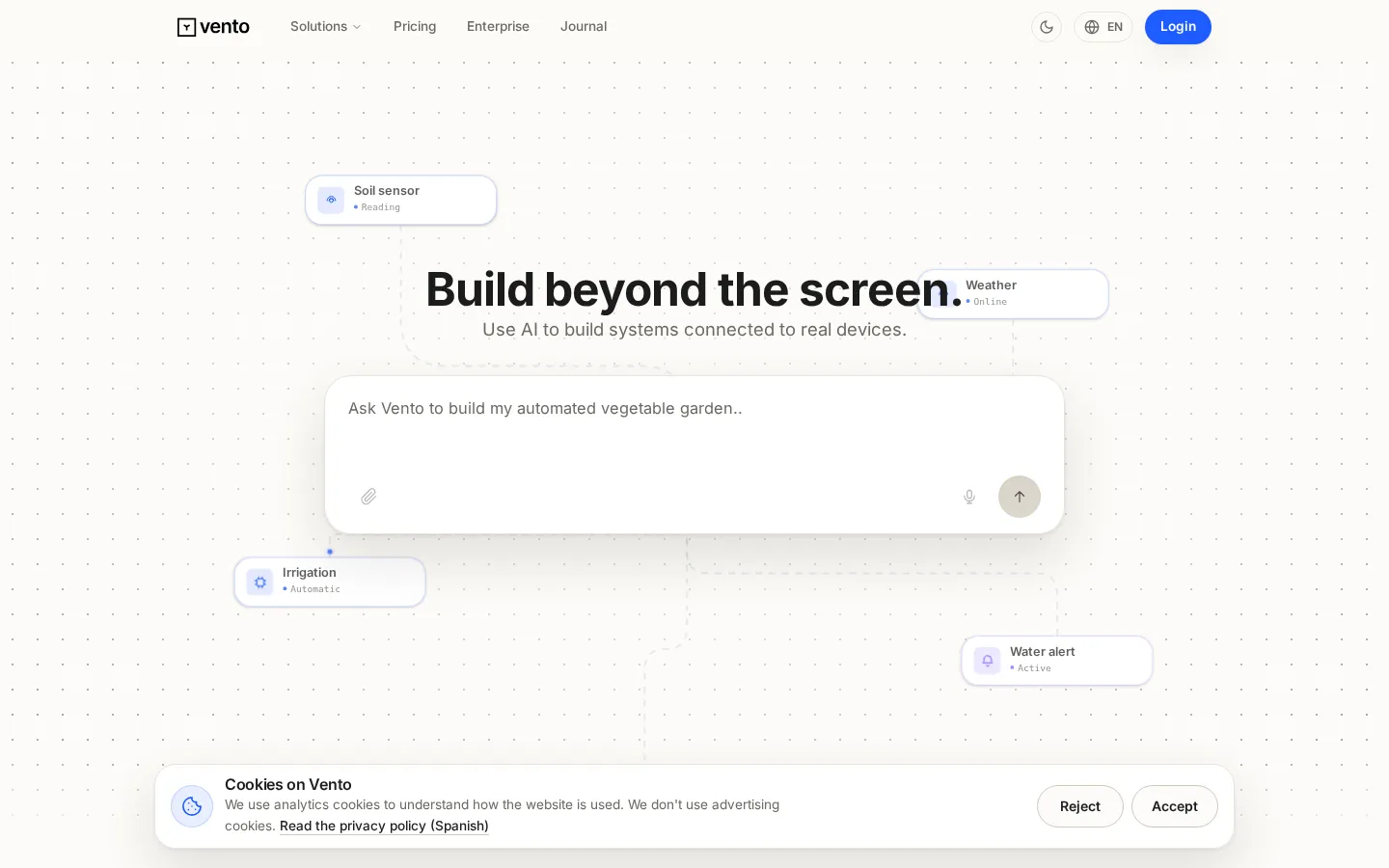
Vento Core Features
Natural-language project building
Vento Agent creates interfaces, automations, data connections and circuits from a description
Connected IoT support for ESP32, Arduino, Shelly, Waveshare, Raspberry Pi, phones, sensors and actuators
Circuit and firmware guidance, including wiring, configuration and connectivity for supported boards
Dashboards, control panels and mobile-friendly web pages linked to live project data and device state
Automations triggered by sensor readings, events, schedules, API calls or webhooks
AI agents that reason over project data and act on devices and external services
Built-in SQLite database with PostgreSQL and Google Sheets options, plus private and public file buckets
Team collaboration through network members, roles and permissions, with shareable published interfaces
Who is Vento for?
Vento targets people who build physical-digital systems but do not want to stitch together electronics CAD, a firmware toolchain, a backend and a dashboard by hand. The clearest fit is the maker or hardware hobbyist who already owns an ESP32, Arduino or Raspberry Pi and wants the software layer around it to exist without writing all of it. Inventors and early-stage product teams use it to get a functional first version in front of real users: a parking station that knows whether a space is free, a dispenser that reports its own state, a controller that schedules equipment across rooms. Vento is positioned for that validation stage and also for production, with Protofy engineers available on enterprise engagements. Designers and artists come for the interface and behaviour side, because they can specify what a piece should sense and how it should respond, then iterate on the interaction instead of waiting on a development cycle. Educators use it in workshops where the point is the system, not the boilerplate: students describe what they want to measure and control, and the resulting project shows circuits, data and interfaces working together. Engineers and small operations teams use Vento where a commercial IoT platform would need heavy customisation, especially when the workflow includes a bespoke interface, an AI agent or an integration that does not exist yet. It suits teams that want one project holding telemetry, device state, controls and logic, with member roles and permissions for collaborators. It is a weaker fit for someone who only needs a marketing website, a purely conversational assistant, or a ready-made automation between two SaaS tools, and for anyone who needs a native mobile app on the App Store today, since Vento does not generate those. Access is limited during beta, so new users may need to request an invitation through the community channels.
Vento Use Cases
Build an ESP32 sensor device with firmware, live readings and a dashboard
Automate irrigation, climate or lighting from sensor thresholds and schedules
Connect a Raspberry Pi gateway that reports every state change to the cloud
Create a booking or inventory app that stays in sync with physical hardware
Add a voice or vision assistant that checks stock and lights the right shelf
Turn a phone into a sensor node for motion, camera or GPS data
Prototype a connected product and validate it before committing to production
Run a workshop where students ship a working connected system in one session
Vento Pros and Cons
Pros
- One project holds electronics, firmware, data, interfaces and automations, so changes do not need re-integration across separate tools
- Credit-based plans keep every capability available and only vary capacity, with a free tier to start
- Broad hardware coverage, including ESP32, Arduino, Raspberry Pi, Shelly devices and phones
- Enterprise path with Protofy engineers supporting integration, deployment and production rollout
Cons
- Still in beta with limited access, so new users may need to request an invitation through community channels
- No native mobile apps, custom domains or full project export yet
- Cannot select your own AI providers or run local models, and metered Credits can run out mid-task
FAQ About Vento
Vento Pricing
Free plan with limited daily credits. Paid plans are 9 EUR (Basic, 100 credits), 25 EUR (Pro, 400 credits) and 42 EUR (Max, 900 credits) per four weeks, excluding taxes. Annual billing is prepaid with two months free and delivered as 13 credit bundles; extra credit recharges are available on paid plans.
Check official pricingFree
Free daily credits when eligible, capped at six per month; credits expire and do not accumulate. No commitment.
Basic
100 Vento Credits every four weeks, accumulating up to 200; full platform access, cancel any time.
Pro
400 Vento Credits every four weeks, accumulating up to 800; 30% off compared to Basic.
Max
900 Vento Credits every four weeks, accumulating up to 1,800; 48% off compared to Basic and marked best value.
Enterprise
Contractual support, deployment planning and production rollout with Protofy engineers; hardware and software integration.
Vento Alternatives

Superblocks
Superblocks is an enterprise platform for AI-generated business apps. Business teams describe internal tools in natural language and the Clark agent builds them on private company data, while IT controls integrations, permissions, secrets, audit logs and deployment. Apps run in the Superblocks cloud or inside a customer VPC on AWS, GCP or Azure.

Modaal
Modaal turns an app idea into shipping native software: it plans each feature as an approved spec, then lets the coding agent you already pay for write SwiftUI and Jetpack Compose from one shared core. Projects stay as real Xcode and Android Studio repositories on your Mac, with simulators, TestFlight, and App Store release built in.

GoDaddy Airo AI Builder
GoDaddy Airo AI Builder is a prompt-driven site builder from GoDaddy. Describe a business or idea and it drafts pages, sections and copy, then lets you refine layout, tone and visuals with guided controls before publishing to GoDaddy hosting with SSL, forms and analytics included. Plans start free with credits, and paid tiers add custom domains, payments, bookings and more sites.