
ShipAny
ShipAny is a production-ready Next.js and TanStack Start template kit for AI products. Clone a template, launch a coding agent, and it wires landing pages, authentication, Stripe and Creem payments, subscriptions, credits, i18n, storage, email, and AI generation. Nearly 100 modules, including a user dashboard and admin panel, are ready to customize and deploy to Vercel, Cloudflare, Docker, or AWS.
What is ShipAny?
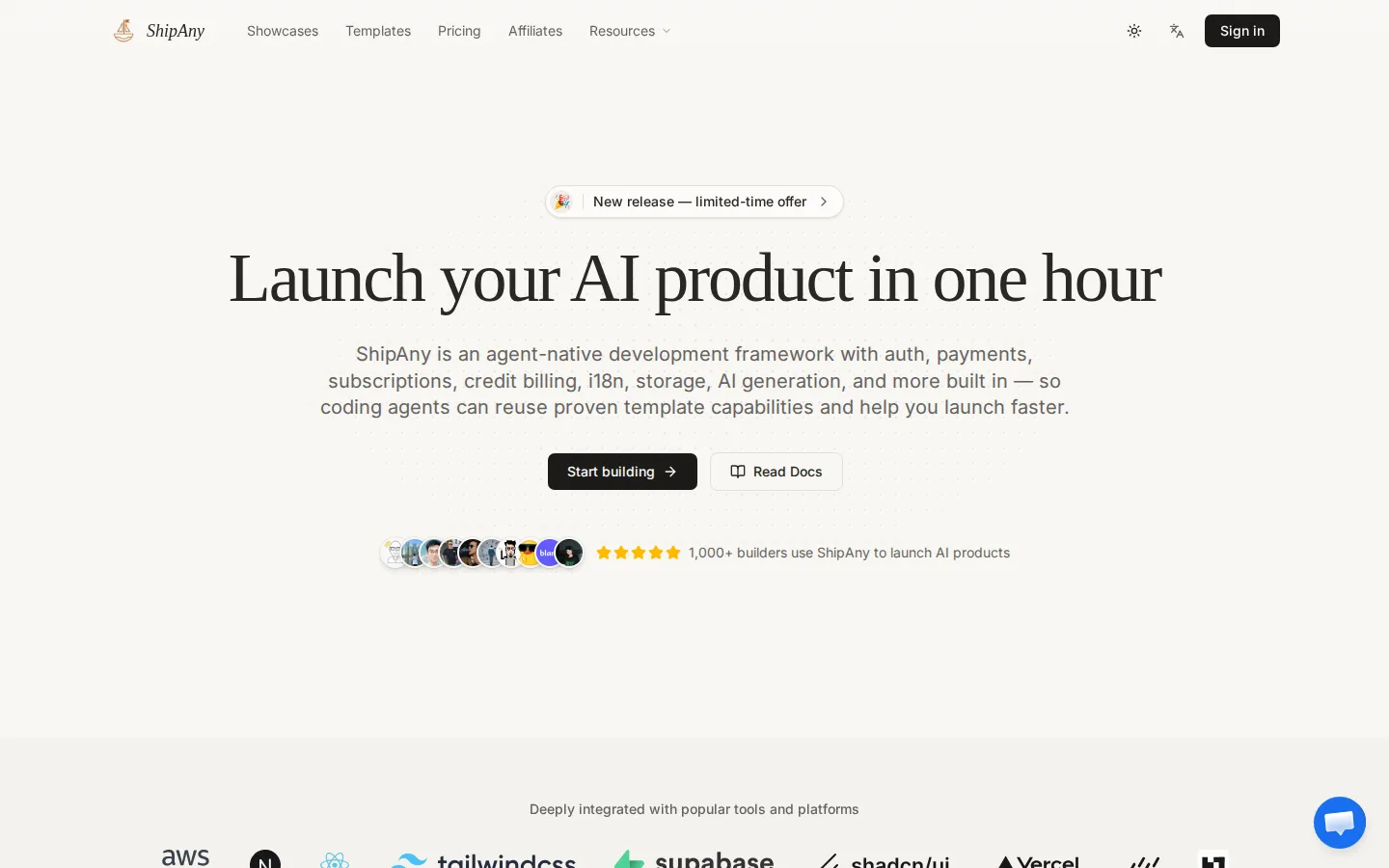
ShipAny is an agent-native development framework and template kit for launching AI products, built around the idea that a coding agent should reuse proven SaaS capabilities instead of rebuilding them from scratch. The promise on the homepage is a launch in one hour: clone a template repository, start a coding agent such as Claude Code, Cursor, Codex, VS Code, or OpenCode, run the ShipAny Skills, and end up with a working product whose authentication, payments, subscriptions, credit billing, internationalization, storage, and AI generation are already wired together.
The repository ships close to 100 built-in SaaS essentials. Landing pages and essentials cover landing blocks, a pricing page, a blog, MDX static pages, auth pages, shadcn/ui components, i18n routing, and light and dark themes. The user dashboard gives customers their subscription plan, billing and payment history, credits balance, API keys, usage statistics, support tickets, and profile in one place. The admin panel manages users, invite codes, RBAC roles and permissions, content, orders and subscriptions, credit grants, and system settings, including provider configuration for payment, email, storage, and AI services.
ShipAny is built to be driven by agents. Its documented Skills map to concrete tasks: /quick-start scaffolds a full SaaS from a one-sentence brief, /clone-website rebuilds an existing site pixel-perfect, /new-module adds a business module with its own API, /new-page and /new-static-page add dashboard and content pages, /generate-image produces page artwork, /security-scan runs a pre-commit security check, /sync-upstream pulls upstream template updates into your fork, and /deploy-cloudflare handles one-command deployment. The documented stack is Next.js, React, Tailwind CSS, shadcn/ui, Drizzle ORM, Better Auth, next-intl, Supabase, Stripe, Creem, Cloudflare R2, and Resend, with TanStack Start offered as an alternative engine for a headless build.
Around the core repository sits a commercial template library: ShipAny TanStack for a headless SaaS engine, ShipAny Next on Next.js 16, plus finished app templates for image generation, image agents, video agents, video lite, and voice agents. Each carries a $199 retail price with member prices from $1.99 to $99. Deployment targets include Vercel, Cloudflare Workers, Docker, Dokploy, AWS, and Netlify. The site reports more than 1,000 paying customers, over 2,000 live websites, more than 100 feature modules, and showcases shipped products such as AITDK, ImgAny, CodexThemes, CCOnline, and Clonesite AI.
ShipAny Core Features
Agent Skills
slash commands including /quick-start, /new-module, /new-page, /clone-website and /security-scan
SaaS essentials
nearly 100 built-in modules covering landing blocks, pricing page, blog, MDX pages and auth screens
User dashboard
subscription plan, billing and payment history, credits balance, API keys, usage stats and support tickets
Admin panel
user management, invite codes, RBAC permissions, content management, orders, credit grants and system settings
Payments and billing
Stripe and Creem checkout with subscriptions, credit billing, orders and provider configuration
Internationalization and theming
next-intl routing with light and dark themes on top of shadcn/ui components
Template library
official image, video and voice agent templates with member prices from $1.99
Multi-platform deployment
one-command deploys to Vercel, Cloudflare Workers, Dokploy, Docker, AWS or Netlify
Who is ShipAny for?
ShipAny is aimed at people who can describe a product but do not want to build SaaS plumbing. Independent developers and vibe coders are the loudest group in the testimonials: several describe launching a site with auth and payments in five to thirty minutes, and one blogger notes that clean architecture is the best context you can hand an AI. If you already drive Claude Code, Cursor, Codex, or OpenCode, the slash-command Skills are the intended entry point. Product managers and technical founders are a second fit. Testimonials on the site come from product managers who jumped from product work to shipping full-stack sites for a global audience, and from a data analyst who says the auth, Stripe payments, and credit management all worked out of the box despite not being a developer. Small teams and agencies use ShipAny as a starting point they can resell or repeat. The template library covers finished product categories such as image generators, image agents, video agents, and voice agents, which suits a studio that wants to ship a polished vertical app rather than invent every screen. Template authors and affiliates are addressed directly: Premium members can submit their own work for free and get featured, sell their own templates with no listing fees, and earn referral commissions through the affiliate program. That makes ShipAny useful to people whose business is selling assets to other builders rather than only shipping products. People who need a no-code website builder, or who will not use a coding agent at all, are a poor fit. ShipAny delivers a codebase and a repository you deploy yourself; customization still happens in code, through an AI agent or a developer.
ShipAny Use Cases
Launch an AI image generator with credits billing, subscriptions and a customer dashboard already built
Ship an AI video or voice agent product with authentication and payments wired before you write features
Hand a one-sentence product idea to a coding agent and generate the full SaaS skeleton
Add a new business module with its own API to an existing ShipAny codebase
Clone an existing marketing site pixel-perfect and rebuild it as your own product landing page
Stand up an admin panel to manage users, subscription orders, credit grants and provider settings
Deploy the same codebase to Cloudflare Workers for edge hosting instead of Vercel
Sync upstream template updates into your customized repository without losing your own changes
ShipAny Pros and Cons
Pros
- Authentication, payments, subscriptions, credits, i18n, storage, and AI generation are already wired, which is what turns weeks of SaaS plumbing into an afternoon of customization
- The Skills map to real jobs such as /quick-start, /new-module, /new-page, and /security-scan, so agent-native development is a working workflow rather than a marketing label
- Nearly 100 modules cover both sides of a SaaS: a customer dashboard with credits and API keys, plus an admin panel with RBAC, orders, credit grants, and provider configuration
- Templates exist for both Next.js and TanStack Start and deploy to Vercel, Cloudflare, Docker, Dokploy, AWS, or Netlify, so the choice of stack and host stays open
- Premium is a one-time payment that unlocks lifetime access and member pricing, so there is no recurring license fee to keep the codebase usable
Cons
- It delivers a codebase, not a no-code builder, so shipping still depends on a coding agent or a developer who can modify and deploy the template
- There is no free tier and the headline launch times assume the agent gets the customization right, which makes the first hour optimistic for anything beyond a standard product
- Template pricing is presented as a $199 retail figure crossed out against a member price, so the real cost depends on buying the $249 Premium membership separately
FAQ About ShipAny
ShipAny Pricing
One-time purchase pricing with no free tier: ShipAny Premium membership is listed at $249, discounted from $299, for lifetime access with no renewals, individual templates carry a $199 retail price, and member prices run from $1.99 for the SaaS engines up to $99 for finished image, video, and voice agent templates.
Check official pricingShipAny Premium
Lifetime access with no renewals. Includes the latest ShipAny TanStack template, six official templates at the $1.99 member price, member pricing on other commercial templates, free submission and featuring of your work, template selling with no listing fees, affiliate commissions, and technical support by email and ticket.
ShipAny TanStack
A headless SaaS engine built with TanStack Start, carrying the core ShipAny modules for auth, payments, subscriptions, credits, i18n, storage, and AI generation, ready to customize with a coding agent.
ShipAny Next
The next-generation AI SaaS engine built with Next.js 16, using the same module set as the rest of the framework and the agent Skills for scaffolding pages, modules, and deployments.
ShipAny Image Lite
A focused AI image generator template built with TanStack Start on the ShipAny SaaS engine, sold as a finished product starter rather than a blank repository.
ShipAny Image Generator, Image Agent, Video Agent and Video Lite
Finished templates for AI image generation, image agents, video agents, and video creation, each built on the ShipAny engine with credits billing, subscriptions, and the user dashboard included.
Enterprise and custom work
The site routes questions about larger or custom projects through its contact and ticket channels, and offers an affiliate program for referrals and a free submission route for showcasing your own work.
ShipAny Alternatives

Softgen
Softgen is an AI web app builder that turns a plain-English description into a working full-stack application. It generates Next.js applications with a managed Supabase database, authentication, payments and one-click integrations, then deploys them to Vercel. Builders can choose from 12+ AI models, export the code to their own GitHub repository, and keep full commercial ownership of everything they ship.

MWM
MWM runs the full lifecycle of mobile apps. MWM AI is an agentic builder that turns a plain-language description into native iOS and Android apps written in Swift and Kotlin. MWM Console is a free workspace for revenue, analytics, ASO and market intelligence, and MWM Publishing funds user acquisition to scale proven apps across 180+ markets.

Miniapps.ai
Miniapps.ai is a free web platform for discovering, using and building AI mini apps and chatbots. Browse a public gallery of user-made apps, chat with frontier models like GPT 6 Astra, Claude Opus 5, Gemini 3.5 Flash and Grok 4.6, generate images, music and video, then describe your own mini app and publish it for the community.