
Fuse AI
Fuse AI combines a large B2B contact database with AI research agents, buying-signal monitoring, and multi-channel outreach in one workspace. Teams can search for prospects, enrich records across dozens of data providers, watch target accounts for intent, and run email, LinkedIn, and phone sequences. It is aimed at revenue teams that want less tool switching and more consistent outbound execution.
What is Fuse AI?
Fuse AI is a sales and revenue automation platform built around AI agents that prospect, research, and engage buyers. Rather than selling a single point tool, Fuse bundles a B2B contact database, data enrichment, buying-signal monitoring, multi-channel outreach, and workflow automation into one workspace. The company is based in San Francisco, is backed by Y Combinator, and says its products are used by sales and marketing teams at more than 1,000 startups and enterprises.
Prospecting starts with Fuse's contact and company data. The site advertises 850M+ contacts and 40M+ companies, enriched through 40+ data providers, with automated ICP matching and the ability to import LinkedIn Sales Navigator lists. Records can be exported to CSV, Salesforce, HubSpot, or Slack, so the platform can feed an existing CRM rather than replace it. Fuse publishes its own accuracy benchmarks, but those figures are vendor-reported and worth validating against your own target market.
On the intelligence side, Fuse monitors target accounts for buying intent. It advertises 50+ real-time signals, including website visits, web activity, and competitor interactions, and uses AI research agents to summarize accounts and suggest a next action. Signals can trigger workflows, which is where the platform tries to separate itself from static databases that only refresh on a schedule.
Outreach runs across email, LinkedIn, and phone from the same workspace. Fuse supports unlimited sequences on paid plans, parallel dialing, connected inboxes, email warmup tooling, and bi-directional CRM sync. Agents can draft and personalize messages, and the pricing page sells credits consumed by enrichment, signal monitoring, agent queries, and dialer minutes, so cost scales with usage rather than seats alone.
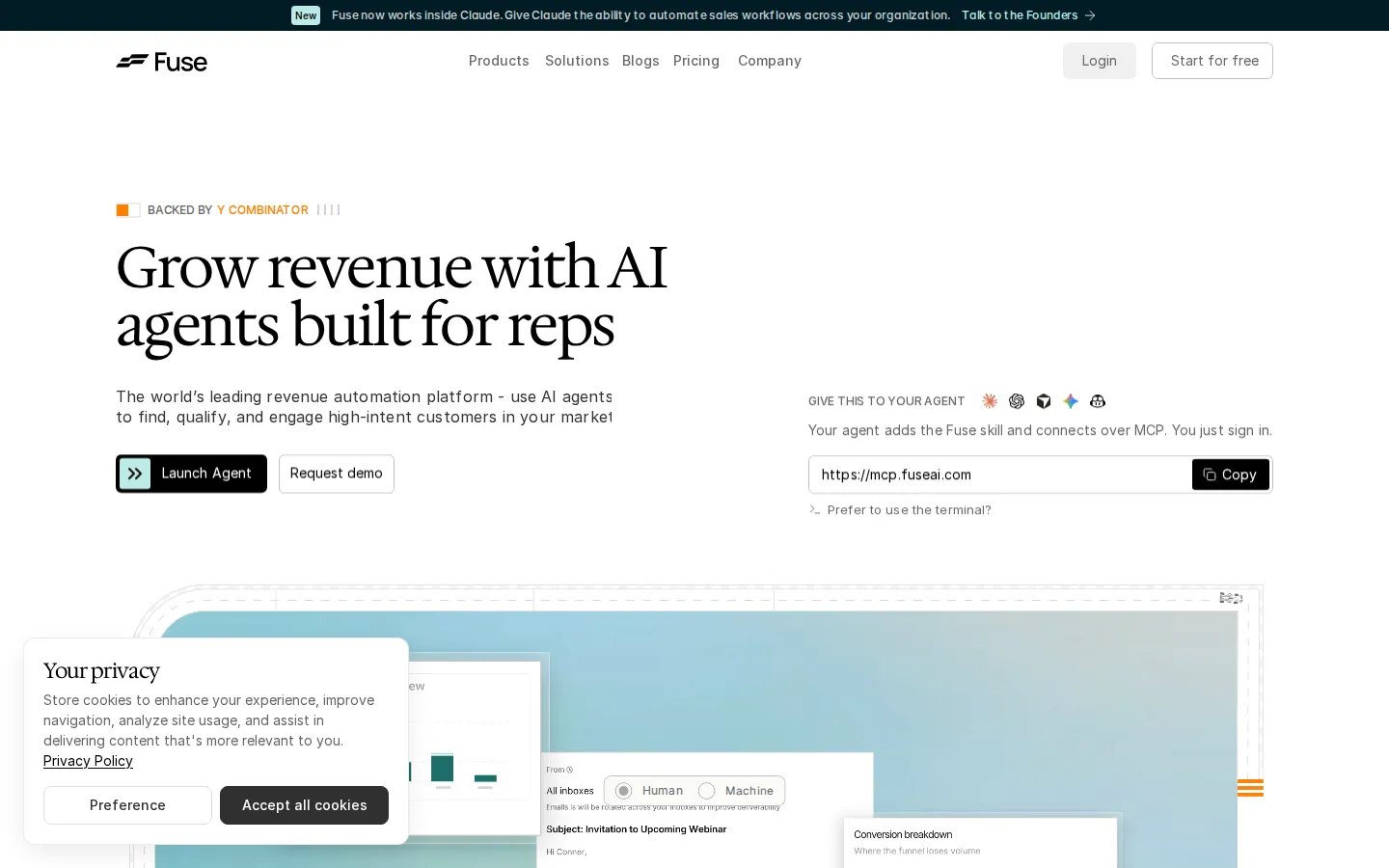
Fuse also exposes an MCP endpoint at mcp.fuseai.com and publishes a skill file, so agents such as Claude, ChatGPT, Cursor, Gemini, and GitHub Copilot can call Fuse directly. That positions the product as infrastructure for agent-driven sales work as well as a conventional web application. API access is listed on every plan, including the free tier.
Enterprise controls include role-based access, agent guardrails, per-agent isolated cloud environments, usage and spend visibility, SSO, and audit logging. Fuse states SOC 2 Type I, GDPR, CCPA, and CASA Tier 2 compliance. Buyers should treat performance claims such as accuracy percentages, fill rates, and deliverability outcomes as marketing figures and test them on their own data before committing to an annual contract.
Fuse AI Core Features
B2B contact database
Search across 850M+ contacts and 40M+ companies, with automated ICP matching to build a target account list.
Waterfall enrichment
Verify and enrich emails and phone numbers through 40+ data providers, with credit costs listed per enrichment type.
Buying-signal monitoring
Track 50+ real-time signals such as website visits, web activity, and competitor interactions on target accounts.
AI research agents
Run agent queries that research accounts, summarize findings, and suggest the next action for a rep.
Multi-channel sequences
Run email, LinkedIn, and phone outreach from one workspace, with unlimited sequences on paid plans.
Parallel dialer
Place multiple calls at once, with connected numbers and per-minute credit pricing shown on the pricing page.
Workflow automations
Build trigger-and-condition workflows across prospecting, enrichment, CRM updates, and outreach with no code.
MCP and API access
Connect Claude, ChatGPT, Cursor, Gemini, or Copilot through mcp.fuseai.com, or call the documented API directly.
Who is Fuse AI for?
Fuse AI is aimed at revenue teams that run outbound as a repeatable process rather than an occasional campaign. It fits organizations that already have a defined ideal customer profile and want prospecting, enrichment, signals, and sequencing handled in one place instead of across four or five subscriptions. Sales development teams and SDR managers use it to build targeted lists, enrich contacts, and run email, LinkedIn, and phone sequences from a shared workspace. Founders and solo sellers on the Solo plan use it as a lower-cost way to run structured outbound without hiring a dedicated operations person. RevOps and sales operations teams use the automation builder and CRM sync to standardize routing, enrichment, and handoffs, and to monitor credit consumption across teams. Demand generation and marketing teams use buying-signal monitoring to identify accounts showing intent and pass them to sales. GTM engineers and technical sellers use the MCP endpoint and API to wire Fuse into agent workflows and internal tooling. Larger enterprises use the Enterprise tier for SSO, RBAC, audit logging, custom credits, and dedicated support. It is less suited to teams that only need a static contact list, or to very small businesses with no outbound motion and no CRM to sync with.
Fuse AI Use Cases
Build a targeted prospect list from an ideal customer profile without manually assembling filters across tools.
Enrich imported or scraped contacts with verified emails and phone numbers before a sequence launches.
Detect accounts researching your category and route the strongest signals to a rep the same day.
Run coordinated email, LinkedIn, and phone cadences from a single sequence instead of three separate tools.
Keep CRM records current by automating field updates and handoffs after each engagement step.
Give a founder or solo seller a structured outbound motion without hiring a sales operations specialist.
Test new market segments quickly by generating a list, enriching it, and launching a small pilot campaign.
Connect Fuse to an AI assistant so agents can run research and enrichment tasks on request.
Fuse AI Pros and Cons
Pros
- Prospecting, enrichment, signals, sequencing, and dialing live in one workspace, which reduces tool switching for outbound teams.
- The free tier and $60 Solo plan make it cheap to test the workflow before committing to a team contract.
- MCP support and API access on all plans let technical teams plug Fuse into agent workflows and internal tooling.
- Published enterprise controls, including SSO, RBAC, audit logging, and SOC 2 Type I, give IT a clear review path.
Cons
- Credit-based pricing makes real monthly cost hard to predict, since enrichment, signals, and dialing each consume different amounts.
- Vendor benchmarks for accuracy, fill rate, and deliverability are self-reported and should be validated on your own data.
- The feature set is broad, so small teams without a defined outbound process may find setup and credit planning heavy.
FAQ About Fuse AI
Fuse AI Pricing
Fuse AI is free to start, with Solo at $60 per month, Team at $200 per month, and custom Enterprise pricing.
Check official pricingFree
One seat, 24,000 credits per year, limited enrichment, limited email sequences, and limited AI agents and buying signals.
Solo
One seat, 480,000 credits per year, premium enrichment across 40+ providers, unlimited sequences, and CRM, MCP, API, and Slack integrations.
Team
Five seats, 1.2 million credits per year, unlimited AI research agents and signals, unlimited parallel dialing, and dedicated onboarding.
Enterprise
Five or more seats, custom credits and rate limits, RBAC, SSO, audit logging, dedicated GTM engineer support, and priority Slack support.
Fuse AI Alternatives

Visidea
Visidea is an AI-powered search and discovery suite for online stores, combining image-based visual search, natural-language semantic search and machine-learning product recommendations, plus email recommendations, in one subscription. Ready-made plugins cover Shopify, WordPress/WooCommerce, Magento and PrestaShop, and a documented REST API fits custom or headless storefronts. A 14-day free trial leads into paid plans from EUR 34.99 per month.

Copyfy
Copyfy is an all-in-one e-commerce toolkit for finding winning products and launching stores with AI. It combines a winning-product database, a Meta and TikTok ads library, competitor store research, and shop analytics with an AI store builder that generates a complete Shopify store in one click. Users can also create ad creatives, marketing plans, and product images with AI.

Origami
Origami is an AI agent that gets customers for a business: enter your website and it recommends the best ways to find leads, enrich accounts, sequence outreach and create content. Approve a play with a click and Origami runs the campaign, using real-time search across 50+ sources and verified contact data. A free tier is available; paid plans start at $49 per month.