
Factorial
Factorial brings HR, payroll, time, talent, finance and IT into one platform, with an AI agent called One that understands your company context. It analyzes data, drafts reports and completes routine work across modules, from approving time off to reconciling expenses. More than 17,000 companies use it, and plans start at $8 per employee per month.
What is Factorial?
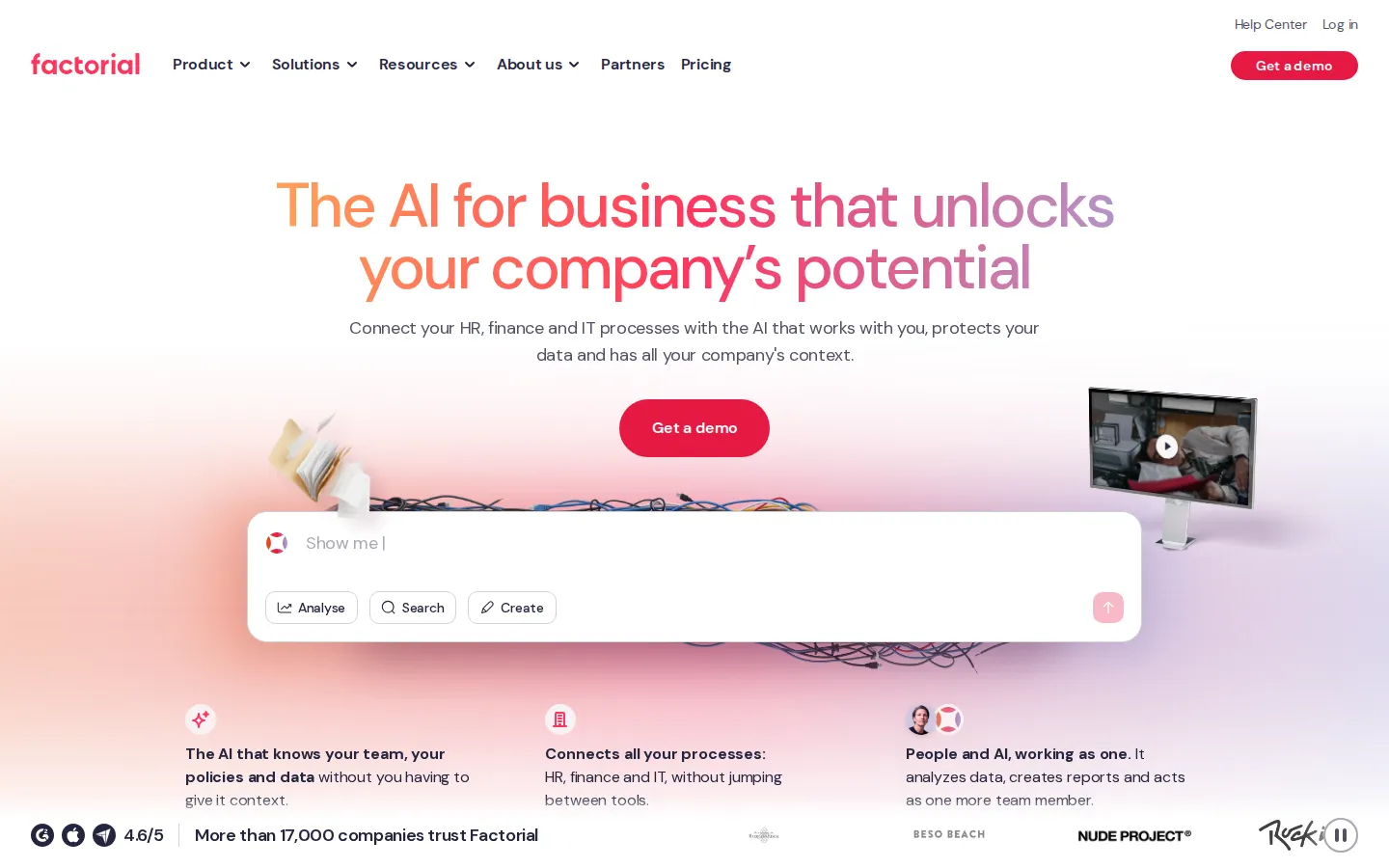
Factorial is a European business management platform that positions itself as the AI for business rather than a traditional HR suite. It connects HR, payroll, time management, talent, finance and IT operations inside one system, then layers an AI agent on top that already knows the company's people, policies and records. The company says more than 17,000 businesses trust the platform, and it reports that customers save roughly 60% of the working hours previously spent on administrative tasks.
The centerpiece is One, an AI agent that every employee gets. Because it runs inside the platform, it works with your company context and your connected tools instead of needing a briefing first. Factorial describes its behavior in three verbs: search, analyze and create. In practice that means asking where a policy sits, having it compare headcount or expense data, or letting it draft a report or a document without leaving the workspace.
The agent also does work rather than only answering questions. On the HR side it prepares the material behind routine processes, including company policies, contracts and documents awaiting signature, so a person reviews and approves instead of assembling paperwork. In finance it reads receipts, reconciles expenses and routes them through approval flows. In IT it can tie device provisioning and application access to the same employee record that onboarding creates.
Underneath the AI sits a broad product surface. Time Management covers time off, time tracking with geolocation and QR check-in, shift scheduling and project time. Talent spans recruitment with AI CV parsing, performance reviews, objectives and OKRs, training and engagement surveys. Payroll handles payroll management, payslip distribution and legal electronic signature. Finance adds expenses with OCR document reading, procurement and corporate cards. Factorial IT adds multi-OS device management, IT inventory, SaaS license oversight and endpoint security.
Security and compliance are part of the pitch, which matters for a system holding payroll and identity data. Factorial describes the platform as secure and EU-compliant, lists ISO 27001 certification and SOC attestation in its footer, and publishes security detail through a dedicated trust portal.
Factorial also publishes an open API and an integration marketplace covering tools such as Google Workspace, Slack, Microsoft Copilot, SAP Business One, Business Central, Power BI, Jira and Zapier, so the platform can sit at the center of a company's stack rather than beside it. Native iOS and Android apps keep requests, approvals and documents available away from a desk.
Factorial Core Features
One AI agent
Every employee gets an assistant that already knows company policies, people and records, so questions about leave, headcount or spend are answered from live data rather than a pasted brief.
Search, analyze, create
The agent works across the three modes Factorial highlights, locating information, comparing data sets and producing reports or documents without leaving the workspace.
Agentic HR workflows
Company policies, contracts, payroll inputs and signature requests are prepared automatically for a human to review and approve, removing assembly work from routine processes.
AI CV parsing
Candidate applications are read and structured automatically during recruitment, so hiring managers filter on criteria instead of retyping details from PDFs.
OCR expense capture
Receipts and invoices are read automatically and matched to approval flows and projects, so finance teams reconcile records instead of chasing documents.
Time and shift automation
Time-off validation, geolocated and QR time tracking, rotating and bulk shift scheduling plus project time all feed a single record of hours worked.
Payroll and e-signature
Payroll management, payslip distribution and legal electronic signature sit in the same system as the leave and hours data payroll depends on.
IT and access automation
Device management across operating systems, IT inventory, SaaS license oversight and endpoint security connect to HR records so access follows onboarding and offboarding automatically.
Who is Factorial for?
Factorial is aimed at companies of roughly 20 to 1,000 employees that have outgrown spreadsheets and a set of disconnected point tools, and it is organized around the roles named on its own site. HR managers and HR leaders are the primary audience. The work is administrative volume: time-off requests, contracts, onboarding paperwork, policy questions and review cycles. Factorial's pitch is that the AI agent assembles that material and answers policy questions from company context, leaving HR to review, approve and spend time on people. The agent also summarizes long documents such as performance reviews, which is the example one customer, FRS Co-Op, cites as the reason it saves managers time on every review. CEOs, COOs and founders are the second audience. The promise is a single view across headcount, payroll cost, expenses and projects, plus an agent that can answer a business question without waiting for a spreadsheet to be built. CFOs and finance teams get expense management with OCR receipt reading, multi-step approval flows, procurement, corporate cards and project-level cost tracking, with the AI reconciling rather than chasing paper. IT administrators are a newer audience, served by Factorial IT: multi-OS device management, asset inventory from purchase to assignment, SaaS license oversight and endpoint security hooked into HR records, so onboarding and offboarding provision and revoke access automatically. Individual employees use the platform directly through a portal and mobile apps, requesting time off, signing documents, submitting expenses and checking payslips. It also suits multi-country mid-market employers, particularly in Europe, where Factorial emphasizes local rules such as severance in Spain and sick leave in Germany. Industry packaging exists for retail, hospitality, manufacturing, healthcare, construction, real estate, consulting and technology. Very small teams with no dedicated HR function may find modular pricing heavier than they need, and enterprises with unusual payroll territories should confirm local coverage before committing.
Factorial Use Cases
Ask the AI agent for headcount cost by team and get a finished report without building a spreadsheet.
Automate time-off validation so requests follow policy rules and managers only see the exceptions.
Parse incoming CVs and shortlist candidates against the requirements of an open role.
Read receipts with OCR and reconcile a month of employee expenses against projects and budgets.
Provision a new hire's device, accounts and SaaS licenses from the same onboarding record.
Run 360 performance reviews and have summaries generated for every manager before calibration.
Track hours by shift and location for teams working across stores, sites or client premises.
Consolidate payroll inputs from leave, overtime and contracts so each cycle starts from clean data.
Factorial Pros and Cons
Pros
- The AI is grounded in company context: because One runs inside the platform, answers draw on real payroll, leave and expense records rather than general model knowledge.
- Genuine breadth across HR, payroll, time, talent, finance and IT, so one employee record feeds every module instead of five integrations holding different versions of the truth.
- Modular pricing from $8 per employee per month lets a small company start with core HR and add finance or IT later without a migration.
- A published open API plus an integration marketplace covering Slack, Google Workspace, SAP Business One, Business Central, Power BI and Zapier.
- The compliance story is documented, with EU data handling, ISO 27001 and SOC attestation listed publicly alongside a dedicated trust portal.
Cons
- There is no real price list: beyond the $8 entry point, module pricing is quoted by a sales specialist, so budgeting takes a conversation instead of a calculator.
- The AI is only as useful as the data inside Factorial, and companies still keeping payroll or records elsewhere will get weaker answers until those processes move in.
- Payroll depth is strongest in Europe, so businesses hiring in unsupported territories should confirm local tax and leave rules before committing.
FAQ About Factorial
Factorial Pricing
Paid, modular pricing starting at $8 per employee per month billed annually for the core platform, with additional HR, talent, finance and IT products quoted per company.
Check official pricingFactorial Core
Entry price for the shared foundation included in every plan: employee directory, onboarding and offboarding, payslip distribution, bulk document sending, legal e-signature, custom notifications and fillable PDFs.
Time Management
Add-on covering time off with smart validations, time tracking with geolocation and QR check-in, shift management with rotating and bulk shifts, and project time tracking.
Talent Management
Add-on covering recruitment with AI CV parsing, 360 performance reviews, competencies, training, goals and OKRs, and engagement tools such as eNPS and climate surveys.
Finance Management
Add-on covering expenses with OCR document reading, multi-step approval flows, procurement and vendor management, project cost tracking and Factorial corporate cards.
IT Management
Add-on covering multi-OS device management with zero-touch provisioning, IT inventory, SaaS license oversight and EDR endpoint security tied to HR records.
Factorial Alternatives

ZenABM
ZenABM is an account-based marketing platform built around LinkedIn ads. It creates and launches campaigns with AI, tracks which companies engage, turns first-party engagement into intent signals and account scores, then reports pipeline and revenue attribution. Sync to HubSpot, Salesforce, or Attio, ask the Zena agent in natural language, or run the same actions from Claude and ChatGPT through its MCP server.

Newo
Newo is a ready-to-deploy voice AI employee that handles inbound and outbound calls, SMS, and web chat for service businesses. Enter your website and Newo builds an agent that already knows your business, then books appointments, routes calls, updates records, and confirms the outcome inside the software your team already uses. Pay-as-you-go starts free with 50 units included.

Ferndesk
Ferndesk is a complete help center with an AI agent named Fern. She checks every article against your codebase and your live product, flags claims that are no longer true, and drafts the corrected text for a human to approve. Merged pull requests trigger new and updated articles automatically, so documentation stops drifting behind the product your customers actually use.