
Emergent
Emergent is an AI development platform that builds production-ready web and mobile apps from natural-language prompts. Describe the product you want, and a team of specialised agents writes the frontend, backend, database and deployment, with visual edits and GitHub sync. You own the generated code, can publish to the web, Play Store and App Store, and pay through monthly credit plans.
What is Emergent?
Emergent is an AI development platform that builds working software from a sentence. You describe the application you want, and a team of specialised agents handles design, frontend, backend, database, testing and deployment, returning a running product rather than a mock-up. The company positions it between no-code builders and hiring developers: unlike drag-and-drop tools everything happens in conversation, and unlike a template site the output is real, production-ready code that you own.
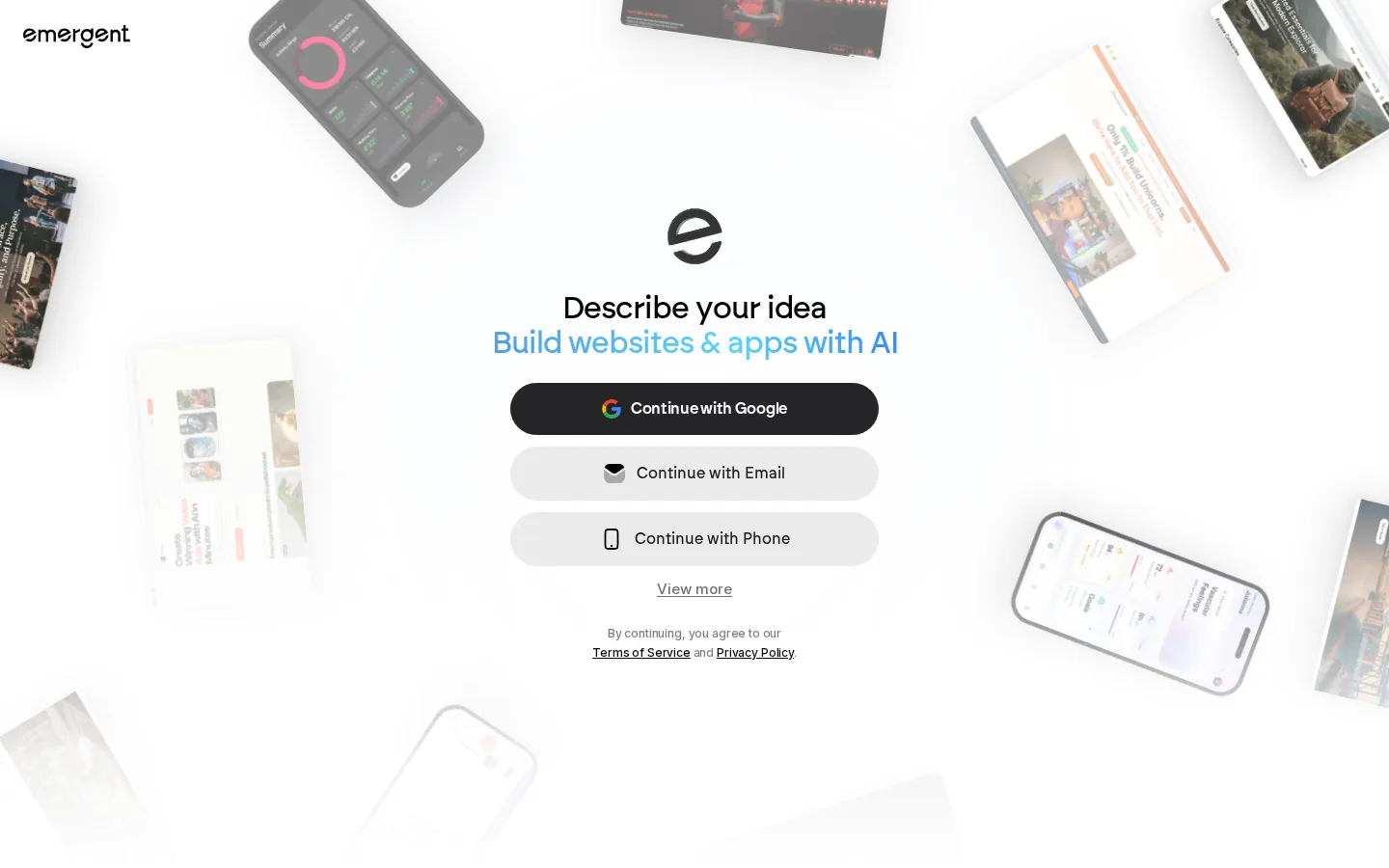
The product runs at app.emergent.sh, with marketing, docs and pricing at emergent.sh. You start by choosing Web app, Website or Mobile app, type a description such as a CRM to track leads, deals and follow-ups for a sales team, and press Build for free. Emergent generates a first version that opens in the browser, and every later change is made by asking for it in plain language. Visual Edits let you click an element and adjust it directly instead of writing a change request, and projects can be connected to GitHub for version control. The generated code can be downloaded, modified or hosted wherever you like.
Emergent advertises a standard agent (E1) for simpler apps and a Pro agent (E2) for complex ones. Higher tiers add a 1M context window, ultra thinking, system prompt editing and the ability to create custom AI agents. Deployment is quick: the site says apps are deployed in minutes, and publishing is supported for the web, Google Play and the Apple App Store. One-click backup and one-click LLM integration are also offered, alongside connectors for services such as Stripe, PayPal, Twilio, Google, Razorpay and Perplexity.
The platform reports more than 10 million builders and lists case studies from founders who shipped internal tools, marketplaces, logistics platforms, medtech software and SaaS products. Emergentlabs publishes SOC 2 and ISO 27001 certification badges in its footer, keeps project code private on paid plans, and offers email support on lower tiers and priority support on Pro.
Access is metered by credits rather than by seat. The Free plan includes ten build credits each month so a first project costs nothing, Standard adds private hosting, GitHub integration and one hundred credits, and Pro unlocks the strongest agent, the fastest models and seven hundred and fifty credits for heavier workloads. Emergent also publishes tutorials, a community space and case studies, and states that generated projects stay private on paid plans.
Emergent Core Features
Prompt-to-app generation
Describe your idea in one sentence and receive a running web or mobile application.
Specialised agent team
Design, frontend, backend, database, testing and deployment agents work on your project together.
Visual Edits
Click any element in the preview and change text, layout or styling without writing a new prompt.
One-click deployment
Publish finished projects to the web, Google Play or the Apple App Store from the dashboard.
GitHub integration
Connect repositories for version control, fork tasks and keep the generated codebase in sync.
Code ownership
Download, modify or self-host everything Emergent generates, with private hosting on paid plans.
Agent and model choice
Standard agent E1 for simple apps, Pro agent E2 with the fastest models for complex builds.
Connector library
Stripe, PayPal, Twilio, Google, Razorpay and Perplexity integrations plus one-click LLM calls.
Who is Emergent for?
Emergent suits people who have a product idea and no wish to assemble a development team. The clearest fit is the non-technical founder or solo builder who can describe a workflow but not write it: the site's own case studies include a roofer replacing five subscriptions with one internal app and a founder who shipped a donor-matching marketplace from a single prompt. Small business owners and operations leads are a second group. Emergent's solution pages target SMB owners building internal tools without developers, operations teams automating repetitive processes and managers who need dashboards rather than spreadsheets. Anyone tracking leads, jobs, inventory or field staff can get a working system without buying and stitching together several SaaS products. Consultants and service businesses fit the same mould. The published stories include a safety consultant who automated manual assessments and grew monthly revenue several times over, and a logistics founder who replaced paper and chat-based dispatch for hundreds of drivers with a custom platform. Product managers and designers use it to turn a written specification into something clickable that stakeholders can test, and to prototype features before committing engineering time to them. IT agencies and freelancers use Emergent to deliver client work faster, which is why the company publishes a dedicated IT agencies solution page and runs an affiliate program. Experienced developers come for a different reason: they want a fast first draft, a real codebase in GitHub and control over deployment rather than a locked proprietary editor. Business and enterprise teams are the final segment, served by Business and Enterprise tiers with single sign-on, role-based access control, shared team workspaces, audit logs, user-level credit limits and the option to deploy in a private cloud VPC. The main mismatch is anyone who needs pixel-perfect bespoke design, heavy compliance review, offline desktop software or a fully hand-written architecture, since Emergent builds hosted web and mobile applications on its own platform.
Emergent Use Cases
Build an internal operations app that replaces several disconnected SaaS subscriptions.
Launch a lead-generation website with forms, hosting and analytics in a few days.
Prototype a SaaS product to test real demand before hiring a development team.
Create a marketplace with user accounts, payments and listings from a written brief.
Ship a mobile app to Google Play and the App Store without native coding.
Automate manual reporting by generating a dashboard fed from your existing tools.
Deliver client projects faster as an agency using reusable prompts and fork tasks.
Turn a product specification into a clickable prototype for stakeholder feedback.
Emergent Pros and Cons
Pros
- A free tier with 10 monthly credits and no credit card requirement, so you can build a real project before paying anything.
- The output is production-ready code you own, with GitHub integration and download or self-host options instead of a locked visual editor.
- Published SOC 2 and ISO 27001 certification badges, private project hosting on paid tiers and human support rather than bots alone.
- More than 10 million builders claimed and detailed case studies across marketplaces, logistics, medtech and internal business tools.
Cons
- Credit-based pricing punishes heavy iteration: Standard gives 100 credits per month for $20, and Pro starts at $200 per month, which is steep for hobby projects.
- Emergent builds hosted web and mobile software, so desktop applications, pixel-perfect bespoke design and deep enterprise compliance workflows fall outside its scope.
- The landing page and the pricing page advertise different entry offers, a $1 first week trial against a $0 free plan, so exact trial terms can change and are worth confirming at signup.
FAQ About Emergent
Emergent Pricing
Emergent runs a freemium credit model: a $0 Free plan with 10 monthly credits, Standard at $20 per month (or $17 billed annually) with 100 credits, and Pro at $200 per month (or $167 annually) with 750 credits, plus custom-priced Business and Enterprise tiers; the landing page separately advertises a $1 first-week Standard trial before $20 monthly billing.
Check official pricingFree
Ten free monthly credits, access to all core platform features, elegant web and mobile builds, the most advanced models and one-click LLM integration. No credit card required to start.
Standard
For first-time builders: 100 credits per month, web and mobile app builds, private project hosting, GitHub integration, fork tasks and the option to buy extra credits. $17 per month billed annually, saving $36.
Pro
For serious creators and brands: 750 monthly credits, 1M context window, ultra thinking, system prompt editing, custom AI agents, high-performance computing, one free app publication and priority support. $167 per month annually, saving $396.
Business
Everything in Pro plus role-based access control, single sign-on, shared team workspaces and real-time co-editing. Priced through a demo request rather than published rates.
Enterprise
Everything in Business plus audit logs, user groups, user-level credit limits, usage analytics, self-hosted database support, VPC deployment in your own cloud and priority SLA and support.
Emergent Alternatives

Rork
Rork is an AI app builder for iOS, Android, and the web. Describe your idea in plain English and an AI agent writes, compiles, and previews a working app on your phone. Pro builds cross-platform apps with React Native and Expo, while Max builds native SwiftUI apps for iPhone, iPad, Watch, and Vision Pro. A free design tier lets you start without paying.

appyq.com
Describe your offer and generate a free branded app preview with home, content, and pay screens for eight creator business types.

FireVibe
FireVibe is an AI design tool for mobile apps. You describe your app in a prompt and it generates a set of consistent, production-ready screens with a design system, AI-generated imagery and exportable code for SwiftUI, Flutter, React Native, Jetpack Compose and React. Screens can be refined in chat, pasted into Figma as vector layers, or handed to an AI coding tool.