
DataFast
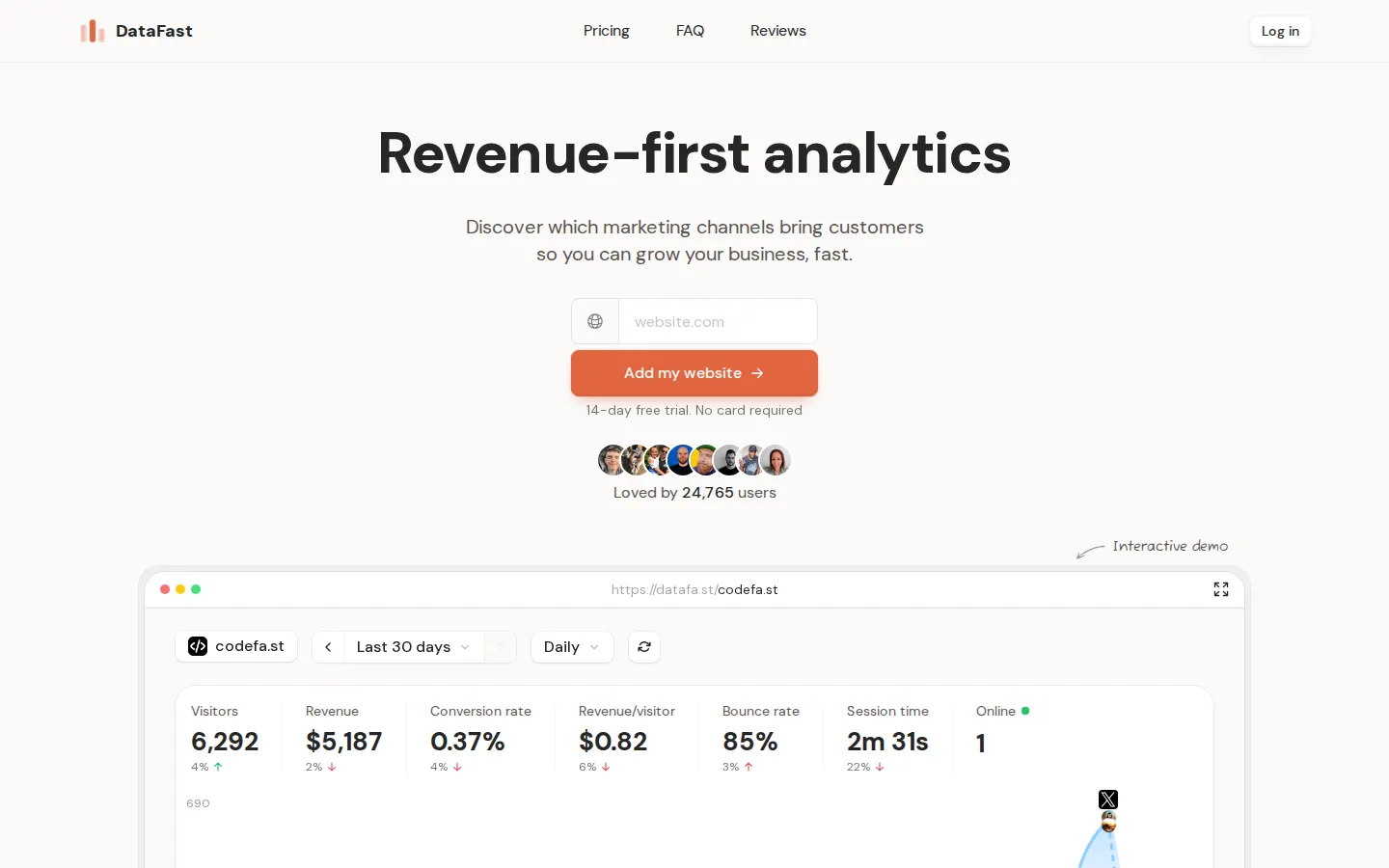
DataFast is web analytics built around one question: which marketing channels bring paying customers? It installs in under a minute, connects to Stripe, LemonSqueezy, Polar, or Shopify, and attributes revenue to traffic sources automatically. Custom goals, funnels, journeys, live visitor intelligence, and an AI agent with API, CLI, and MCP access turn raw traffic data into growth decisions instead of vanity metrics.
What is DataFast?
DataFast is a web analytics and revenue attribution platform that tells businesses which marketing channels bring in paying customers, rather than reporting vanity metrics such as pageviews and bounce rates. It was created by Marc Lou, an indie maker who has built 24 startups and earned more than two million dollars online, and it is currently used by more than 24,000 users. The product is positioned directly against Google Analytics and PostHog, with testimonials calling it simpler than Google Analytics and good enough to replace PostHog for revenue attribution. Setup takes under a minute: users add DataFast to their site with a script, a WordPress plugin, a Shopify app, a Google Tag Manager container, or one of the many no-code integrations for platforms like Webflow, Framer, Bubble, Wix, Squarespace, Ghost CMS, Podia, and Kajabi, while developers can use the npm package with Next.js, Express, Vue, Django, Laravel, React Router, and other frameworks. The second step is connecting revenue data from Stripe, LemonSqueezy, Polar, or Shopify, plus a Payment API for sending payment data directly. DataFast then attributes revenue to traffic sources automatically and analyzes the funnel to find what makes people buy. Core capabilities include web analytics focused on growth metrics, revenue attribution that surfaces which channels drive paying customers and which segments have the highest lifetime value, custom goals with full visitor journeys from first click to conversion, and live visitor intelligence that shows who is on the site in real time and who is likely to buy. On top of the dashboard sits an AI analytics agent: DataFast exposes the same data through an API, a CLI, and an MCP server, so users can connect Cursor, Claude Code, Codex, ChatGPT, Gemini, Copilot, or Grok and ask questions about traffic and revenue in plain English, or manage websites, funnels, goals, alerts, and team members programmatically. DataFast also supports importing historical data from Plausible, tracks across subdomains and multiple domains, works with a cookieless script for GDPR-conscious setups, and ships native iOS and Android apps.
DataFast Core Features
Revenue Attribution
Connects Stripe, LemonSqueezy, Polar, and Shopify so DataFast can show which marketing channels drive paying customers, which customer segments have the highest LTV, and which patterns influence purchase decisions.
Growth-Focused Web Analytics
Google-Analytics-style insights without the noise — pageviews and sessions matter only when they connect to revenue, keeping dashboards focused on what drives growth.
Goals, Funnels & Journeys
Custom goals like signups or downloads, with the full journey each visitor takes from first click to conversion so you can see exactly what drives results.
Live Visitor Intelligence
Watch visitors in real time, see who is likely to buy, and use the API to act instantly on what you observe.
AI Agent Mode
Ask questions about traffic, revenue, visitors, and funnels in natural language through datafast.ai-style agent mode or from Cursor, Claude Code, Codex, ChatGPT, Gemini, Copilot, and Grok.
Complete API, CLI & MCP Server
Query analytics and journeys, send server-side goals and payments, identify users, and manage websites, funnels, alerts, team members, integrations, and API keys programmatically — with the same tokens, permissions, and safety checks across all three.
40+ Integrations
WordPress plugin, Shopify app, Google Tag Manager, Webflow, Framer, Bubble, Wix, Squarespace, Ghost CMS, Podia, Kajabi, plus an npm package and guides for Next.js, React Router, Vue.js, Django, Laravel, and other stacks.
GDPR-Friendly Tracking
Default cookie-based tracking is most accurate, while a cookieless script avoids cookie banners entirely with a small accuracy trade-off, plus a Data Processing Agreement and subdomain and cross-domain tracking.
Who is DataFast for?
DataFast is built for founders and teams who need to know where their revenue actually comes from, not just how many pageviews they get. Solo founders and indie makers are the clearest fit — the Starter plan covers one website and one team member, and creator Marc Lou built it while shipping products in front of more than 127,000 followers. SaaS startups use revenue attribution across Stripe, LemonSqueezy, Polar, and Shopify to see which channels drive signups and to compare acquisition channels by customer lifetime value rather than clicks. Growth marketers and performance marketers use goals, funnels, and journeys to trace the full path from first click to conversion and to spot the channels that produce paying customers. Product managers and analytics leads replacing heavier tools find DataFast simpler than Google Analytics and lighter than PostHog; one testimonial on the homepage says it removed the need for PostHog entirely. E-commerce and content-site operators track product pages and lead magnets, using the mobile apps for iOS and Android to check analytics on the go. Developers and AI-agent builders get the most out of the platform through its complete API, CLI, and MCP server, which let coding agents like Cursor, Claude Code, and Codex query visitors, revenue, and funnels from the terminal in natural language. Agencies managing several client sites scale to the Growth plan with its 30-website allowance, and affiliate marketers can earn 50 percent commission for up to 12 months of referred payments.
DataFast Use Cases
Find out which marketing channels bring paying customers instead of just pageviews, so you can cut spend on channels that only generate traffic.
Connect Stripe or LemonSqueezy revenue to traffic sources to compare acquisition channels by customer lifetime value.
Set custom goals like signups or lead-magnet downloads and trace the full journey from first click to conversion.
Watch live visitors and identify who is likely to buy so you can act instantly — for example, with a targeted email or sales call.
Ask the AI analytics agent in plain English which campaigns grew revenue last week, from your terminal, editor, or chat tool.
Replace or complement Plausible, Google Analytics, or PostHog with a simpler, revenue-first alternative that imports your Plausible history.
Track unified analytics across subdomains and multiple domains, from marketing site to app, with web-to-app funnel tracking via the React Native SDK.
Monitor metrics on the go with the native iOS and Android apps and share live dashboards with your team.
DataFast Pros and Cons
Pros
- Revenue-first by design: instead of pageviews and bounce rates, DataFast shows which channels produce paying customers, segments with the highest LTV, and the journeys that convert — the metrics founders actually need.
- AI-native access: the same data is available through an API, CLI, and MCP server, so AI agents in Cursor, Claude Code, or Codex can answer traffic and revenue questions in natural language.
- Simple to install and use: setup takes under a minute with dozens of no-code integrations, an npm package, and one homepage testimonial reporting a doubled conversion rate in 30 days.
- Generous trial and honest pricing: a 14-day free trial with no credit card, straightforward Starter and Growth plans from $9 per month, and no forced upgrades when you exceed your event quota.
- Strong social proof and support ecosystem: 24,763 users, a 50 percent affiliate program, GDPR documentation, mobile apps, and Plausible data import show an actively maintained product.
Cons
- No permanent free tier: DataFast offers a 14-day trial without a credit card, but after that every plan starts at $9 per month, which may be more than casual hobby sites want to pay.
- Cookie-based tracking is most accurate: the default script uses cookies and may require a cookie banner, while the cookieless alternative is less accurate for revenue attribution over weeks or months.
- Younger ecosystem than incumbents: integrations and docs are growing fast, but data import currently covers Plausible (Google Analytics migration is listed as next), and very large teams may need the Growth plan's 30-seat ceiling or custom setup.
FAQ About DataFast
DataFast Pricing
DataFast is a paid SaaS with no permanent free tier, though it offers a 14-day free trial with no credit card required. Traffic-based monthly plans are Starter at $9/month (or $90/year) and Growth at $19/month (or $190/year), with the pricing page noting two months free on yearly billing. Starter covers 10,000 monthly events, one website, one team member, three years of data retention, and 100K AI bot requests; Growth covers 30 websites, 30 team members, 5+ years of retention, social media mentions, and X link attribution. Event-volume tiers scale from 10k to 100k/200k and 1M+ monthly events as traffic grows, and extra AI bot requests cost $9/month per additional million.
Check official pricingStarter
10k monthly events, 1 website, 1 team member, 3 years data retention, 100K AI bot requests, API/CLI/MCP; also $90/year.
Growth
10k+ monthly events, 30 websites, 30 team members, 5+ years data retention, social mentions, X link attribution; also $190/year.
DataFast Alternatives

Beeko AI
Private OSINT search for emails, usernames, and images with cited evidence and AI summaries.

scvd.store
Free conformance checking for any issuer’s x402 signed offers and receipts including our competitors’ a weekly signed Bitcoin-anchored corpus.

ViralDrop
ViralDrop helps content creators and marketers understand what makes videos go viral. Analyze the hook, structure, and retention patterns of TikToks.