
Trooly
Trooly is an AI-native qualitative research platform. It writes the research plan, screens and recruits participants, moderates one-on-one multimodal voice interviews, and synthesizes transcripts into themed reports. Product and research teams can bring their own users at $10 per interview, or let Trooly recruit from a network of 180M+ respondents, with every interview quality-checked before delivery.
What is Trooly?
Trooly is an AI-native user research platform built around one core claim: in-depth interviews can be run by an AI moderator without losing the texture of a real conversation. A team describes a research goal, and Trooly drafts the audience definition, discussion outline and screener, then launches one-on-one voice interviews that adapt their follow-up questions to what each participant actually says. Transcripts, video, summaries and themed reports follow automatically.
The interviewer is multimodal rather than a scripted form. Trooly says its agent listens for tone, hesitation and inconsistency, asks layered follow-ups, and can switch language mid-conversation across 50+ languages. On the marketing side the company frames this as empathic insight: the goal is to reach the reason behind an answer, not just to collect one. Public demo scenarios cover concept testing, packaging comparison and brand perception, and visitors can try a sample interview without an account.
Sample quality is the other half of the product. Before an interview starts, each project applies custom screening, geolocation checks, usage verification and scenario testing. During the conversation, what Trooly calls fast and slow thinking works as real-time false-response detection, and after the project a post-processing review checks every interview against the client's objectives. The company reports a 97% accuracy rate validated across 20,000+ interactions, a figure it publishes without an independent audit.
On the supply side, Trooly maintains a respondent network it describes as 180M+ people across five continents, 25 countries and eight regions, and claims recruitment three to five times faster than traditional panels at roughly 60% lower cost. Customers can also bring their own user list and let Trooly handle design, interviewing, analysis and reporting. Published logos include Xiaohongshu, JD.com, Tencent, Alibaba, TikTok, miHoYo, NIO, Anker and Insta360, and the site counts 400+ teams.
Beyond interviews, the platform ships 20+ research skills that reuse the same participant and analysis layer: desk research, competitor analysis, NPS surveys, usability testing, brand tracking, public VOC collection, returns follow-up and consumer due diligence for investors. A conversational analysis mode lets a researcher question the transcript corpus directly, and an enterprise tier adds multi-seat workspaces and a dedicated research team. Trooly is web-based, sells per completed interview rather than by subscription seat, and states that it is pursuing SOC 2 Type II and ISO 27001 while holding GDPR and CCPA compliance.
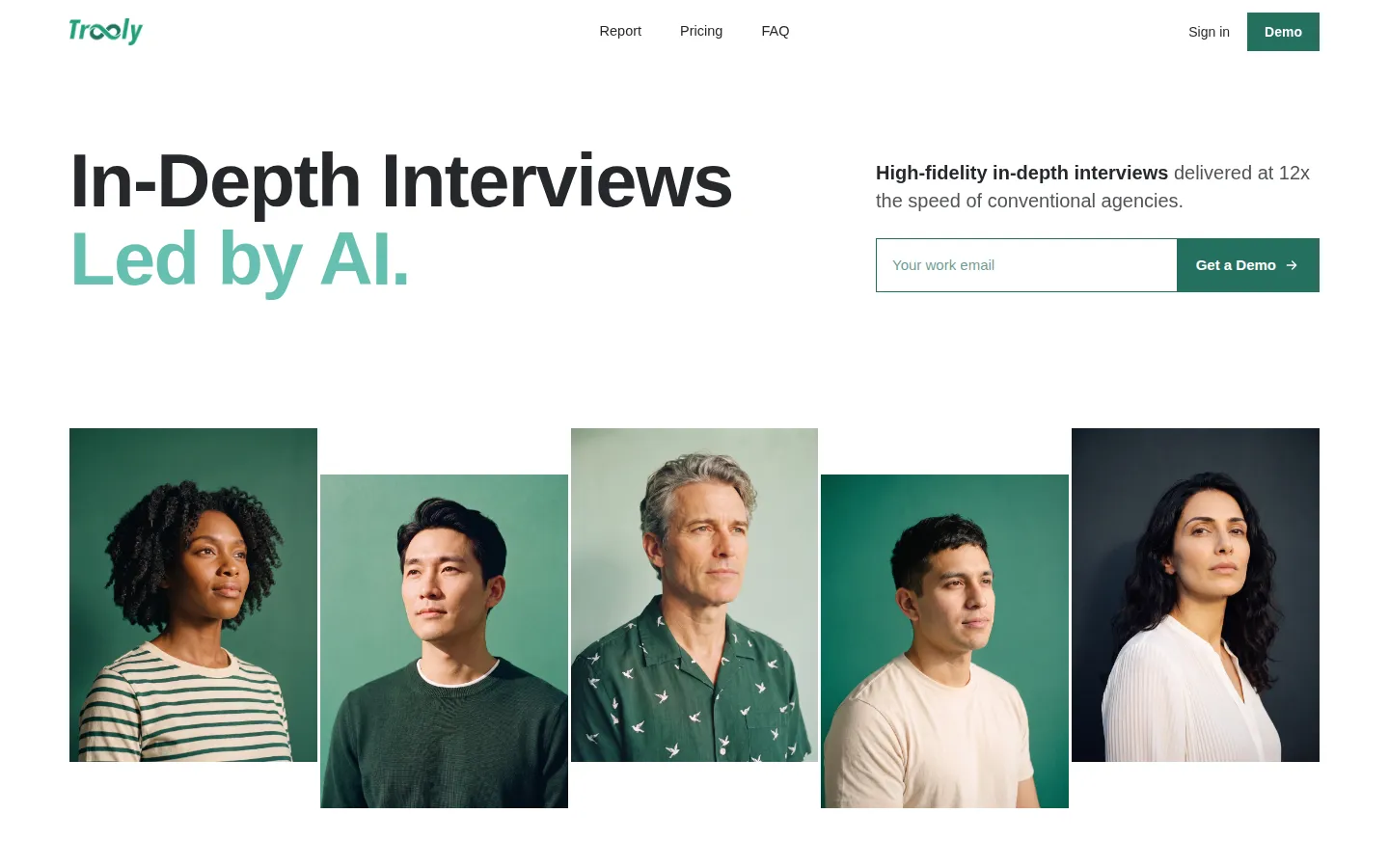
Trooly Core Features
AI research plans
Describe a goal in a sentence and Trooly drafts the audience definition, discussion outline, screener and launch plan, all editable before the study goes live.
AI-moderated in-depth interviews
A multimodal voice agent runs one-on-one conversations, listens for hesitation and tone, and asks layered follow-ups instead of reading a fixed script.
50+ language support
On-demand language switching with semantic understanding of context, so multi-market studies can run from one brief without local moderators.
Participant recruitment and screening
Access to a network described as 180M+ respondents, with custom screening, geolocation, usage verification and scenario testing before each interview.
Quality control
Real-time false-response detection during interviews plus a post-processing review of every completed session against the client's stated objectives.
Insight synthesis
Automatic transcripts, video, summaries and themed reports, with a conversational analysis mode for questioning the transcript corpus directly.
20+ research skills
Reusable workflows for desk research, competitor analysis, NPS surveys, usability testing, brand tracking, public VOC collection and consumer due diligence.
Privacy controls
A Privacy Mode that stores no data on Trooly servers, a no-training-on-customer-data commitment, GDPR and CCPA compliance, and SOC 2 Type II and ISO 27001 listed as in progress.
Who is Trooly for?
Trooly fits teams that need qualitative depth but cannot justify a traditional agency timeline or budget. Product managers are the clearest audience: they can test a concept or pricing page with eight target users and have themes back within days instead of waiting two months for a report. UX researchers use it to run more studies per quarter and to keep recruitment and screening in one place, then query transcripts directly when a stakeholder asks a follow-up question. Startups and mid-sized companies without a research department get the most obvious leverage, because the platform supplies the plan, the screener, the moderator and the synthesis that a specialist would otherwise provide. Consumer brands and e-commerce teams use it for packaging tests, brand tracking and post-purchase follow-up across markets and languages. Game studios and app publishers run concept and usability studies on tight pre-launch schedules. Agencies and consultancies can white-label the throughput: they keep the client relationship while Trooly handles fieldwork and first-pass analysis. Strategy and insight leads at larger organisations use the enterprise tier for multi-seat collaboration and a dedicated research team. Investors and corporate development teams use the consumer due diligence skill to stress-test a thesis with verified respondents. It is a weaker fit for teams that need purely quantitative statistical confidence, since the product is built around interviews rather than large-N surveys. It is also awkward for buyers who want to self-serve immediately: pricing exists on the site, but starting a study runs through a demo request, and the published trust certifications are still listed as in progress.
Trooly Use Cases
Validate a product concept or prototype with target users before committing engineering time to a build.
Test packaging, pricing and visual design by uploading stimulus files and probing reactions in a live interview.
Run brand perception and brand tracking studies across several markets without hiring moderators in each language.
Replace slow agency fieldwork for recurring NPS, churn and post-purchase research with a repeatable in-house process.
Recruit hard-to-reach professional or niche audiences for a study that a panel provider cannot fill quickly.
Screen and interview your own user base to understand why a feature is or is not being adopted.
Pressure-test an investment thesis with consumer due diligence interviews and verified respondents.
Collect public voice-of-customer material and consolidate it with desk research before a strategy review.
Trooly Pros and Cons
Pros
- The combination of AI moderation, recruitment and synthesis in one workflow removes the handoffs that make agency studies slow, and the published per-interview pricing is easy to model before committing.
- Verification is treated as a product feature rather than an afterthought: screening, geolocation, usage checks, in-interview detection and a post-hoc review all target sample quality.
- Multi-language interviewing and a large respondent network make cross-market qualitative work feasible for teams that could not staff moderators in each region.
- The 20+ adjacent skills, from desk research to consumer due diligence, let a research team reuse one participant and analysis layer for several study types.
Cons
- There is no self-serve free tier: every plan is quoted or billed per completed interview, and starting a study goes through a demo request rather than an instant signup.
- The headline accuracy and speed figures are self-reported, and the SOC 2 Type II and ISO 27001 certifications are listed as in progress rather than completed.
- Depth still depends on the agent's judgment: teams with highly technical or sensitive research topics will likely want to review transcripts closely rather than trust automated themes.
FAQ About Trooly
Trooly Pricing
Usage-based, billed per participant who completes an interview. Bringing your own users costs $10 per interview for sessions under 30 minutes and $19 for 30 to 60 minutes, excluding recruitment and incentives. End-to-end delivery, where Trooly recruits and screens, is $99 per standard participant or $199 for hard-to-reach audiences and includes channel fees and incentives. Enterprise plans are custom-quoted on sample size, audience difficulty and scope.
Check official pricingBring Your Own Users
AI study design, AI-moderated one-on-one interviews, interview video, transcripts, summaries, insight reports and conversational analysis for your own participant list. $10 per interview under 30 minutes, $19 for 30 to 60 minutes. Recruitment and incentives not included.
End-to-End Delivery
Everything in the bring-your-own-users plan plus participant screening, scheduling, recruitment channel fees and incentives. $99 per standard participant, $199 for hard-to-reach audiences under 1% national penetration. Failed samples replaced free of charge.
Enterprise
Custom quote based on sample size, audience difficulty and delivery scope. Adds multi-seat access with shared data and collaboration, advanced enterprise features, flexible monthly or annual settlement, a fast-track recruitment channel and 24-hour support from a dedicated research team.
Trooly Alternatives
Metaso
Metaso (秘塔AI搜索) is an AI search engine built for research-grade answers rather than link lists. It searches the open web, document libraries, and academic indexes such as PubMed, SCIE, EI, and JCR, then writes a structured, cited answer. Extra modes produce mind maps, slides, interactive web pages, and deep-research reports, and a paid Search API exposes the same index to developers.
QwQ AI
Search the live web, research complex topics, and make sense of financial data with traceable sources.

Felo
Felo combines multilingual AI search with document analysis and content creation. Users can ask questions, investigate topics, and create slides, mind maps, documents, webpages, images, or videos. A free Standard plan covers everyday searching, while Pro adds a broader model lineup, creation tools, shared usage credits, and API access. Separate Enterprise plans support team administration and internal knowledge workflows.