
siift
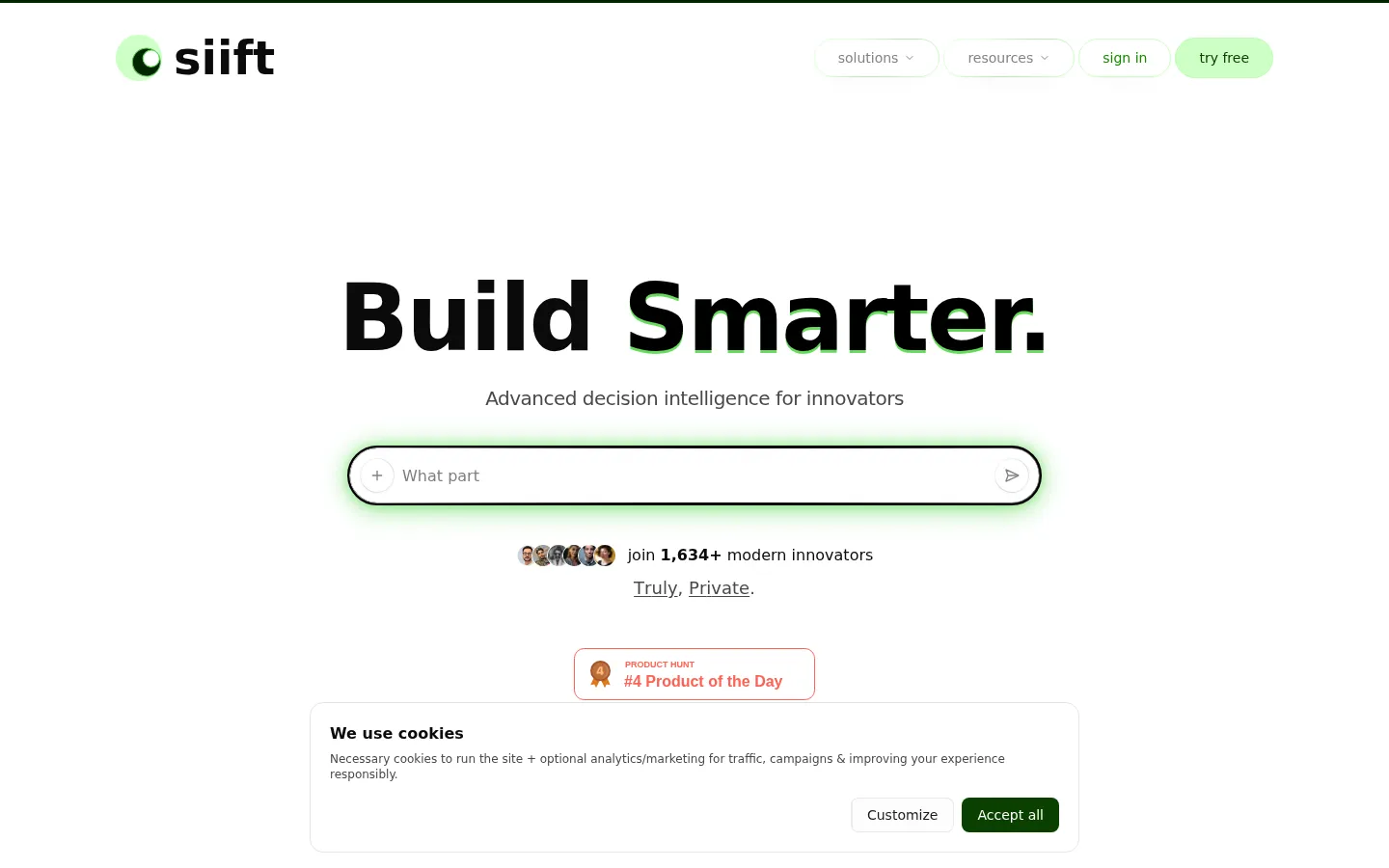
siift is an AI decision platform for founders and business teams that need a clearer direction. It maps your business on an intelligent canvas, turns assumptions into evidence-scored research, and prioritizes what to do next. A shared context system keeps strategy, actions and results aligned across teammates and outside AI assistants, so progress compounds instead of scattering.
What is siift?
siift is an AI platform for business strategy and decisions, built for founders and teams who need to know what to do next rather than generate more content. Its core idea is an execution filter: instead of producing another business plan, siift keeps a living model of the business - ideas, assumptions, evidence, actions, metrics and results - and uses it to recommend the move that matters at the current stage.
The workspace centers on an intelligent business canvas. You map problems, audiences, offers and delivery choices as connected nodes, and siift surfaces blind spots, adjacent opportunities and paths that fit the evidence you already have. Because the canvas updates as you learn, ideation becomes a structured search rather than a brainstorm that disappears after one session.
Underneath the canvas sits a master context system that siift calls living memory. Agents read what you have already decided, what has been tested and what changed, so each new answer is grounded in your situation instead of generic advice. The company says the system is private by design: your material is not used to train models and is not shared with third parties. For teams, that context can be shared with teammates and with outside AI assistants through an MCP connection.
Validation is where the product is most distinctive. siift breaks a strategy into explicit assumptions, runs research against each one, and scores the strength of the evidence behind every claim. Weak claims stay visibly weak, so a decision is not carried by confident-sounding prose. The same standard is applied when comparing competing ideas, which makes it easier to justify a choice to a co-founder, a board or a client.
From there, siift supports the rest of the arc: scoping the lightest build that produces the next useful signal, planning go-to-market around a testable ideal customer and channel hypothesis, aligning stakeholders on a shared strategy map, and diagnosing the constraint that limits growth once traction exists.
Five modes structure the work - ideate, validate, build, go to market and scale - each with its own tools, templates and questions. siift also offers managed automations across more than 200 applications, so approved actions can run without leaving the workspace. It is explicitly not a tool for HR, legal, compliance or finance, which the company excludes because of regulatory risk.
Pricing is credit-based, with a free tier that includes the full feature set and 50 credits per month, then paid plans at 200 and 1,000 credits per user. siift is made by siift ai inc. of Vancouver, Canada, has been used by more than a thousand builders, and holds a Product Hunt top-post badge along with partnerships that include RBCx, AWS Startups and NVIDIA Inception.
siift Core Features
Intelligent Business Canvas
Maps ideas, actions, metrics and results as one visual strategy surface that updates as the business evolves.
Evidence-scored validation
Breaks strategy into explicit assumptions, researches each one and grades the strength of the supporting signal.
Living memory context system
Persistent agentic context that remembers past decisions, tests and changes so answers stay specific to your business.
Five guided modes
Separate ideate, validate, build, go-to-market and scale workspaces, each with its own tools, templates and next-step guidance.
Constraint diagnosis
Connects acquisition, activation, retention and delivery metrics to reveal the bottleneck with the greatest system-wide leverage.
Safe automations
Managed actions across 200+ connected applications, so approved work can run inside the workspace rather than in scattered tabs.
Shareable workspaces
Layered strategy maps and decision rationale that teammates, advisors and stakeholders can review and discuss.
MCP access
Connect ChatGPT, Claude and other AI assistants as plugins to a shared siift workspace and decision layer.
Who is siift for?
siift is built for people who are creating something new and have to make consequential calls with incomplete information: which idea to pursue, what to build first, whether the evidence is strong enough, and where growth is actually blocked. It suits small teams without a strategy function more than large enterprises that already have research departments and formal planning cycles. Teams of one to twenty get the most from it, because that is where strategy work falls to the founder by default and where a structured second opinion changes the outcome. The roles it fits best: - Early-stage founders moving from a raw idea to validated demand, who need a repeatable way to test assumptions instead of relying on instinct and encouragement. - Solo founders and indie builders who want advisory-grade structure without hiring a consultant or joining a paid accelerator cohort. - Intrapreneurs and innovation leads inside larger companies, who must compare internal opportunities and produce auditable evidence to win stakeholder buy-in. - Product leaders and solution teams connecting continuous discovery, product strategy and delivery choices back to customer evidence. - Consultants, coaches and accelerator mentors who need to dig past a pitch deck into the assumptions and logic underneath it, then share that context with the team they advise. - Small business owners and operators who already have traction but want to find the constraint limiting growth before spending more on acquisition. - Startup studios and venture teams screening several ideas in parallel, who need each opportunity judged against the same evidence standard. It is a poor fit for anyone looking for a one-click business plan generator, for regulated work such as HR, legal, compliance or finance, or for teams that want a fully autonomous agent making decisions without human review.
siift Use Cases
Map a raw business idea into a structured opportunity canvas with ranked, evidence-backed options.
Validate a startup idea by turning it into testable assumptions with scored market evidence.
Scope the lightest MVP that can produce the next useful signal before writing code.
Plan a go-to-market launch around a validated customer, offer and channel hypothesis.
Align co-founders and stakeholders on one strategy map with traceable decision rationale.
Diagnose the growth constraint limiting activation or retention before raising acquisition spend.
Pressure-test a pitch or business case as a consultant before advising a client.
Evaluate an internal innovation portfolio and build auditable evidence for leadership approval.
siift Pros and Cons
Pros
- Evidence scoring is the differentiator: claims carry a visible strength rating, which is more honest than the confident prose most AI assistants return.
- The free tier is the full product with unlimited projects, not a stripped demo, so the workflow can be judged before paying.
- Persistent context means later sessions build on earlier decisions instead of forcing you to re-explain the business each time.
- Covers the whole arc from ideation to growth constraint diagnosis, reducing the number of disconnected tools a small team needs.
Cons
- Credit consumption is hard to predict: an agent turn costs between 1 and 20 credits depending on tool calls and inference, and unused credits do not roll over.
- The canvas-and-assumptions method has a real learning curve, and the value depends on how much context and evidence you feed it.
- It deliberately excludes HR, legal, compliance and finance, and has no public REST API beyond MCP access, so it cannot be a company-wide operating system.
FAQ About siift
siift Pricing
siift uses per-user, credit-based pricing with a genuinely usable free tier. Free costs 0 dollars forever and includes the full product, unlimited projects and 50 credits per user per month. Discover is 29 dollars per user per month (about 11 dollars effective on annual billing at 131 dollars per year) for 200 credits and human support under 48 hours. Focus is 99 dollars per user per month (about 37 dollars effective annually at 449 dollars per year) for 1,000 credits and priority support under 12 hours. A LAUNCH26 promotion advertises an extra lifetime discount, showing 20 dollars for Discover and 69 dollars for Focus monthly. Enterprise is custom-priced with pooled credits, private servers, custom frameworks and consolidated billing. Unused credits do not roll over, and extra credits can be bought in one-time batches.
Check official pricingFree
Full product with unlimited projects, intelligent business canvas, living memory, evidence-backed feedback, step-by-step guidance, automations across 200+ apps, shareable workspaces and 50 credits per month. No credit card required.
Discover
For anyone starting a business: everything in Free plus 200 credits per month (4x usage) and human support with responses under 48 hours. About $11/user/month effective on annual billing ($131 per year); LAUNCH26 promotion shows $20 monthly.
Focus
For people growing a business: everything in Discover plus 1,000 credits per month (5x usage) and premium support with responses under 12 hours. About $37/user/month effective on annual billing ($449 per year); LAUNCH26 promotion shows $69 monthly.
Enterprise
For teams and corporate programs: everything in Focus plus discounted pooled credits, private servers and governance, custom frameworks and integrations, consolidated billing, and advanced analytics.
siift Alternatives

Synthesise AI
Synthesise AI turns your expertise into a sellable digital product. It calculates a Unique Value Zone from audience demand and your own skills, then generates a fully populated product charter and framework you can package into a course, playbook or paid digital program. One plan costs $2,999 one-time, with unlimited credits and a personalised dashboard.

Weave
Weave is engineering intelligence software that scores every merged pull request in expert hours, tracks quality, review health and DORA delivery metrics, and attributes output to AI or human authorship. Wooly, its research agent, answers questions about the org with cited sources, while Token Intelligence ties AI spend to shipped work and benchmarks cost per merged PR.

tiun
tiun is an AI-native commercial backend for SaaS and AI products. It bundles email-OTP authentication, prebuilt checkout overlays, Merchant of Record payments with global tax handling, a customer database, and AI analytics behind one SDK, replacing the auth provider, payment processor, CRM, and analytics tools that teams usually stitch together with webhooks, sync jobs, and reconciliation scripts.