
Autonomyware
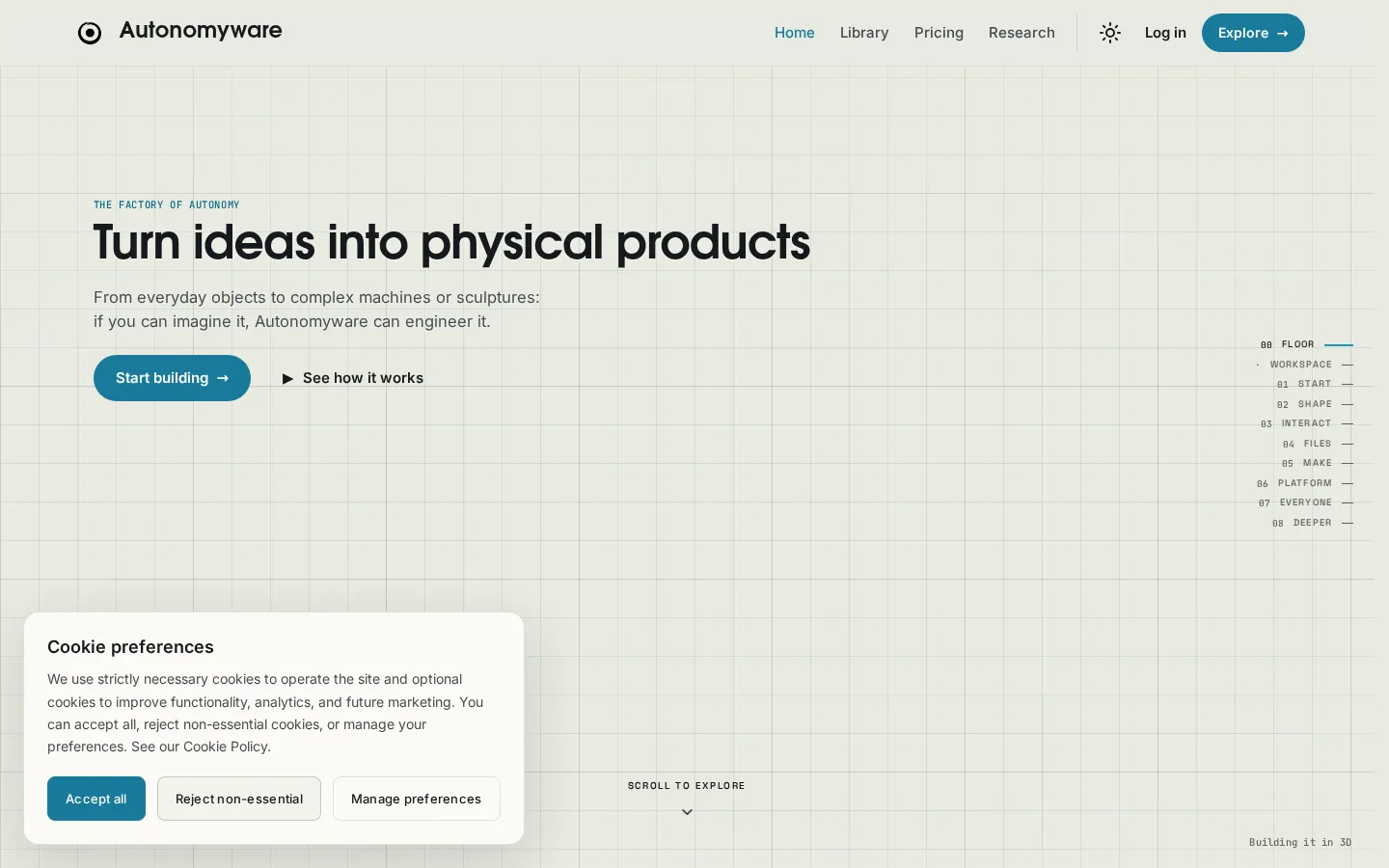
Autonomyware pairs a chat and files workspace with a geometry kernel the company built itself, so a description, sketch, or existing product becomes an inspectable model rather than a render. Its five steps cover starting an idea, shaping trade-offs, watching mechanisms move, reviewing parts and files, and exporting for 3D printing, milling, or a manufacturer. Paid plans run from $19.99 to $49.99 per month.
What is Autonomyware?
Autonomyware is an AI-native engineering workspace for turning a described idea into a physical product. You type what you want in plain language, upload a sketch, or bring in a product that already exists, and the platform returns 3D geometry together with a parts breakdown and the reasoning behind its choices. The company frames this as an alternative to both text chatbots and image-based 3D generators: the output is exact CAD geometry that can be inspected part by part and exported for manufacturing, not a picture of a result. Autonomyware B.V. is registered in Friesland, the Netherlands, is a member of the NVIDIA Inception program, and launched publicly on Product Hunt.
The product centers on one workspace rather than a chain of separate tools. Its own documentation splits the flow into five steps. Start takes a sentence, a sketch upload, or an existing product. Shape works through trade-offs, such as how far a drone should fly or how much it should carry, and asks you to make the calls. Interact animates the design so rotors lift and fans spin before anything is made. Files exposes an engineering view that breaks the model down to individual bolts and offers exports. Make covers 3D printing, milling, or sending the result to a manufacturer.
The site advertises 27 example products in a browsable Library, ranging from a skateboard, screwdriver, vise, and angle bracket to a quadcopter, turbofan, industrial robot arm, imaging satellite, and sculpted animals. These serve as demonstrations of range rather than a promise that any object can be produced at the same level of detail.
Underneath, Autonomyware says it runs on its own exact-geometry kernel rather than a mesh generator. That matters for two reasons it emphasizes: geometry has to assemble as a network of relationships rather than a pile of shapes, and the model must satisfy the rules a solid needs before it can be manufactured. The company also says it checks its own work through adversarial verification instead of trusting a single pass, and it publishes research notes on representation, on reading existing CAD and drawings, and on deriving a bill of materials from manufacturable geometry.
Scope is deliberately bounded. The FAQ states that Autonomyware is strongest on mechanical work and is not a single button that produces a finished complex machine such as a complete vehicle on its own. Output today includes parts and assemblies as exact CAD geometry, a bill of materials, system architecture, and recorded reasoning, with export options described as growing as the product leaves alpha.
Autonomyware Core Features
Conversational design
Describe an object in plain words, or upload a sketch or existing product, and refine it by chatting instead of clicking through CAD menus.
Forge 3D workspace
Rotate, inspect, and travel through a live 3D scene that shows the design and its mechanism rather than a static image.
Trade-off mapping
Autonomyware lays out engineering trade-offs such as range, payload, and size, then leaves the decision to you.
Motion preview
Fans spin and rotors lift in an animated view so you can judge how a design works before any part is made.
Engineering view and files
Break a design down to individual bolts, with Files, Parts, and Guide views ready for export.
Manufacturing exports
STEP, STL, and 3MF outputs for 3D printing at home, CNC milling, or handoff to a manufacturer.
B-rep exact geometry on Create
Manufacturing-grade mechanical geometry where every part is dimensioned and assembled, rather than a mesh approximation.
Electronics open beta
Chip and PCB work covering specification, schematic, sketch, layout, routing, and ECAD, available on the Create tier.
Who is Autonomyware for?
Autonomyware is aimed at people who have a concrete object in mind and need engineering work done on it, rather than at teams looking for another rendering or image tool. The pricing page names three audiences directly: makers and curious minds who want to see ideas in 3D, designers and small teams who want to make the real thing, and engineering organisations with compliance obligations. Makers and hobbyists use the Explore tier to sculpt printable shapes and run quick 3D experiments without learning CAD software. Product designers and industrial designers use the Create tier to move from a concept sketch to dimensioned B-rep parts and assemblies they can review with a manufacturer. Hardware startups and small engineering teams use it to produce an engineered prototype with requirement traceability and architecture decomposition before committing tooling budget. Mechanical engineers use the engineering view to check part-by-part structure, exports, and bills of materials against their own review process. Educators and students use the Library and the documented research notes to show how geometry, assemblies, and manufacturability relate. Engineering organisations in regulated industries are the target of the Engineer tier, which adds compliance-oriented autonomous engineering, collaborative scoping, and kernel access from their own tooling. It is a weaker fit for someone who needs photorealistic marketing renders, or for a team that wants a fully finished, safety-certified machine produced with no human review, since the company itself cautions that AI output should be checked before safety-critical use.
Autonomyware Use Cases
Turn a described enclosure or bracket into dimensioned CAD parts you can send to a machine shop.
Sculpt a printable figurine or decorative object from a short written description for a home 3D printer.
Prototype a small drone or camera mount and test payload and range trade-offs before buying components.
Rebuild an existing product from a photo or sketch to understand how its parts fit together.
Produce a bill of materials and part breakdown for a prototype review with a manufacturer.
Teach assembly and manufacturability concepts using the browsable Library of 27 example products.
Run early mechanical concept work without a CAD licence or a dedicated draughtsperson on the team.
Explore chip and PCB layout during the electronics open beta when a design needs a simple circuit board.
Autonomyware Pros and Cons
Pros
- Combines conversation, 3D inspection, part breakdown, and export in one workspace instead of separate CAD and rendering tools.
- The engineering view and STEP, STL, and 3MF exports produce files that machine shops and 3D printers can actually use.
- Published research notes on geometry representation, existing engineering data, and bills of materials give technical buyers something concrete to evaluate.
- The $19.99 Explore tier makes it inexpensive to test whether the conversational workflow suits how you design.
Cons
- The company states the tool is strongest on mechanical work and cannot produce a finished complex machine such as a complete vehicle on its own, so expectations need calibrating.
- Credits are priced in euros while plan prices are shown in USD, and usage is metered, which makes monthly cost harder to predict than a flat seat price.
- Electronics is labelled an open beta, export options are described as still growing, and there is no free plan beyond limited free account insights.
FAQ About Autonomyware
Autonomyware Pricing
Autonomyware is a paid subscription with Explore at $19.99 per month (1,000 credits) and Create at $49.99 per month (2,500 credits); the Engineer tier is quoted on contact. Yearly billing saves up to 21%.
Check official pricingExplore
1,000 credits per month. Sculpt for any 3D-printable shape and Experiment for rapid 3D prototyping, aimed at makers and curious minds.
Create
2,500 credits per month. Everything in Explore plus Build for manufacturing-grade B-rep geometry, the Electronics open beta for chip and PCB work, and Engineered Prototype.
Engineer
Quoted on contact. Everything in Create plus compliance-oriented autonomous engineering, collaborative scoping, kernel access from your own harness, and dedicated capacity.
Autonomyware Alternatives

Hyper3D
Hyper3D is Deemos Tech's AI 3D generation platform, built around the Rodin model. Give it a text prompt, a product photo, a sketch or a multi-view set and it returns a textured, quad-topology 3D asset in under a minute. Bounding-box, voxel and point-cloud controls steer the result, and exports drop straight into Blender, Unity or Unreal.

APPLORE
APPLORE is a browsable archive of 18,700+ real app icons from the App Store and Google Play, organized by category, color, style, letter and release date, with every past redesign kept on record. It pairs that research library with an AI icon generator, AI app naming, PNG to SVG redraw, logo animation, on-device previews and export packs, so teams can go from competitive reference to shippable icon assets in one workspace.

Osmo
Osmo is an AI-native video editor that turns briefs, Figma files and footage into editable, on-brand motion graphics for product launches. Its cloud agent and CLI write real animation code you can refine keyframe by keyframe, then export to MP4, WebM or 4K ProRes with transparent backgrounds. A free tier includes monthly credits; paid plans start at $19 per month.