ZooWork
ZooWork packages professional expertise into deployable AI agents. Experts describe their role, load company knowledge and working SOPs, set delivery standards and tool permissions, then publish an agent that plans tasks, calls real systems, pauses at human approval gates, and produces deliverables. A managed runtime handles orchestration, sandboxes, and model routing across OpenAI, Claude, Gemini and DeepSeek, plus Slack, Teams and API access.
What is ZooWork?
ZooWork is an AI agent delivery platform built for forward-deployed engineers (FDEs) and domain experts who want their expertise packaged as software rather than explained in documents. Instead of asking teams to learn prompt engineering, it takes the material a senior operator already has - role definition, company knowledge, working SOPs, delivery standards, and the exact tools the role touches - and turns it into an agent that runs the job continuously.
The core idea is that whoever runs the agent owns the loop. An agent on ZooWork is defined by the outcome it owns, what it is allowed to touch, and what done means before work ships. Agents plan a task into checkable steps, execute tool calls against real systems such as POS, inventory, WMS, CRM, Jira, GitHub, Google Workspace, Microsoft 365, Slack, and Lark, stop at approval gates before moving money or writing data, and return an actual deliverable: a deck, a document, a purchase order, or an updated record. A store ops agent, for example, can check 214 stores against yesterday's planogram photos, name the nine that missed a reset, message each store lead, and re-verify later the same day.
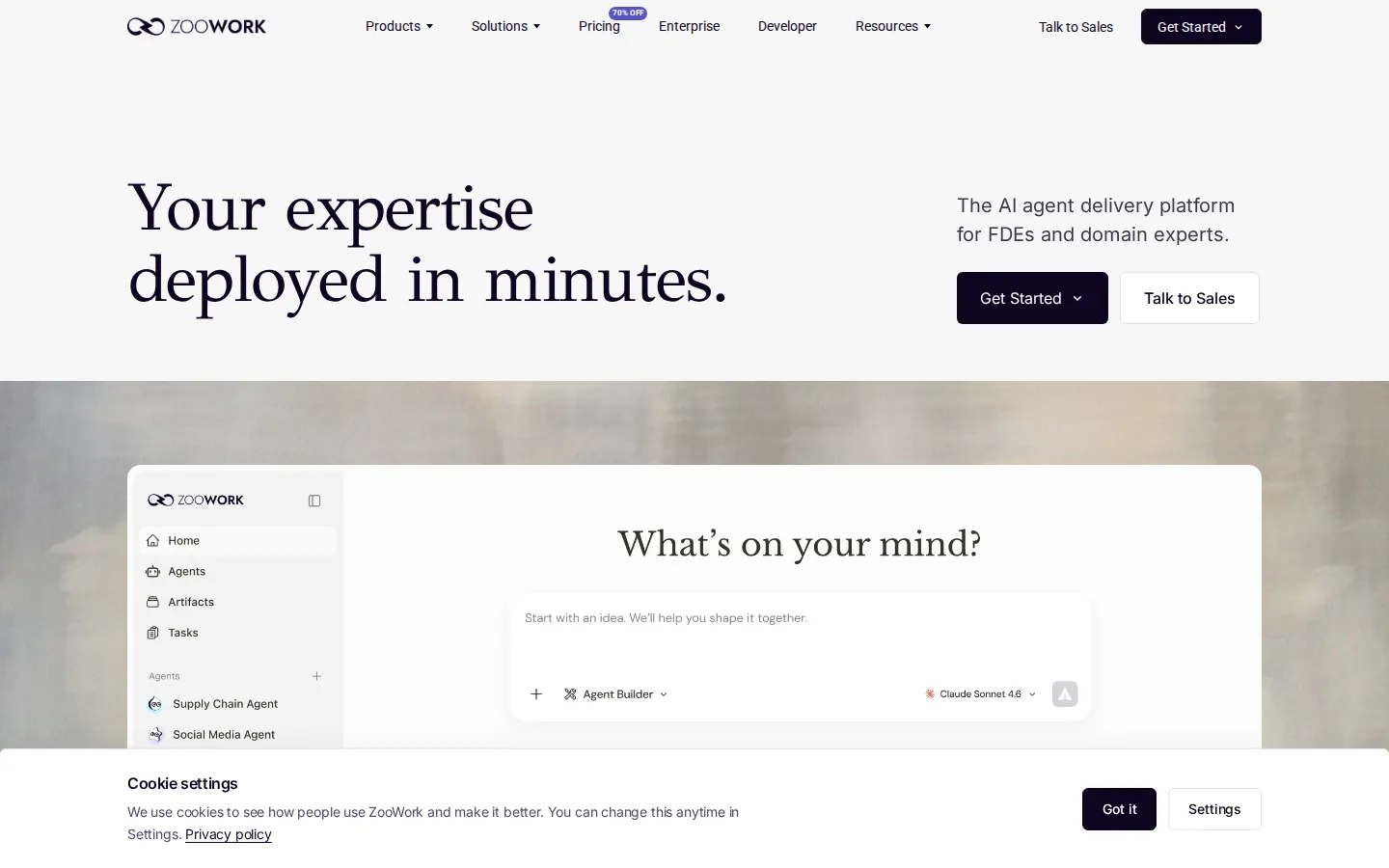
Building happens in conversation. Agent Builder turns a chat into a working agent that can be previewed and published in a click, and 50+ industry and role templates mean teams start from a proven playbook instead of a blank prompt. The Agent Runtime supplies what would otherwise be rebuilt in-house: a harness that decomposes and executes long tasks with guardrails, a feedback loop that captures outcomes from each run to improve Agent Skills, isolated sandboxes with Python, shell, and browser access, Kubernetes-native autoscaling, optional GPUs, and full observability.
ZooWork is deliberately model-agnostic, routing hard problems to stronger models and routine work to faster ones across OpenAI, Claude, Gemini, DeepSeek, Kimi, GLM, and Seedance, with no vendor lock-in. ZooData converts any URL into agent-ready JSON with up to 75% fewer LLM tokens, which makes external commerce, finance, and social data usable inside agent workflows. Agents also live where the team already works: Slack, Microsoft Teams, WhatsApp, the ZooWork app, or embedded into a product through the Managed Agent API and SDK.
Security is treated as a product surface, not an afterthought. The company reports SOC, GDPR, and HIPAA alignment, continuous control monitoring, annual penetration testing, enterprise SSO with role-based access, least-privilege tool scopes, runtime policy checks on every input, output, and tool call, tenant isolation with zero data retention, and replayable audit trails for every decision and approval.
Deployment follows a seven-day path: define one real workflow and its human checkpoints, connect the systems and load the role's standards, then run production tasks with the team reviewing each step. Enterprise buyers also get a forward-deployed engineer to scope the first workflow.
ZooWork Core Features
Conversational Agent Builder
Describe a role in chat and get a previewable, publishable agent with escalation rules, starting from 50+ industry and role templates rather than a blank prompt.
Agent Skills from your playbook
Package role and goals, company knowledge, working SOPs, delivery standards, and tool permissions so an agent starts with the full job description.
Managed Agent Runtime
A harness that plans and decomposes long tasks, captures feedback from every run, and runs isolated Python, shell, and browser sandboxes on Kubernetes with autoscaling.
Human approval gates
Sensitive actions such as writing to an ERP, issuing a purchase order, or updating a CRM pause for review before execution, and every decision stays replayable.
Model-agnostic routing
OpenAI, Claude, Gemini, DeepSeek, Kimi, GLM, and Seedance are available out of the box, letting hard problems go to strong models and routine work to fast ones.
Native workplace channels
Mention agents in Slack, Microsoft Teams, or WhatsApp, or embed them in your own product through the Managed Agent API and SDK.
ZooData URL-to-JSON
Turn any product or public page into structured, agent-ready JSON with up to 75% fewer LLM tokens, billed only for the data actually used.
Enterprise security controls
SSO and role-based access, least-privilege tool scopes, runtime policy enforcement, tenant isolation, zero data retention, and full audit trails.
Who is ZooWork for?
ZooWork targets people whose value is a repeatable method rather than a single answer. The strongest fit is organizations that already know how good work looks and want that standard enforced while the work runs, not audited after it fails. Forward-deployed engineers and solutions teams: they must deliver a working agent inside a customer environment in days, so they need scoping help, prebuilt system connections, and a production runtime without assembling an agent stack from scratch. The seven-day pilot path is written directly for them. Domain experts and senior operators: retail ops leads, agency strategists, contract reviewers, store analysts, brand planners, and research associates who hold the playbook in their heads and want it executing around the clock instead of being retyped into prompts every Monday. Operations and delivery leaders in retail chains, cross-border e-commerce, smart manufacturing, and integrated marketing agencies: the site publishes vertical playbooks with measured shifts, such as store walk-throughs moving from two hours to forty minutes and anomaly diagnosis from forty-five minutes to ten, which is the language these buyers evaluate. Sales, CRM, and revenue operations teams: an agent that reads pipeline data, cross-references several CRMs, flags deals at risk, and keeps records current matches the announced CRM use case, and the approval gate covers the writes that make RevOps nervous. Investment research and analytical teams: analysts who spend hours gathering filings, pricing, and news before they can form a judgment can hand collection to an agent and keep the judgment for themselves, which is the actual constraint on coverage. Product and platform engineers: the Managed Agent API and SDK let them embed approval-gated agents inside their own applications, passing context in and receiving approved actions out, without operating the harness, sandboxing, and model routing themselves. Enterprise IT, security, and compliance stakeholders: SSO, role-based access, least privilege, tenant isolation, zero retention, and replayable audit trails are the criteria they will check before any agent is allowed near production systems or customer data.
ZooWork Use Cases
Detect store-level stockout risk before the weekend and draft replenishment actions for manager approval.
Run daily e-commerce operations sweeps across hundreds of SKUs and flag pricing or listing anomalies.
Draft credible client proposals from a case library and brand voice, cutting first drafts from days to hours.
Review contracts against internal standards and route exceptions to legal with cited clauses.
Compile daily investment research briefs from filings, pricing, and news for analyst judgment.
Triage manufacturing line alerts, diagnose likely causes, and escalate only what needs a human.
Keep CRM records current by researching prospects and updating pipeline fields after every call.
Answer operations questions inside Slack with live data from POS, inventory, and ERP systems.
ZooWork Pros and Cons
Pros
- Agents are framed around a real job with SOPs, delivery standards, and permissions, which produces more dependable output than blank-prompt assistants.
- Approval gates and replayable audit trails make it usable for work that writes to ERP, CRM, or order systems.
- Model-agnostic by design, with OpenAI, Claude, Gemini, DeepSeek, Kimi, GLM, and Seedance available without lock-in.
- Seven-day pilot path with a forward-deployed engineer lowers the risk of a first production deployment.
- Runs where teams already work - Slack, Teams, WhatsApp, iOS app, or embedded API - so adoption does not require a new daily tool.
Cons
- Public pricing covers only the Pro workspace plan; the Managed Agent API and Enterprise tiers require a sales conversation before costs are clear.
- The published industry playbooks and their performance figures are benchmark scenarios, not independently verified customer results.
- Value depends on having documented SOPs and clean system access, so teams with undocumented tribal knowledge face real setup work.
FAQ About ZooWork
ZooWork Pricing
Pro is the only publicly priced plan: $30 per month under a 70% launch discount from $100, including 6,000 monthly credits plus 14,000 bonus credits and a 4-core, 4GB, 40GB workspace. Managed Agent API usage and Enterprise deployments are quoted through sales.
Check official pricingZooWork Alternatives

OpenBot
OpenBot is a desktop workspace where several AI agents live on your machine, each with its own name, instructions and workspace. They message each other, hand off tasks and share files. You pick the provider - Codex, Claude Code, Gemini, Grok, Cursor, Cline, OpenCode or a local model - and your files, conversations and browser data stay local, running on subscriptions you already own.

Opengeni
Opengeni is a cloud harness for long-running AI agents. Each agent gets a sandboxed computer with git, a shell, Python and a browser, connected to your repos, Slack and MCP tools. Credentials sit in an encrypted vault, teammates can open and steer the same chat, and you can bring any model, including a Codex or SuperGrok subscription. Free includes $10 of monthly usage.
Rill
Rill is a free beta browser for Apple silicon Macs that puts Claude Code and Codex beside your browsing. Press Command-E on any page to send a task, with the page or selection attached, and Rill routes it to the right local project. Your existing agent plan powers everything, with no new subscription or API keys, and nothing to configure.