
Z.ai
Z.ai brings Zhipu AI's GLM models into a single workspace, combining a multimodal chatbot, an agent that handles research and data work, document and slides generation, and a full-stack web builder. Developers can plug the same models into editors through the GLM Coding Plan or call them through the model API, with per-token pricing for GLM-5.3 and GLM-5.3-Flash.
What is Z.ai?
Z.ai is the international platform from Zhipu AI, the lab behind the GLM model family, and it bundles those models into three products that share one account: a chat and agent workspace at chat.z.ai, a coding subscription called the GLM Coding Plan, and a pay-per-token model API for developers. The site runs its own English-language pricing and billing, separate from the China-facing site it links to as a regional alternative, and it targets builders outside mainland China.
The model lineup is the core of the offer. GLM-5.3 is the current flagship, described by Z.ai as significantly stronger at coding, agentic task handling and cybersecurity, with a 50% performance gain on Z.ai Code Bench and a 1M-token context window at $1.4 per million input tokens and $4.4 per million output tokens. GLM-5.3-Flash is the first native multimodal model in the GLM-5 series, accepting image, video, file and text input at $0.15 and $0.5 per million tokens, which makes it the cheap default inside the chat product. Behind them sit GLM-5.2 for reasoning, GLM-4.6V for vision and GLM-OCR for document text extraction, all listed with cached-input rates and a limited-time free cache store.
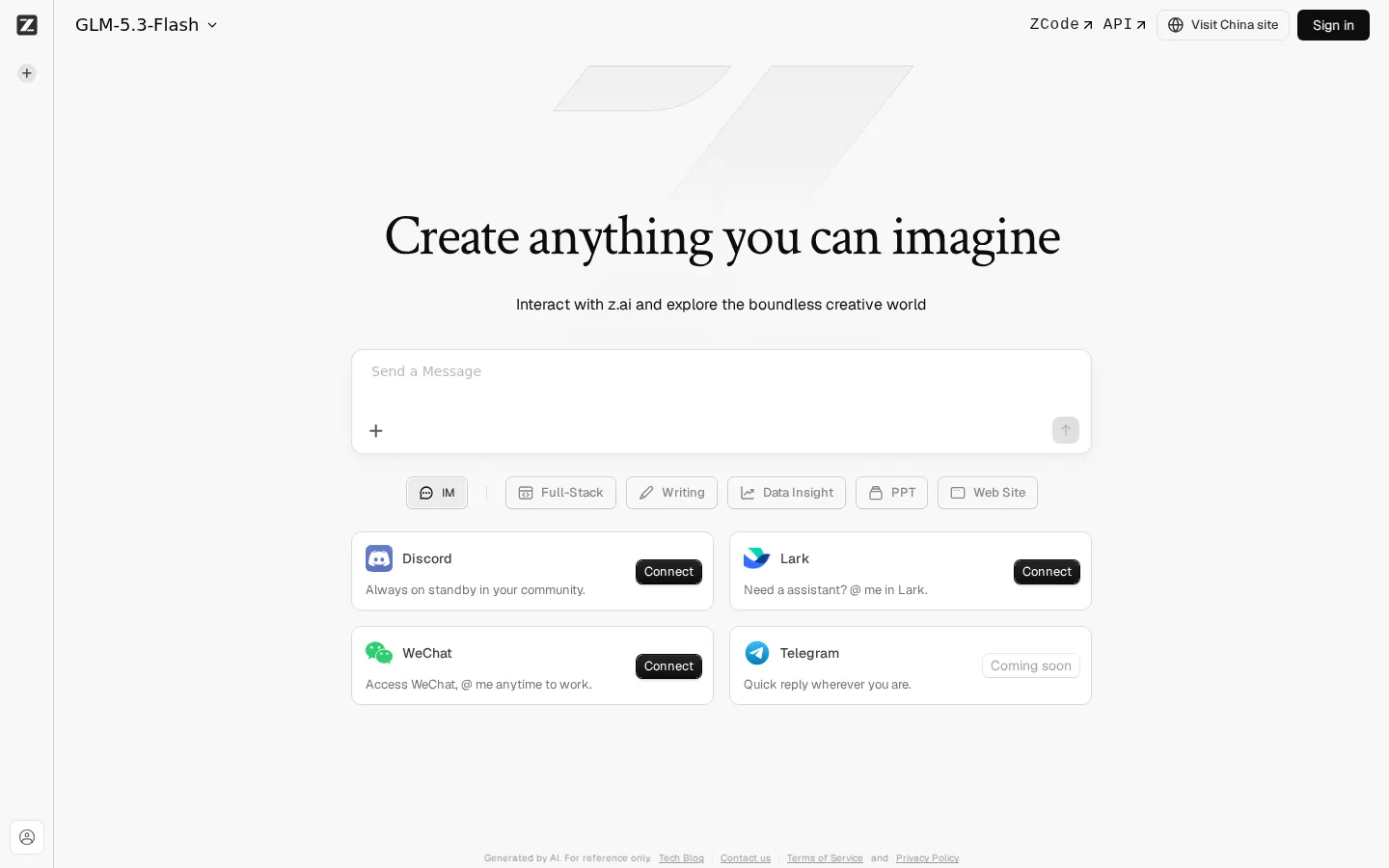
The chat workspace is organized around task modes rather than a blank prompt box. From the landing page you can pick IM, Full-Stack, Writing, Data Insight, AI Slides, PPT or Web Site, so the same assistant can draft a message, scaffold an app, produce a slide deck or build a small site. Z.ai also connects the assistant into team chat surfaces: Discord and Lark are live, WeChat is offered, and Telegram is marked coming soon.
The GLM Coding Plan targets developers who want frontier models inside existing editors. One subscription covers 20+ agent tools including ZCode, Claude Code, Codex, Cursor, Cline, Kilo Code, OpenCode, Trae and OpenClaw, with weekly credit quotas that scale from 10,000 on Lite to six times and fourteen times that on Pro and Max. Z.ai pairs the plan with two first-party tools: ZCode, an agent-powered IDE tuned for GLM models, and AutoClaw, a work assistant with expert knowledge bases and ready-to-use skills. Team seats add centralized permission management, usage dashboards, invoicing and a promise that customer data is never used for model training.
For builders, the API path is straightforward: create a key, pick a model, and pay only for tokens consumed, with usage bundles available as an alternative to metered billing. Documentation covers language, vision, video generation and agent endpoints, and cached input is billed at a steep discount on every current model. A referral program pays up to 20% back in credits with no stated limit or expiry.
Z.ai Core Features
GLM-5.3 flagship model
Z.ai's strongest model for coding, agentic task handling and cybersecurity, with a 1M-token context and a reported 50% gain on Z.ai Code Bench over its predecessor.
GLM-5.3-Flash multimodal tier
The first native multimodal model in the GLM-5 series, accepting image, video, file and text input at $0.15 per million input tokens.
Task modes in chat
Purpose-built modes for IM, Full-Stack development, Writing, Data Insight, AI Slides, PPT and Web Site, each pre-configured for its output type.
GLM Coding Plan
Weekly-credit subscriptions from $18 to $168 per month that work inside 20+ agent tools including Claude Code, Codex, Cursor, Cline and OpenCode.
ZCode IDE
A first-party, agent-powered coding environment optimized for GLM models, offered alongside the plan as a download.
AutoClaw work assistant
An agent built for real work tasks with expert knowledge bases and ready-to-use skills, covering deep research, business data analysis and automated execution.
Team administration
Standard and Premium seats add seat and permission management, usage dashboards, centralized billing and a no-training-on-customer-data guarantee.
Model API and bundles
Per-token access to GLM-5.3, GLM-5.2, GLM-4.6V and GLM-OCR, with cached-input discounts and purchasable usage bundles for predictable spend.
Who is Z.ai for?
Z.ai suits people who want GLM-class models without managing infrastructure, and it is broad enough that the audience splits by entry point rather than by skill level. Software engineers and indie developers are the loudest group. The GLM Coding Plan is built for them: weekly credit quotas, compatibility with more than 20 agent tools, and a first-party IDE in ZCode. A developer already paying for Claude Code or Cursor can point the tool at GLM models and keep the same workflow while cutting subscription cost. The Lite tier is explicitly positioned for lightweight iteration on small repositories, while Max targets people working across mid-to-large codebases. Engineering managers and platform teams get a separate story. Team seats add seat and permission management, a usage and R&D efficiency dashboard, centralized invoicing, and enterprise-grade security language around encryption, access control and auditability, with data excluded from model training. That makes Z.ai a reasonable candidate for a pilot inside a company that cannot send source code to a consumer chatbot, and the Standard and Premium seats give procurement two clear price points to compare. Product managers, analysts and operations staff use the chat workspace instead of an editor. Data Insight handles uploaded business data and returns charts plus written recommendations; AI Slides and PPT turn a brief into a deck; Full-Stack and Web Site produce working front ends. These users rarely touch the API and care mostly about whether the output is presentable enough to hand to a client. Founders and solo builders treating Z.ai as a low-cost stack benefit from the combination: a chat subscription, a coding plan and per-token API access on one bill, with usage bundles when metered spend gets unpredictable. Cost-sensitive teams migrating off pricier frontier subscriptions are the clearest fit, since yearly billing brings Lite down to $12.6 per month. Writers, marketers and students come for the general assistant: long-context drafting, rewriting and summarization across a 1M-token window, plus document and slide generation for coursework or campaign material. Finally, AI product teams evaluating Chinese frontier models use the API to benchmark GLM-5.3 and GLM-5.3-Flash against Western alternatives, and the low per-token rates make side-by-side evaluation cheap enough to run on real traffic before committing to a vendor.
Z.ai Use Cases
Generate a working full-stack web app prototype from a short written product brief.
Run a GLM coding agent inside Claude Code or Cursor to refactor a mid-sized repository.
Turn a research question into a structured report with cross-source citations and evidence.
Upload sales data and get visual charts plus written operational recommendations.
Build a client-ready slide deck or PowerPoint from a paragraph of context.
Draft and rewrite long marketing copy while keeping a one-million-token source window open.
Add GLM-5.3-Flash multimodal understanding to an app through the pay-per-token API.
Standardize AI tooling across an engineering team with seats, dashboards and central billing.
Z.ai Pros and Cons
Pros
- Coding plans are priced well below comparable frontier-model subscriptions, with quarterly and yearly discounts up to 30%.
- One subscription works inside 20+ agent tools, so teams can keep Claude Code, Cursor or Codex instead of switching editors.
- The 1M-token context window is usable across both the chat product and the API, which suits long repositories and multi-day workflows.
- Clear separation between consumer chat, coding subscription and metered API, all billed from a single account with team controls on top.
Cons
- Credit quotas are expressed in weekly credits rather than tokens or requests, which makes real cost hard to predict before subscribing.
- Several regional integrations are still incomplete, with Telegram marked coming soon and the China-facing product split onto a separate site.
- Documentation and support lean on self-service, and enterprise needs route through a sales conversation rather than transparent public pricing.
FAQ About Z.ai
Z.ai Pricing
Paid subscription plus metered API. Individual GLM Coding Plans cost $18/month (Lite), $80/month (Pro) and $168/month (Max), with 20% off quarterly and 30% off yearly billing ($12.6, $56 and $117.6 per month). Team seats are $88 (Standard) and $188 (Premium) per seat monthly, about 10% cheaper annually. API usage is billed per million tokens: GLM-5.3 at $1.4 input and $4.4 output, GLM-5.3-Flash at $0.15 and $0.5.
Check official pricingZ.ai Alternatives

Giga
Giga is an enterprise AI agent platform for customer support. Its agents resolve complex issues across chat, voice and email, act inside your own tools, and improve against the KPI you set. Deployment takes weeks rather than quarters, and buyers start with a contact-sales pilot. DoorDash runs it at scale with a 90%+ Did We Resolve rate.

BuildMyDiscord
BuildMyDiscord is a free AI Discord server builder. Describe your community in plain language and Claude designs the categories, channels, roles and permission rules, then deploys them to your own server in under two minutes. Every build ships with a management bot covering moderation, welcome banners, leveling, tickets and polls, while a Pro AI Editor keeps editing the live server on command.

Google AI Studio
Google AI Studio is a free browser workspace for building with Gemini models. It pairs a prompt playground for text, image, audio and video with structured output, function calling, Google Search grounding, API key management and one-click code export, and deploys finished projects straight to the Gemini API, which bills per token beyond its free tier.