
Vapi
Vapi is an API-first platform for building, testing, and deploying advanced voice AI agents. Developers use it to launch natural-sounding conversational agents for support, sales, and scheduling in minutes, with sub-500ms latency, tool calling, 200+ model integrations, and telephony control. Trusted by Ring, Intuit, and ServiceTitan, Vapi powers 1 billion calls with SOC 2, HIPAA, and PCI compliance.
What is Vapi?
Vapi is an API-first platform for building, testing, and deploying voice AI agents, handling the entire stack from speech-to-text and language model reasoning to text-to-speech, telephony, and real-time media transport. Developers configure an assistant — system prompt, voice, model, tools, and conversation flow — through the dashboard or the REST API, and Vapi orchestrates everything with responses in under 500 milliseconds.
The platform is built for natural, low-latency conversation: turn-taking, human-like voices, custom pronunciation and keywords, and support for 100+ languages including English, Spanish, and Mandarin. It offers over 200 built-in model and integration options for transcription, LLM, and voice, or lets teams bring their own API keys and self-hosted models, with automatic failover and latency balancing across providers.
Agents can access business data and trigger actions through tool calling and MCP support, and integrate authenticated internal APIs. For telephony, Vapi provides phone number management, custom SIP support, warm transfers, voicemail detection, and DTMF. Developers can run automated test suites to catch hallucinations before production, run A/B experiments on prompts, voices, and flows, and track performance through reporting dashboards and exports. Multi-agent orchestration chains agents or squads with intelligent handoffs and routing.
Enterprise capabilities include contractual uptime SLAs with reserved capacity, dedicated deployment engineers, SSO, OAuth, RBAC, AI guardrails that prevent hallucinations, data residency, and SOC 2, HIPAA, and PCI compliance. Customers such as Ring, Intuit, ServiceTitan, and New York Life trust the platform at enterprise scale, with deployments spanning customer support, healthcare, and staffing marketplaces. The platform reports 1 billion calls supported, 99.9% uptime for enterprise clients, 2.5 million agents launched, over 750,000 developers, and average latency under 500ms. Pricing is usage-based: $0.05 per minute for call hosting, $0.005 per chat message, with model provider costs passed through at cost or waived if you bring your own keys. Voice AI adoption across support, sales, and scheduling workflows continues to expand as latency and naturalness keep improving.
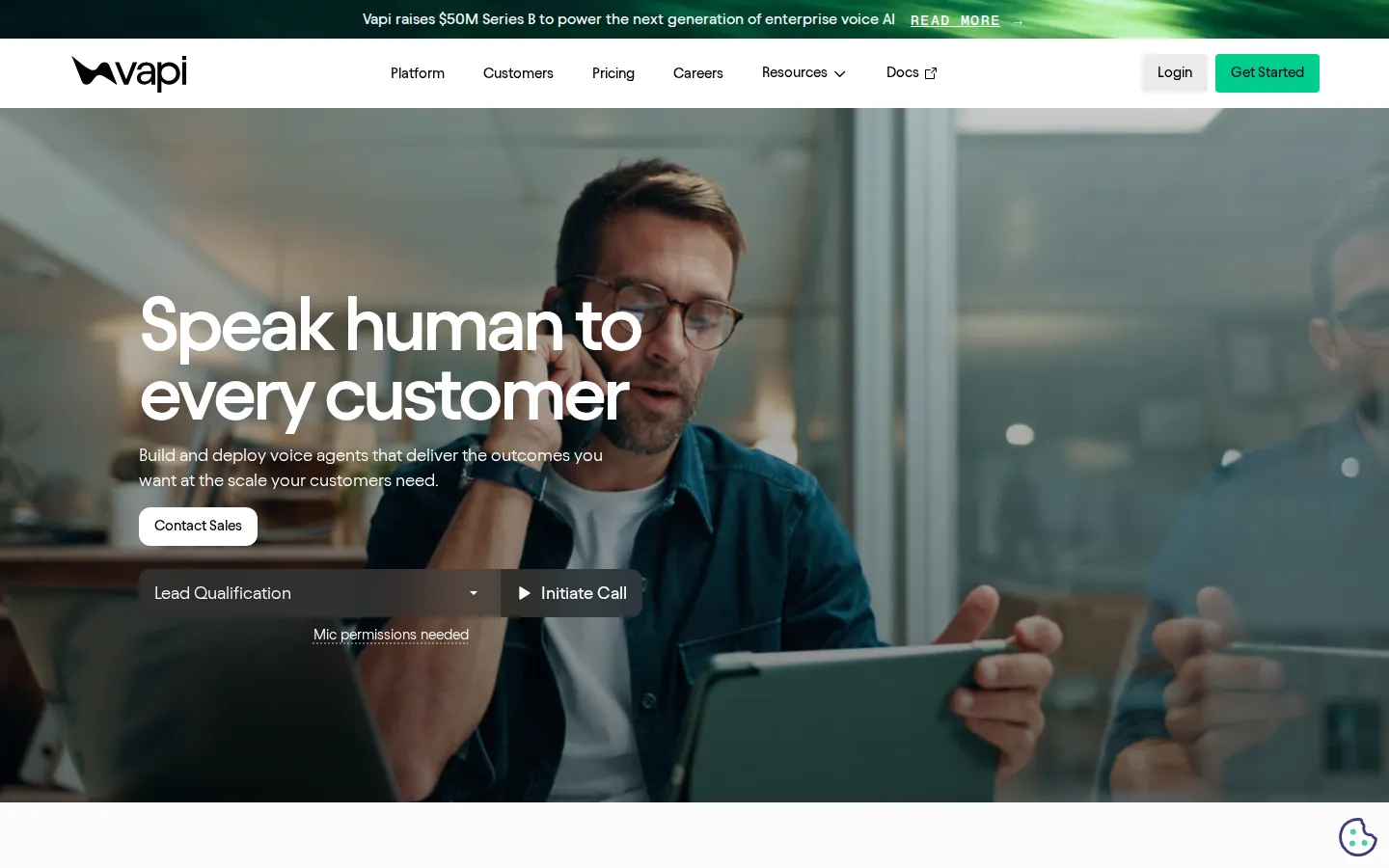
Vapi Core Features
Build, test, and deploy production-ready voice agents in minutes via API or dashboard
200+ model and integration options, or bring your own API keys and self-hosted models
Ultra-low latency with responses in under 500ms for natural real-time conversation
Tool calling and MCP support to access business data and trigger actions in apps
Multilingual voice agents in 100+ languages including English, Spanish, and Mandarin
Telephony control with SIP, warm transfers, voicemail detection, and number management
Automated testing, evals, and A/B experiments to catch hallucinations before launch
Enterprise security with SOC 2, HIPAA, PCI compliance, SSO, OAuth, and RBAC controls
Who is Vapi for?
Vapi is built for software developers and engineering teams that want to add voice AI to their products without managing telephony, model, and infrastructure complexity. Individual developers can sign up for free, receive $10 in credits, and deploy a working voice agent in minutes, while product teams embed voice assistants into existing applications through REST APIs and TypeScript, Python, and React SDKs. It is equally designed for enterprises and high-volume businesses. Customers including Amazon Ring, Intuit, ServiceTitan, New York Life, Kavak, Instawork, and Unity AI run hundreds of thousands to millions of calls per month on Vapi for customer support, lead qualification, appointment scheduling, healthcare outreach, and marketplace staffing. The enterprise Scale tier adds support SLAs, dedicated deployment engineers, SSO, RBAC, data residency, and HIPAA compliance for regulated industries like healthcare and finance. Startups and agencies building voice agents for clients will find the self-serve Build plan sufficient, with custom voices, model access, automated testing, and Discord community support. Less technical teams can also benefit because Vapi offers a dashboard UI to configure conversation flows, voices, tools, and integrations, plus analytics and A/B experiments for tuning agents in production. Whether you need one support assistant or millions of calls per month, Vapi targets anyone who wants to deploy conversational voice AI at scale.
Vapi Use Cases
Customer support automation — Ring routes 100% of inbound calls through Vapi
Lead qualification and routing for sales and marketing teams
Appointment scheduling and reminders for clinics and service businesses
HIPAA-compliant healthcare outreach, patient engagement, and telehealth coordination
Marketplace and staffing coordination — Instawork handles 1M+ calls per month
Revenue growth and sales acceleration — Unity AI achieved 5X revenue growth
Multilingual customer service across 100+ languages for global businesses
SMS and chat agents for omnichannel customer conversations
Vapi Pros and Cons
Pros
- API-first with SDKs for TypeScript, Python, and React, plus full REST API access
- Transparent pricing — model provider costs passed through at cost with no markup
- Enterprise-grade reliability with 99.9% uptime, sub-500ms latency, and compliance
- No vendor lock-in — bring your own models, API keys, and telephony provider
Cons
- No fixed monthly pricing — self-serve is pay-as-you-go, which is harder to budget
- SSO, RBAC, SOC 2, and support SLAs are only available on the enterprise Scale plan
- Model provider and telephony costs are billed separately, so total spend varies
FAQ About Vapi
Vapi Pricing
Self-serve usage-based pricing with $10 free credits: $0.05/min call hosting and $0.005/chat message, model costs passed through at cost, plus custom annual-contract Scale plans for enterprises.
Check official pricingFree
$10 free credits to start building with no credit card; usage-based pricing applies once credits are used
Build
Usage-based call hosting ($0.05/min calls, $0.005/msg chat) plus model costs at cost; 10 call concurrency lines, custom voices, email and Discord support
Scale
Annual contract with fixed platform fee and committed volume; SSO, RBAC, SOC 2, HIPAA, data residency, support SLA, dedicated account team
Vapi Alternatives

Devin
Devin is an AI software engineer built by Cognition that plans, codes, debugs, and ships software tasks autonomously. It combines Devin Desktop for local work, cloud agents powered by the SWE 1.7 model, Tab completions, and inline edits across major IDEs. Plans range from a free tier to Pro at $20 per month, Max at $200, and Teams with centralized billing.

Manus
Manus is an AI agent platform that goes beyond answering questions to execute real tasks, automate workflows, and extend human reach. Users describe a goal and Manus plans and completes it across browsers, computers, and code. It offers Agent Mode with Manus 1.6 models, Chat Mode for conversation, and Team plans for collaboration, with free and paid memberships.

Polsia
Polsia is an AI platform that runs companies on autopilot. Built on agent SDKs and MCP integrations, Polsia plans roadmaps, ships code, runs ads, replies to customers, and posts content around the clock without human intervention. Founded by Ben Cera and operated by Polsia, Inc., it is free to start with no credit card required and subscription billing via Stripe.