
Tunee
Tunee is a conversational AI music agent for creating songs, music videos, and AI music characters in one workspace. Chat naturally or upload reference audio to generate tracks, then switch between nine music and video models, split stems, master for streaming, clone vocals, and turn any track into a cinematic MV. A free plan needs no credit card.
What is Tunee?
Tunee is a conversational AI music agent that creates songs, music videos, and a persistent AI music character inside one web workspace. Instead of teaching you prompt syntax, Tunee works like a producer you chat with: you describe a mood, upload a reference melody, or share a video clip, and the agent answers with follow-up questions before composing. Music Agent is the creation surface, and it is driven by a multi-agent architecture the company says is built on DIFY, orchestrating file analysis, task planning, lyrics generation, web research, and final music generation in a single thread.
The platform is deliberately multi-model. Tunee switches between nine models automatically or lets you choose manually, drawing on Mureka, MiniMax, TemPolor, Ace-Step, Kling, Seedance, Wan, Lyria, and Seedream families depending on the task and the current promotional pricing on each one. That model layer is what makes the rest of the pipeline possible: Smart Mastering optimizes loudness, EQ, and dynamics for streaming at four credits a track; stem separation splits any song into 2, 4, or 6 sources for remixing, sampling, or isolating a vocal; and voice cloning applies a consistent vocal identity to generated tracks so a project keeps the same AI singer across releases.
MV Studio handles the visual side. Any track can become a story-driven music video, with the workspace exposing music analysis, creative direction, character details, scene plans, and storyboard previews alongside the final render. Free accounts are capped at short videos, while paid tiers unlock full-length MVs, and concurrent video tasks scale from six on Basic to unlimited on Ultra. Related tools cover lip sync, which animates a photo into singing mouth movement for short-form posts, AI dancing, and motion control for camera angles, character movement, and scene transitions. An AI Character feature packages a look, a voice, and a story into a reusable persona for audience-building.
Ownership and distribution are part of the pitch. Content made on paid plans carries a full commercial license with no revenue sharing, copyright certificates can be claimed from the library as proof of ownership, and free-plan tracks stay non-commercial with attribution. Tunee Skills extends the agent beyond the site, issuing API keys that plug music generation into agent platforms such as OpenClaw.
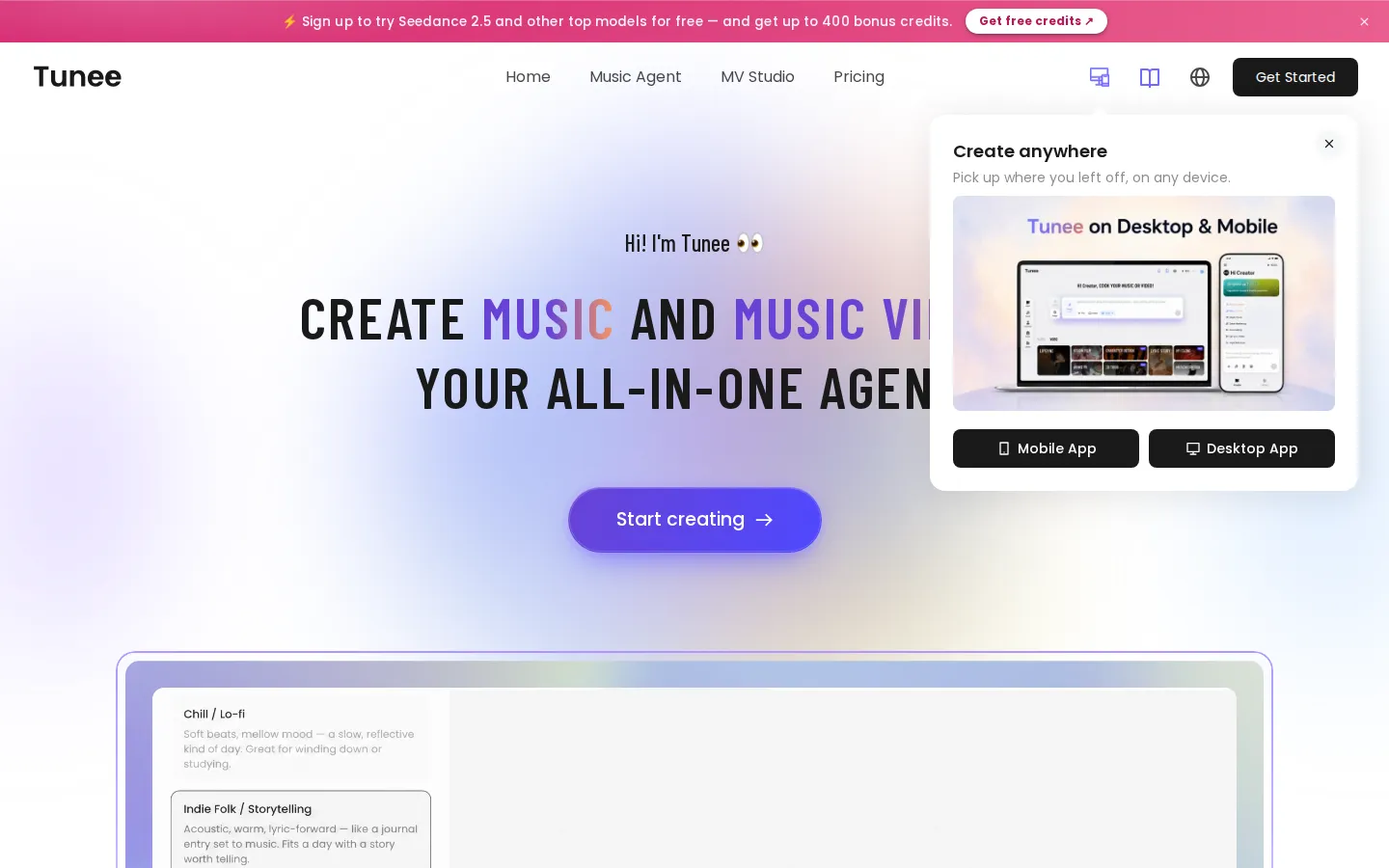
Tunee also ships mobile and desktop apps and markets free song and video creation with no credit card required.
Tunee Core Features
Conversational Music Creation
Describe a mood, upload a reference, or share a clip in chat and Tunee plans, writes lyrics, and generates the track with no prompt engineering required.
Multi-Model Switching
Nine music, video, and image models including Mureka, MiniMax, TemPolor, Seedance, Wan, and Kling, selected automatically or switched manually per task.
MV Studio
Turn any track into a story-driven music video with music analysis, creative direction, scene plans, storyboard previews, and full-length renders on paid plans.
AI Character
Build a consistent AI music persona with a unique look, voice, and story, then publish content under that identity on autopilot.
Stem Separation
Split any song into 2, 4, or 6 stems for remixing, sampling, or isolating vocals, with one free six-source use for new users.
AI Mastering
Optimize loudness, EQ, and dynamics for streaming at 4 credits per track, with watermark-free downloads on paid tiers.
Voice Cloning
Clone a vocal style and apply it to any generated track so a catalog keeps one consistent AI singer.
Tunee Skills API
Generate API keys and plug music generation into agent platforms such as OpenClaw, with published ClawHub and GitHub integrations.
Who is Tunee for?
Tunee targets people who have musical ideas but not the production skills, software, or session musicians to realize them. Independent artists and singer-songwriters use it to sketch arrangements, generate a demo vocal, and iterate on a hook before taking a track into a DAW, treating the chat thread as a fast idea partner rather than a finished mastering suite. Content creators, YouTubers, and TikTok or Instagram producers use Music Agent to make original background scores and then push the same song through MV Studio, lip sync, or dance videos so one track becomes a week of short-form posts without licensing headaches. Video editors and small production teams use Tunee when a client needs a custom soundtrack or a full-length MV on a tight deadline: they generate the track, separate stems to duck music under dialogue, and hand over a mastered file with a copyright certificate. Game developers and app builders lean on mood-driven generation and API access to produce scene-specific loops and adaptive background music, while advertisers, agencies, and brand marketers use the commercial license on paid plans to clear tracks for campaigns and social ads. Podcasters, audiobook creators, and newsletter writers use the mastering and stem tools to polish intro music and isolate vocals from existing recordings. Beginners and hobbyists who hear songs in their heads but have never studied music theory are explicitly served: the conversational flow accepts descriptions like something sad but hopeful, and there is no need to learn prompting techniques. Developers and automation builders use Tunee Skills, ClawHub, and GitHub integrations to wire music generation into agent pipelines and music-based apps. Finally, bedroom creators and aspiring virtual artists use AI Character to build a consistent persona with a look, a voice, and a story, publishing on autopilot. It is a poor fit for anyone who needs a fully human-performed recording or guaranteed copyright registration, since fully AI-generated works may not qualify for protection in the United States.
Tunee Use Cases
Turn a mood description into a finished song without any music theory
Generate a cinematic music video for an existing track in MV Studio
Split a song into 2, 4, or 6 stems for remixing, sampling, or karaoke
Master a track for streaming release at 4 credits per song
Build a consistent AI music character to grow a virtual artist audience
Clone a vocal style so every release keeps the same AI singer
Animate a photo into a lip-sync video for short-form social posts
Automate music generation inside agent workflows with the Tunee Skills API
Tunee Pros and Cons
Pros
- Genuinely conversational workflow that removes prompt engineering for beginners
- All-in-one platform covering music, mastering, stems, voice cloning, MV Studio, and AI characters
- Free plan with no credit card required and daily credits that refresh automatically
- Nine switchable music, video, and image models inside one workspace
- Full commercial ownership and claimable copyright certificates on paid plans
Cons
- Four separate credit types (daily, event, membership, top-up) expire on different schedules, which makes budgeting confusing
- Free-plan music is owned by Tunee and limited to non-commercial use with attribution
- Long-form music videos and premium tools are credit-hungry, and promotional plan pricing changes frequently
FAQ About Tunee
Tunee Pricing
Tunee is freemium: a free plan with daily credits and no credit card, plus Basic, Plus, Pro, and Ultra subscriptions priced from about $15 to $129 per month on annual billing (list prices $18 to $199 monthly), with top-up credits for paid subscribers.
Check official pricingFree
Free song and short music video creation with welcome credits and daily credits, non-commercial use with attribution, and one free six-source stem separation.
Basic
Billed annually at $180 ($18 monthly). About 6,300 credits per month (1,800 upfront plus 4,500 daily check-in), full-length MVs, 6x concurrent video tasks, copyright certificate, and commercial license.
Plus
Billed annually at $360 ($38 monthly). About 8,600 credits per month (4,100 upfront plus 4,500 daily check-in), 10x concurrent video tasks, and a limited-time annual bonus of 3,600 credits.
Pro
Billed annually at $816 ($89 monthly). About 14,400 credits per month (9,900 upfront plus 4,500 daily check-in), 30x concurrent video tasks, 6x concurrent projects, and a limited-time annual bonus of 12,000 credits.
Ultra
Billed annually at $1548 ($199 monthly). About 27,400 credits per month (22,900 upfront plus 4,500 daily check-in), unlimited concurrent video tasks and projects, and a limited-time annual bonus of 36,000 credits.
Tunee Alternatives

MusicGPT
MusicGPT is a browser-based AI music studio. Type a prompt or supply lyrics and it generates complete songs, instrumentals, sound effects and speech, with optional vocal or instrumental output. Paid plans add remixing, extension, stem downloads and text to speech, while the free tier supplies monthly credits so anyone can test generation before committing to a subscription.

VidMuse
VidMuse is a web-based AI video platform that turns audio into music videos and product details into winning ads. It combines an agent-driven chat workflow, an App Hub of community apps and templates, and access to many video, image and music models. Lab modes cover Story MV, Viral Shorts, Video Remix, UGC and Cinematic Ad, with CLI and Skill plugin options for builders.

Moises
Moises is an AI music app for musicians. Upload any song and it separates vocals, drums, bass, guitar, keys and more into clean stems, detects chords, key and BPM, transcribes lyrics, and generates a smart metronome. Slow songs down, change the key, mute your part, then export stems or take the idea into Moises Studio to record, generate parts and collaborate.