
Kits AI
Kits AI is a studio for AI vocals built by Arpeggi Labs. It clones a singing voice from a short recording, converts any take into one of 100+ licensed artist voices, and adds vocal removal, stem splitting, harmonies, AI mastering and instrument models. A free plan includes 15 conversion minutes; paid tiers start at $10 per month.
What is Kits AI?
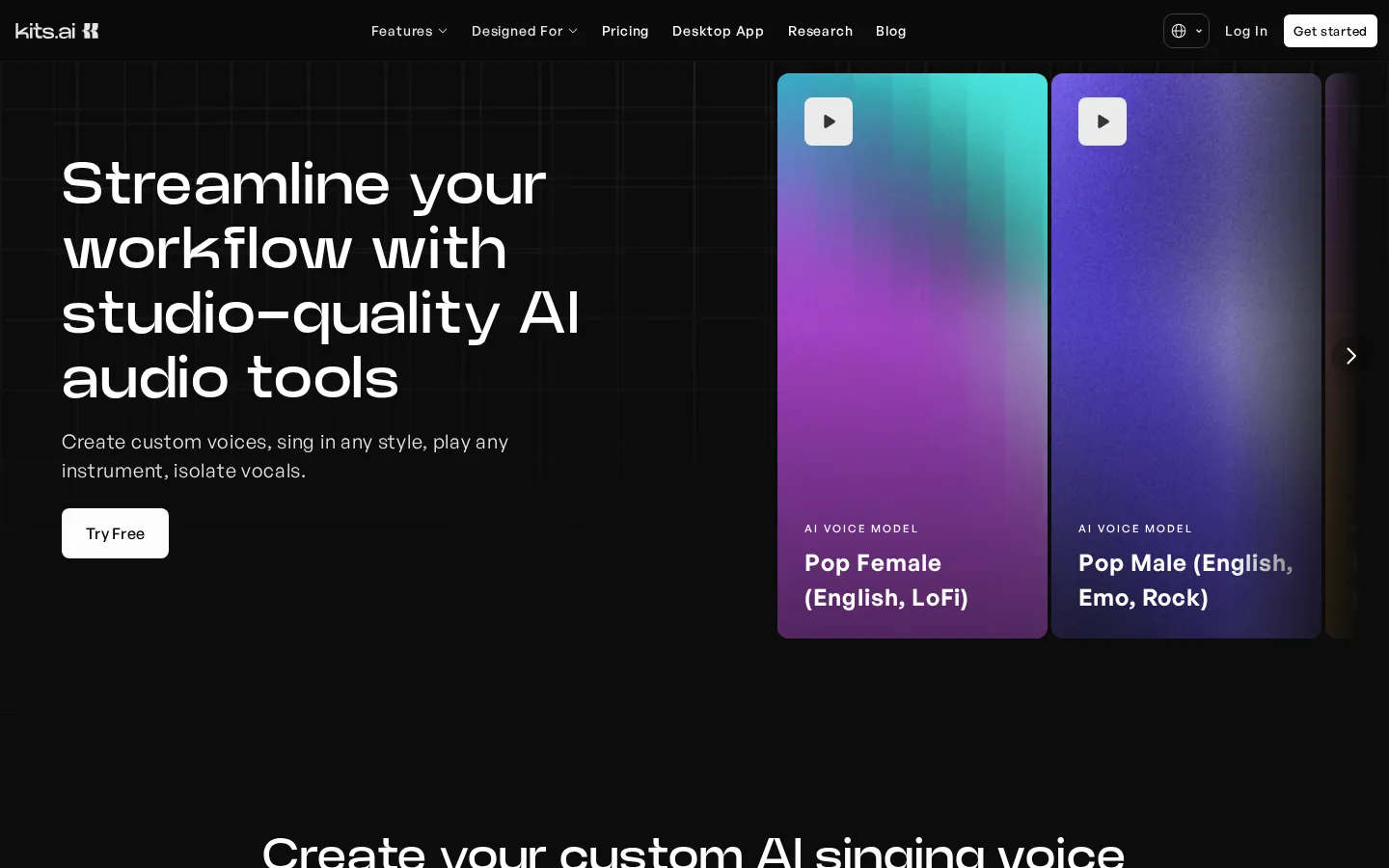
Kits AI is a browser-based AI audio studio from Arpeggi Labs, built around one idea: your vocal performance should not be limited by your voice. You upload a dry acapella, and the platform trains a model that can sing anything you feed it, keeping your phrasing and timing while changing the timbre. The same conversion engine powers a library of more than 100 licensed artist voices, so a songwriter can hear a demo in a pop, rock, R&B, rap or voiceover tone before a session singer is ever booked.
Around that core, Kits bundles the utilities a vocal take usually needs. Vocal Remover isolates a vocal from a mix with de-echo and de-reverb options, Stem Splitter separates vocals, drums, bass and instruments, Harmonies stacks backing parts from one line, and Vocal Enhance repairs noisy or thin recordings. AI Mastering finishes a track, stem or sample, the AI Instrument Library supplies session-style parts for sketching, and Key and BPM Finder reads a track's tempo and key in seconds. Voice Designer builds a voice from chosen traits, Voice Blender fuses existing models, and Voice Variants nudges an existing voice in a new direction.
The company leans hard on licensing. Every voice in the artist library is licensed directly from the artist with revenue sharing, the site is Fairly Trained certified, and there is a Kits Earn programme that lets voice owners publish a model and collect royalties. The flagship in-house model is Kits VC, documented on a dedicated research page.
Delivery is web-first at app.kits.ai, with a desktop app for producers who want the tools closer to a session. Free accounts get 15 conversion minutes but no downloads and no voice slots; Starter at $10 adds two slots, professional cloning and 15 download minutes; Producer at $30 removes the conversion cap and raises downloads to 60 minutes; Professional at $60 makes downloads unlimited. Annual billing cuts up to 47%. A public API exposes voice conversion, voice blending and vocal separation, with keys generated inside the app and documentation at docs.kits.ai.
Kits AI Core Features
Voice cloning
Train a custom singing voice from a short dry acapella upload, then apply it to any vocal take you record.
AI singing generators
Convert a performance into 100+ royalty-free artist voices across pop, rock, R&B, rap and voiceover styles.
Vocal Remover and Stem Splitter
Isolate vocals, drums, bass and instruments, with de-echo and de-reverb cleanup built in.
AI Mastering
Master a full track, a stem or a sample to a release-ready finish without leaving the browser.
Harmonies and Vocal Blending
Turn one vocal line into stacked backing parts, or fuse two voices into a tone that does not exist yet.
Voice Designer and Variants
Build a voice from selected traits, then make subtle or drastic variants of an existing model.
AI Instrument Library
Sketch parts with session-quality instrument models before hiring players or booking studio time.
Developer API
Voice conversion, voice blending and vocal separation endpoints, with keys managed inside the app.
Who is Kits AI for?
Kits AI is aimed at people who work with vocals rather than at general text-to-speech buyers. Songwriters and topliners are the centre of the audience: they can sing a rough idea, convert it into a polished voice, and pitch a demo that sounds finished without hiring a session singer. Independent producers use it to try a chorus in three different vocal tones in an afternoon, and to stack harmonies on parts they cannot physically sing. Sync and advertising composers, musical theatre writers and jingle shops use it for the same reason: they need to audition a vocal idea quickly for a client or a director. One testimonial on the site comes from a musical theatre composer who uses Kits to hear what an actor might sound like before rehearsal, which is a casting and pre-production use case rather than a music release one. Labels, publishers and management teams use it for reference demos, since the artist voices are licensed and the output can be shared internally without the clearance worry that comes with a scraped model. Mixers and mastering engineers use the cleanup tools, especially vocal removal, stem splitting and de-echo, to salvage takes that arrived in poor condition. Podcasters, video editors and game audio teams are served by the speaking-voice and text-to-speech side, though that is a smaller part of the product than singing. Hobbyists can start free without a card, but the free plan has no downloads, so anyone who intends to keep a file will end up on the $10 tier. Voice owners who want passive income are a separate audience, handled by Kits Earn.
Kits AI Use Cases
Demo a song in a professional-sounding voice before booking a session singer.
Write vocal toplines in your own cloned voice without leaving the writing room.
Swap a guide vocal for a licensed artist tone when pitching a reference demo to a label.
Rescue a noisy phone recording with vocal enhance, de-echo and de-reverb.
Stack harmonies on a chorus without singing the part six times.
Split a finished mix into stems for remixing, sampling or live performance.
Add lifelike voiceover to a video, podcast episode or game build with speaking voices.
Kits AI Pros and Cons
Pros
- Built for singing rather than narration, with licensed artist voices and singing-aware conversion instead of generic text-to-speech.
- The $30 Producer tier removes the conversion cap entirely, which suits writers who iterate on dozens of takes a day.
- Every artist voice is licensed directly with revenue sharing and Fairly Trained certification, which removes the usual clearance anxiety.
- One tab covers conversion, cleanup, harmonies, mastering and stem splitting, so a demo rarely needs another subscription.
Cons
- The free plan includes zero download minutes and zero voice slots, so you cannot export a file or keep a clone without paying.
- Producer still caps downloads at 60 minutes a month even though conversions are unlimited, which bites on long projects.
- The API is beta and request-based, and text-to-speech was removed from it in September 2025, leaving three endpoints.
FAQ About Kits AI
Kits AI Pricing
Kits AI is free to try with 15 conversion minutes and no credit card, then costs $10, $30 or $60 per month for Starter, Producer and Professional, with annual billing up to 47% cheaper.
Check official pricingFree
15 conversion minutes, 0 voice slots and 0 download minutes; voice designer, blender and generative vocals included.
Starter
60 conversion minutes, 2 voice slots and 15 download minutes, plus instant and professional cloning at medium quality.
Producer
Unlimited conversion minutes and voice slots with 60 download minutes per month at high-fidelity model quality.
Professional
Unlimited conversion minutes, voice slots and download minutes for full-time production work.
Kits AI Alternatives
Sonilo
Sonilo turns video into licensed music and sound effects. Upload a clip and it writes an original soundtrack that follows the cuts, adds Foley and ambience, or generates songs from lyrics and prompts. Free credits refresh every two weeks with no credit card required, Pro adds commercial licensing with a downloadable certificate, and paid plans start at $11.99 per month.

Greysound
Greysound is a browser DAW that pairs a full multi-track studio with an AI co-producer named CoProducer. Record, arrange, mix and master using built-in synths, samplers and effects, generate samples and MIDI parts, split stems, and keep sessions in the cloud. Core editing is free; you pay only for AI credits.
Songscription
Songscription converts recordings into playable notation. Upload an MP3, WAV, or M4A file, paste a YouTube or TikTok link, or photograph printed sheet music, and its AI writes out notes, chords, and guitar tabs. Musicians, teachers, and producers use it to learn songs by ear faster, archive original compositions, and move audio into notation software or a DAW.