Triple 3D
Triple 3D makes it easier to turn images, sketches, and text prompts into editable 3D models without complicated software or a steep learning curve.
What is Triple 3D?
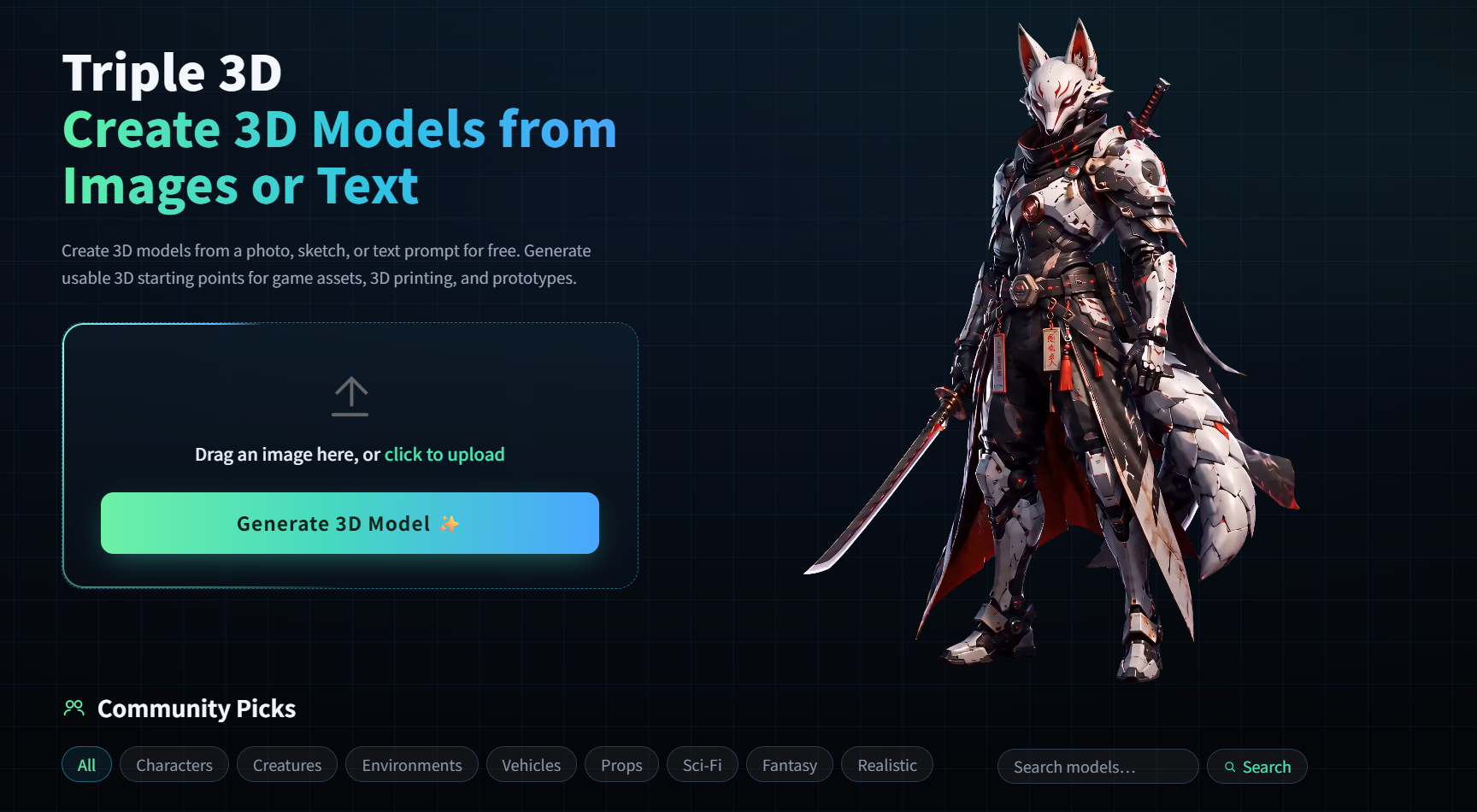
Triple 3D is an online AI 3D creation platform that converts 2D inputs and natural-language prompts into 3D meshes. Image-to-3D and photo-to-3D reconstruct an object’s volume, proportions, and surface patterns from a single subject photo or reference; text-to-3D synthesizes props, characters, creatures, decorations, and printable concepts from descriptive prompts. The output emphasizes recognizable shape, detailed texture, low-poly options, cleaner surfaces, and export-ready files instead of purely decorative previews. Generated models are starting points: game teams may still retopologize, unwrap UVs, build LODs, add colliders, or rig; print users may still repair non-manifold areas, adjust wall thickness, add supports, cut models, or verify scale. The platform supports online viewers and conversion helpers for common formats, so creators can move from idea to base mesh to production tool without manual blocking from zero.
Triple 3D Core Features
Image / photo / text to 3D
Generate from product shots, sketches, character references, or prompts.
Online preview & inspection
Rotate, zoom, check shape, texture, scale, boundaries, and mesh condition before download.
Game-asset mode
Low-poly options, cleaner topology, silhouette preservation, texture detail, and engine-export orientation.
3D-printing mode
STL-oriented workflow with scale, thickness, watertight, and printable-shape checks.
Format export & viewers
Export/conversion support for STL, OBJ, GLB and related viewer/converter tools.
Free early-stage generation
Test image-to-3D and text-to-3D ideas before spending time on final cleanup.
Who is Triple 3D for?
For indie game developers, 3D artists, prototypers, product designers, ecommerce and marketing teams, and 3D-printing hobbyists. Ideal for anyone who needs fast props, low-poly background assets, miniatures, figurines, product mockups, or concept models without modeling every base mesh from scratch.
Triple 3D Use Cases
Game prototypes: Crates, furniture, sci-fi/fantasy props, environment pieces, low-poly background assets, collectibles.
3D printing: Pet figurines, miniatures, toys, keychains, ornaments, decorations, custom gifts.
Product mockups: Turn product images or ideas into 3D previews for ecommerce, ads, client review, design validation.
Triple 3D Pros and Cons
Pros
- Fast first draft: Skips blank-canvas blocking; minutes from photo/prompt to rotatable model.
- Workflow-oriented: Previews, inspectors, low-poly/print modes, and standard exports fit real pipelines.
- Broad creator access: Free start lowers barriers for indie devs, hobbyists, students, marketers.
FAQ About Triple 3D
Triple 3D Alternatives

SeeleAgent
SeeleAgent by Seele AI is an AI game generator and multimodal creation agent. From a single text or image prompt it builds playable 2D and 3D games, 3D models, textures, rigs, audio, video, and project code, then lets you playtest in the browser and export the project to Unity, Unreal Engine, or Three.js. A Seele REST API is also available.

Immersity AI
Immersity AI is Leia Inc's 2D-to-3D conversion platform, trusted by more than five million users. Upload a photo or video and its neural depth engine adds realistic depth, letting you export Immersive Motions with parallax, Apple Spatial Videos, depth maps, side-by-side and anaglyph stereo, and Leia Image Format files for any screen or XR device. Free mobile apps and paid web plans are available.

QuickMagic
QuickMagic is an AI motion capture platform that estimates full-body, hand, and facial movement from a single video, or generates motion from text prompts, and exports it as editable 3D animation data. It supports FBX, BVH, and pipeline-specific formats for Blender, Unreal Engine, Unity, Maya, MMD, and humanoid robots. Free plan with paid plans from $14.9/month.