
Superhuman
Superhuman combines an email client, calendar, collaborative docs, databases and a cross-app AI assistant called Go. Agents draft replies, label and archive mail, prep meetings, verify claims and schedule calls, while more than 100 prebuilt agents and a no-code builder let teams extend the suite. Plans start at $25 per member each month, billed annually.
What is Superhuman?
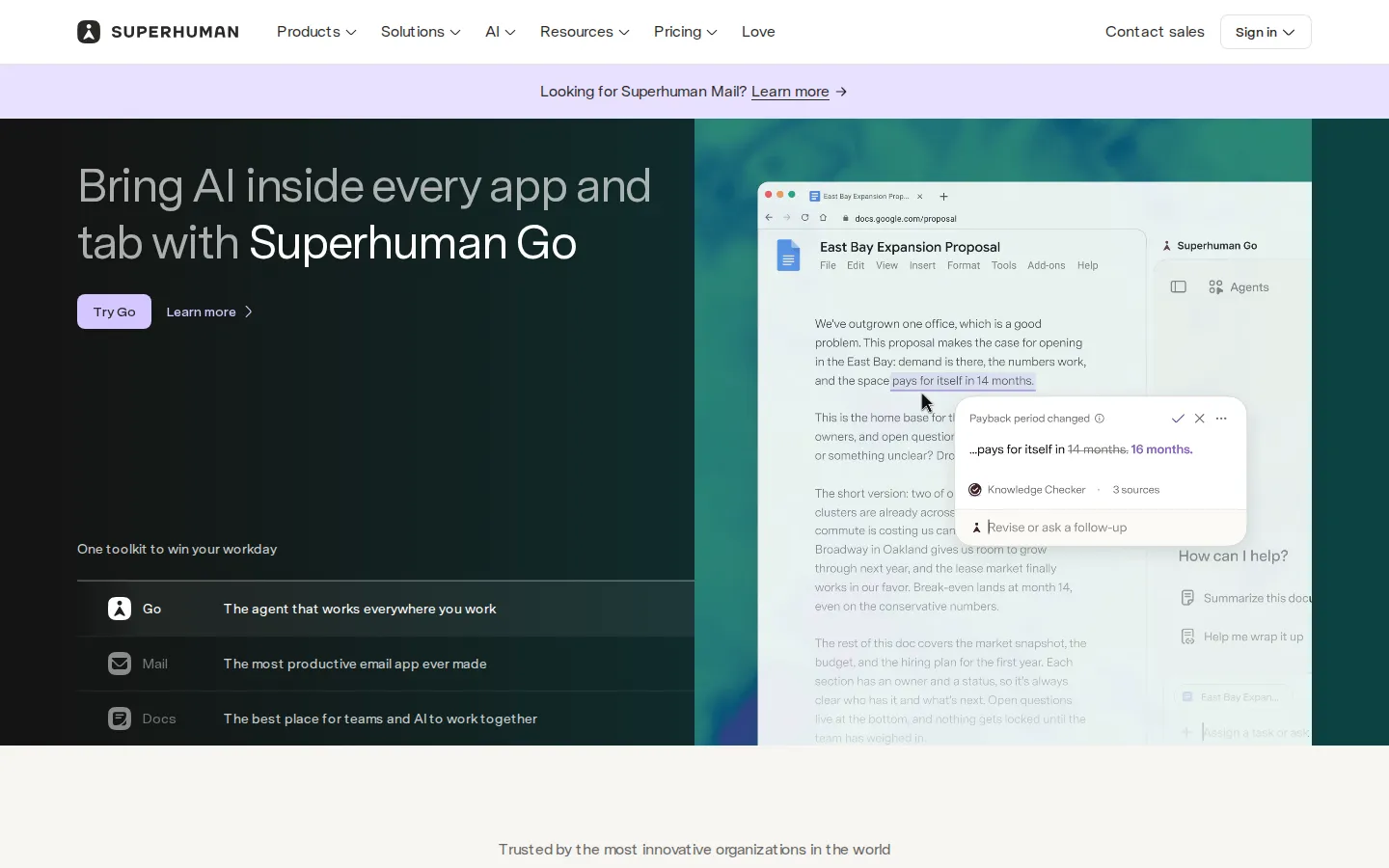
Superhuman is an AI productivity suite that puts a single assistant, Superhuman Go, on top of the email, calendar, document and database tools a team already uses. The company started as a keyboard-driven email client and now sells a platform: Go for agents that work inside other apps, Mail for the inbox, Calendar for scheduling, Docs for collaborative documents and Databases for structured team data. Go is the layer that ties them together. It runs beside whatever app is on screen, reading context and underlining suggested edits mid-sentence, and it also has its own app where you queue tasks and manage several agents at once. Underneath sit connectors, including Mail MCP and Docs MCP, that let agents read and write across the suite and supported outside tools, plus a store of prebuilt agents from Superhuman and partners; the site advertises more than 100.
The agent catalogue is where most of the day-to-day value sits. Grammarly reviews writing, Email Assistant drafts replies and clears noise, Auto Labels files incoming mail by priority, Auto Archive removes marketing and cold pitches, and Auto Drafts leaves a folder of replies written in your voice. Humanizer rewrites AI text so it reads naturally, Knowledge Checker verifies claims against company data and fixes them inline, and AI Detector scores how much of a draft looks machine-written. Daily Briefs collect deadlines, commitments and meetings into one view, and a scheduling agent finds a slot, drafts the invite and sends it to you for approval. Teams can build their own agents by describing them in chat or stepping through a visual builder, then share them with colleagues or publish them to a company directory so everyone benefits.
Mail remains the anchor product and is marketed around saving four or more hours a week, with split inboxes, booking links that stay current and AI drafts. Docs extends the same account into a workspace where documents, tables, projects and workflows live on one surface, and it can be drafted into by AI through Docs MCP. Enterprise adds single sign-on, admin security controls, team analytics and a customer success manager. Superhuman publishes logos of OpenAI, Figma, Cursor, Retool, Zapier and DoorDash as customers. A customer quote on the homepage makes the intended benefit concrete: people stay in one tab and finish the task instead of bouncing between tools. The suite also has an enterprise rollout page, and the Superhuman Store distributes both agents and connectors, so an administrator can standardise which assistants a team reaches rather than leaving that to individual habit. Everything is sold per member, billed annually on the published page, across Starter and Business tiers with a contact-sales Enterprise tier.
Superhuman Core Features
Go inline suggestions
Agents underline what needs attention while you type, so edits, unsupported claims and small mistakes surface mid-sentence without leaving the app.
Cross-app assistant
Chat about whatever is on screen with Go beside you, or open the Go app to launch several tasks and manage the agents running them.
Agent builder and store
Describe an agent in chat or step through a visual builder, then share it or browse 100+ prebuilt agents from Superhuman and partners.
Email Assistant and Auto Drafts
Drafts are written from inbox, calendar and web context, so a folder of replies in your voice is waiting when you start.
Inbox triage
Auto Labels files incoming mail by priority and context, while Auto Archive removes marketing, cold pitches and social network updates before you see them.
Writing agents
Grammarly suggests edits, Humanizer makes AI text sound natural, Knowledge Checker verifies claims against company data and AI Detector scores AI-likeness.
Calendar and scheduling
Share availability with booking links that stay current, or tell Go who to gather and approve the invite it drafts through Google Calendar.
Docs, Databases and MCP
Collaborative documents, tables, projects and workflows live on one surface, and Mail MCP plus Docs MCP let agents work with that content.
Who is Superhuman for?
Superhuman is built for teams whose day runs through email, meetings and shared documents, and the tiering shows it. Solo professionals and small groups land on Starter, which covers email productivity, Superhuman AI, team collaboration, calendar and scheduling, plus unified admin and billing. Revenue and customer-facing teams are pushed toward Business, where the advanced AI, auto drafts, Ask AI, custom auto labels and CRM integrations start to matter; the site markets separately to sales, marketing, IT and EPD teams, and offers an education route alongside enterprise. Individuals who want a faster inbox with an assistant that drafts and triages for them are the classic entry point, and writers or anyone publishing AI-assisted text get a second reason to stay, since Humanizer, Knowledge Checker and AI Detector address the specific worry of sounding generic or stating something you cannot support. Builders and operations people who like assembling their own workflows will care most about the no-code agent builder, the connector store and the ability to publish agents to a company directory. Organisations with compliance requirements are served by the Enterprise tier: single sign-on, admin security and controls, team analytics, a customer success manager and priority support. Buyers who only want a chat window with a model behind it, or who need a free tier before committing, will find this packaging heavier than they need, because every published plan is a paid per-member subscription billed annually. Two kinds of buyer get the least from it. Anyone whose work happens mostly outside email and documents will find the assistant's reach narrower than the marketing implies, and price-sensitive individuals comparing free chat assistants will struggle to justify a seat. Teams already paying separately for writing or scheduling tools should check overlap too, because grammar checking, booking links and document drafting all sit inside this one subscription, which is either consolidation or duplication depending on what you already own.
Superhuman Use Cases
Clear a crowded inbox each morning using Auto Labels, Auto Archive and pre-written Auto Drafts.
Prepare for a customer call by having a custom agent pull the relevant emails, notes and docs.
Turn rough meeting notes into a recap with owners and follow-ups ready to send attendees.
Schedule a multi-person meeting by telling Go who to gather and approving the drafted invite.
Check a proposal for unsupported claims against company data before it leaves the team.
Publish a shared agent to your company directory so teammates reuse the same workflow.
Consolidate project briefs, tables and workflows into one Docs surface instead of scattered files.
Give sales reps CRM-aware auto labels and drafts so follow-ups go out the same day.
Superhuman Pros and Cons
Pros
- One assistant covers email, calendar, docs and databases, so agents work inside tools a team already has rather than in a separate chat window.
- The agent catalogue is unusually concrete, naming writing, scheduling, triage and meeting-prep agents instead of leaving users to write generic prompts.
- Inline suggestions appear while typing, which keeps review in the document rather than in a side panel that has to be copied back.
- Enterprise bundles single sign-on, admin controls, team analytics and a success manager, and Business pricing drops 15% from five seats.
Cons
- Every published plan is per member and billed annually, so a small team pays business rates up front before knowing whether the agents earn their keep.
- Plan details are split across product-specific routes (Go + Agents, Mail, Docs, Suite), which makes comparing what a given seat actually unlocks harder than one table would.
- Agent access to mail and docs runs through MCP connectors; the sources document no general-purpose REST API, so custom integrations depend on what those connectors expose.
FAQ About Superhuman
Superhuman Pricing
Superhuman is sold per member, and the published numbers use annual billing: Starter is $25 per member per month and Business is $33 per member per month, with Business discounted 15% for teams of five or more. A monthly and annual toggle advertises 17% off annual billing, so monthly seats cost more than the figures above. Enterprise is priced as Let's talk via contact sales and adds SSO, admin controls, team analytics, a customer success manager and priority support. The rendered pricing page sits on the Mail route; the site also splits pricing into Go + Agents, Docs and full Superhuman Suite pages, so confirm which plan covers the products you need before buying.
Check official pricingSuperhuman Alternatives

Synthesise AI
Synthesise AI turns your expertise into a sellable digital product. It calculates a Unique Value Zone from audience demand and your own skills, then generates a fully populated product charter and framework you can package into a course, playbook or paid digital program. One plan costs $2,999 one-time, with unlimited credits and a personalised dashboard.

warmwind
warmwind gives you AI workers that each control a separate cloud desktop, logging into portals, clicking through apps and moving data the way a person would. You teach a task once, set a schedule, and the worker repeats it unattended, even while you are offline. German hosting, credit-based pricing and a free plan to start.

siift
siift is an AI decision platform for founders and business teams that need a clearer direction. It maps your business on an intelligent canvas, turns assumptions into evidence-scored research, and prioritizes what to do next. A shared context system keeps strategy, actions and results aligned across teammates and outside AI assistants, so progress compounds instead of scattering.