
Solid
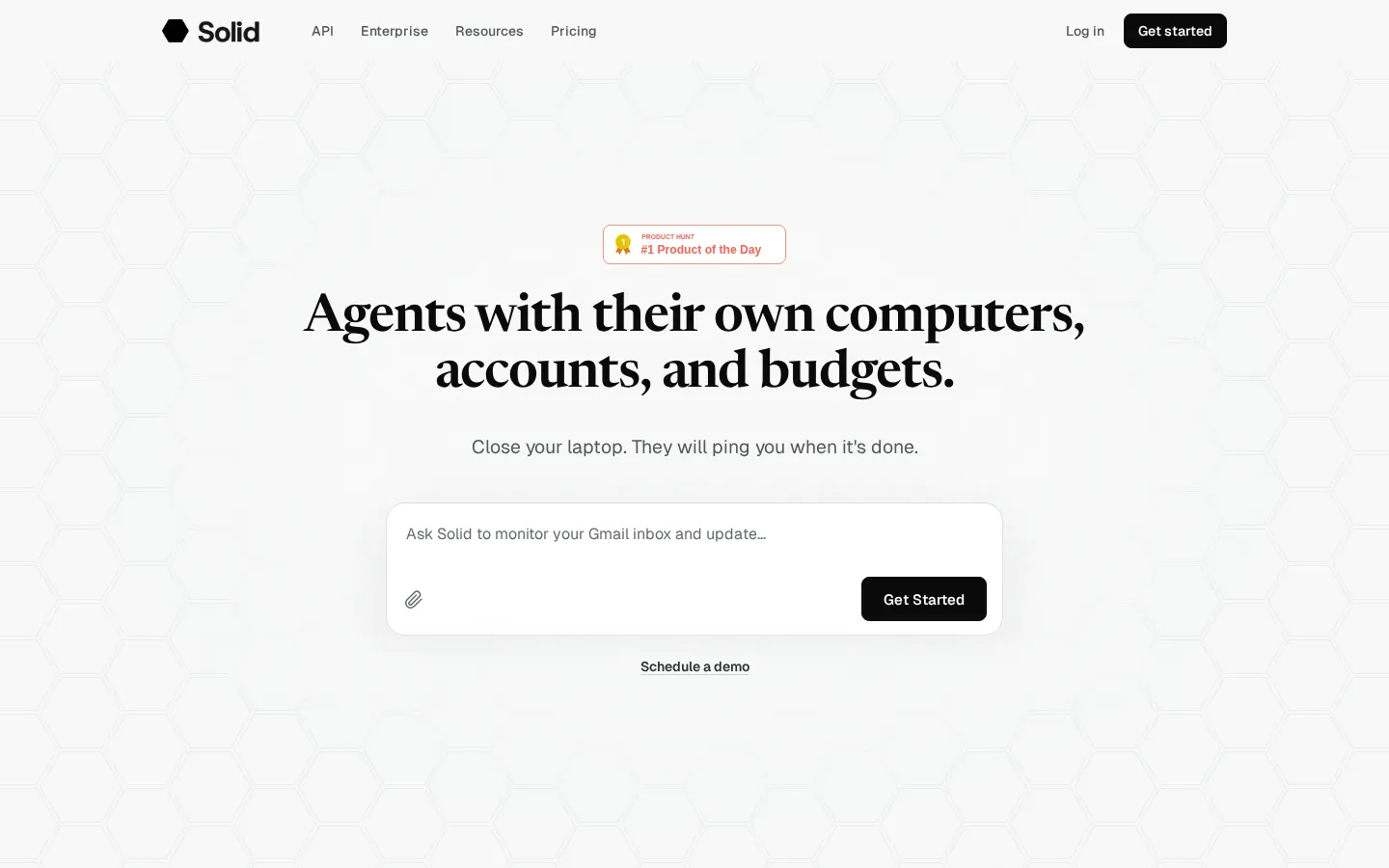
Solid is an AI agent platform where every agent gets its own computers, accounts, and budget. Describe the job, set approval rules, and close your laptop: the agent works out the steps, uses or builds the tools it needs, checks the result, and messages you with a finished deliverable you can review, test, and share.
What is Solid?
Solid is an AI agent platform built on a simple premise: useful agents need more than a chat window. Each Solid agent gets its own computers, its own accounts, and its own budget, so it can take a goal and deliver a finished result rather than a list of suggested next steps. You describe the job in plain language, grant the access it needs, and decide which actions require your approval. The agent works out the steps, connects to the tools involved, builds anything that is missing, checks its own output, and messages you when the work is ready to review or share.
Unusually, Solid does not depend on a catalogue of prebuilt connectors. If a person can use a piece of software, the agent is expected to use it too, whether that means calling an API, writing a missing integration, or operating a website, desktop application, or phone app directly. Agents run across Windows and macOS computers, Linux servers, and iOS and Android devices, and they can create their own Google or Apple accounts when a service demands one. They can also sign up for and pay for services, staying inside the budgets and approval rules you define.
Autonomy is handled in layers the company calls self-healing, self-improving, and self-scaling. When a tool breaks or a setup fails, the agent investigates, repairs what it can, and re-checks that the job still runs; if it stays blocked it explains the obstacle instead of failing silently. Corrections from your team are kept as lessons that shape later jobs, so you should not have to repeat the same instruction twice. For larger jobs, an agent can spin up additional Solid agents or bring in coding agents such as Codex and Claude Code, divide the work, coordinate the group, and return one checked result.
Documented example workflows include turning customer meeting notes into a hosted, tested sales demo; researching LinkedIn leads and drafting outreach for approval before follow-up and CRM updates; building AI product evaluations after each release; resolving a production alert into a reviewed fix; and working a stalled support ticket through to a recorded resolution. Billing runs on monthly credit plans — Mini at $20, Basic at $40, Pro at $160, and Max at $640 — where AI usage, machines, and agent purchases all draw from a single balance with no separate platform fee. A trial is offered, and API access plus enterprise deployment options support teams that want these agents inside their own products, VPCs, or on-premises infrastructure.
Solid Core Features
Own computers and devices
Agents run on Windows and macOS machines, Linux servers, and iOS and Android phones, with as many as the job needs drawn from your balance.
Own accounts and budgets
Each agent can create Google or Apple accounts and sign up for services, paying from a balance governed by your budgets and approval rules.
No connector requirement
Agents call APIs, write missing integrations, or operate websites, desktop software, and phone apps directly instead of waiting for a prebuilt connector.
Self-healing execution
When a tool or setup fails, the agent investigates the fault, makes a repair, re-checks that the job runs, and explains any blocker it cannot clear.
Learning across jobs
Corrections from your team are retained as reusable lessons that change how the agent uses tools and approaches similar work next time.
Agent team scaling
A lead agent can create more Solid agents or bring in Codex and Claude Code, split the work, coordinate the group, and return one checked result.
Spending transparency
Agents are meta-agents that can see their own workspace, so you can ask what a job cost and get a breakdown of AI, machines, and purchases.
API and enterprise deployment
Always-on agents can be embedded in your product or run on Solid Cloud, in your own VPC, or on-premises depending on your setup.
Who is Solid for?
Solid is aimed at builders and operators inside companies that have recurring work which is too fiddly for classic no-code automation but too small to justify a dedicated engineering project. The company says its users include people at Revolut, ElevenLabs, EY, British Airways, NVIDIA, Stanford, MIT, Berkeley, NYU, Swiggy, TELUS Digital, and the UK Government Digital Service, which points to a mix of startups, large enterprises, universities, and public sector teams. Typical fits are sales and revenue operations teams that want researched lead lists, outreach drafted for approval, and CRM records updated; support teams that need stalled tickets investigated across several systems and resolved within policy; engineering teams that want production alerts reproduced, fixed, and verified before a human reviews the pull request; and product teams running AI evaluations after every release. Founders and small teams use it to build and host internal dashboards or small web apps without hiring a developer. Anyone who loses hours each week copying data between tools, chasing status across dashboards, or rebuilding the same report on a schedule is a reasonable candidate. It is a weaker fit for people who mainly want a conversational assistant to think alongside them, since Solid is oriented toward delegated, checkable work rather than open-ended chat. Teams that need strict determinism, fully audited workflows on day one, or no third-party processing should look closely at the enterprise controls and deployment options before committing, and very low-volume users may find that a single focused task does not justify a monthly credit plan. Platform teams embedding agents in their own products, and organisations that need agents inside their own VPC or on-premises environment, are served through the API and enterprise offering rather than the self-serve plans.
Solid Use Cases
Turn customer meeting notes into a tested, hosted sales demo and share the link.
Research LinkedIn accounts against your ideal customer profile and draft outreach for approval.
Update a live dashboard automatically when source data or pipeline stages change.
Investigate a stalled support ticket across systems and apply a fix within policy.
Reproduce a production alert, open a tested fix, and verify recovery after deployment.
Build and run AI product evaluations after each release, then report pass and fail reasons.
Assemble a recurring weekly report by pulling from email, CRM, and internal tools.
Embed always-on agents inside your own product using the Solid API.
Solid Pros and Cons
Pros
- Genuinely unattended execution: agents keep working after you close your laptop and message you with a finished, checked result rather than a to-do list.
- No prebuilt connector dependency, so agents can reach software through APIs, custom integrations, or by operating the interface like a person would.
- Clear, unusual cost model where AI usage, machines, and agent purchases draw from one credit balance with no separate platform fee.
- Documented end-to-end workflows with visible step logs and test evidence, which makes results easier to review and trust.
- API and enterprise paths, including VPC and on-premises options, for teams that need agents inside their own infrastructure.
Cons
- Usage-based credits make total monthly spend hard to predict in advance, since heavier machine use consumes the balance faster.
- Credential-heavy autonomy raises real governance questions, and approval rules and access scoping need deliberate setup before delegating.
- Pricing starts at $20 per month with no permanent free tier advertised, so casual evaluation depends on the trial, and complex regulated workflows may still need human checkpoints.
FAQ About Solid
Solid Pricing
Monthly credit plans with no extra platform fee: Mini $20/month ($20 credits), Basic $40/month ($40 credits), Pro $160/month ($180 credits, 12.5% bonus), and Max $640/month ($800 credits, 25% bonus). AI usage, machines, and agent purchases all draw from the same balance. A trial is available, and team or enterprise pricing is quoted on request.
Check official pricingSolid Alternatives

Motion
Motion is a video agent from Mosaic that turns a written brief, raw footage or a reference clip into an edited video. It plans the story, generates or cuts shots, adds music and sound, then lets you refine the result in chat, on the preview or in a timeline before exporting to Premiere Pro, After Effects or DaVinci Resolve.

Cotlet
Cotlet is a hosted MCP server and REST API for apps with no API. Cotlet builds and maintains each integration and fixes it when the app changes. Cotlet is operated by Take Group sp. z o.o., Katowice, Poland.

Buddy
Buddy is a DevOps and platform-engineering automation suite for building, testing and shipping software. It pairs visual and YAML CI/CD pipelines with deployments to thousands of targets, ephemeral cloud sandboxes, tunnels, domains and visual regression tests. Its AI angle is agentic: a hosted MCP server, the bdy CLI and agent skills let Claude Code, Codex and Cursor run pipelines and deploy.