
SiRay
SiRay.AI is an AI infrastructure platform from RUNEX AI that puts 300+ generative models behind one API. Claude, GPT, Gemini, Grok, DeepSeek, Qwen, Flux, Wan, Seedance, Kling and Midjourney are all callable with one key, billed per token, image or video second, with no subscription. It also carries uncensored model variants and claims roughly 30% average savings through intelligent routing.
What is SiRay?
SiRay (SiRay.AI) is an AI model aggregation and inference platform that gives developers one API key for more than 300 generative models from providers including Anthropic, OpenAI, Google, xAI, DeepSeek, Alibaba (Qwen and Wan), ByteDance (Seedance and Seedream), Moonshot AI, MiniMax, Kuaishou (Kling), Vidu, PixVerse, Lightricks, Midjourney, Tencent and Black Forest Labs. Instead of signing separate contracts with each vendor, teams point a single base URL at SiRay and call chat, image and video endpoints with a consistent request shape.
The catalog is organised into three endpoint families. The Chat tab lists text and multimodal models with input and output prices per million tokens, for example anthropic/claude-haiku-5.5 at $0.09/$0.45 and openai/gpt-5-nano at $0.04/$0.32. The Image tab prices work per image, from $0.004 for gpt-image-2.5 and z-image-turbo up to $0.10 for tencent/hunyuan-image-3. The Video tab prices per second of output, from $0.016 for vidu-q2 up to $0.41 for flux-3-v2v. Chat covers Claude 5.5, GPT-6, Gemini 3.1, Grok 4.1, Kimi K3, GLM 5.2 and DeepSeek V4; image covers Midjourney V7, Nano Banana, Seedream 5.0 and Flux Kontext; video covers Wan 3.0, Veo 3.1, Seedance 2.5 and Kling 3.0.
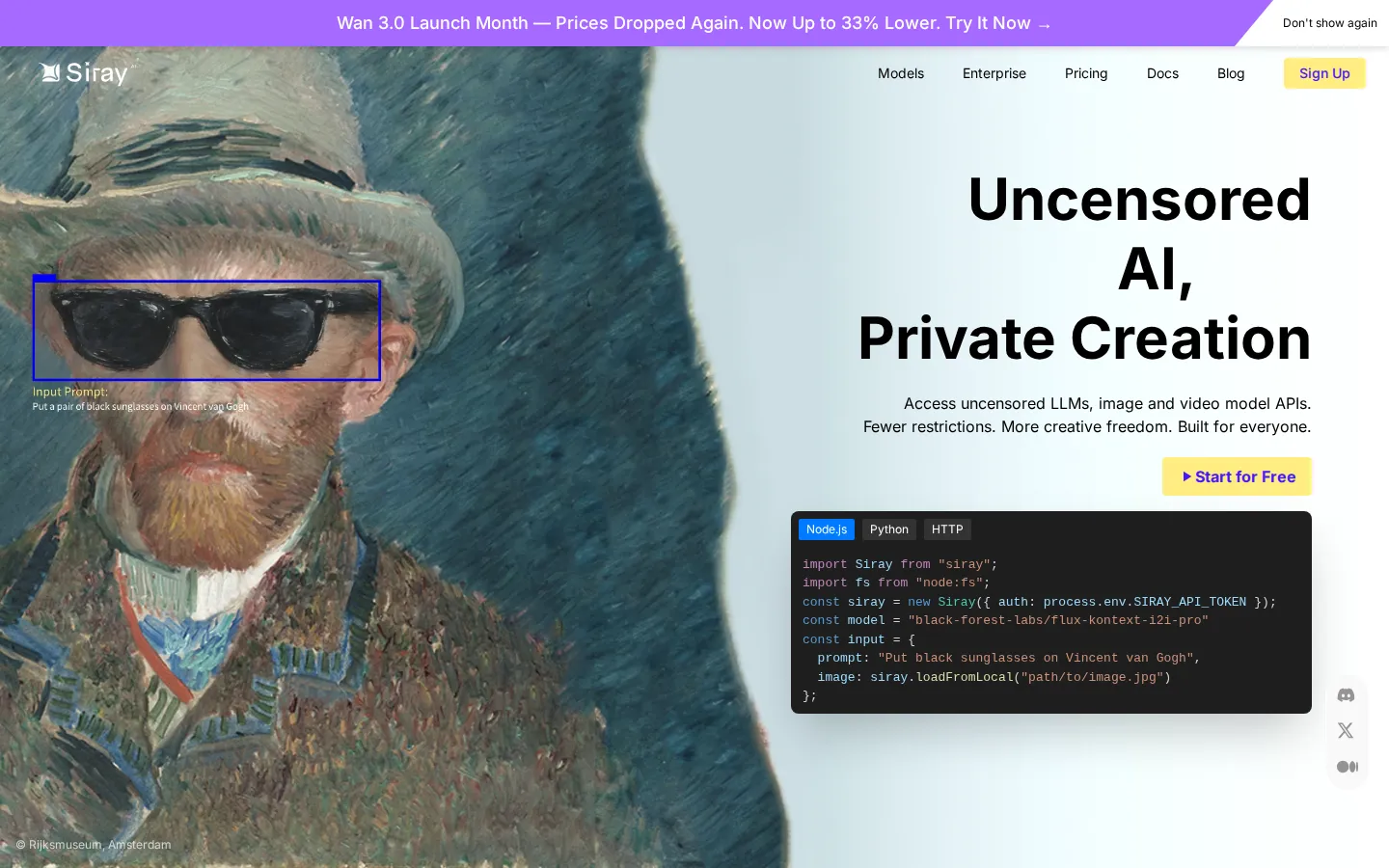
Positioning is explicit about content policy: the homepage promises uncensored LLMs plus image and video APIs, with fewer restrictions and more creative freedom, and several catalog entries carry a spicy or uncensored suffix. SiRay also markets reliability and cost: 300+ LLMs, roughly 30% average savings claimed from intelligent routing, a 99.9% uptime guarantee, about 10ms routing overhead and 15+ global data centres, with SOC 2 compliance and zero data retention named on the trust panel.
Integration is deliberately light. SiRay ships a Node.js SDK, a Python client, and a raw HTTP endpoint at api.siray.ai/v1 with asynchronous task polling for image and video jobs. Accounts are created in the console at console.siray.ai, where API keys, model browsing and spend live. Model detail pages expose context windows and per-unit rates before you spend anything, and the console tracks what each key has consumed, which matters when several products share one account. The docs at docs.siray.ai cover authentication, model slugs and asynchronous job handling, and onboarding follows four published steps: sign up, grab a key, point your base URL at SiRay, then run a first call. Billing is pure pay-as-you-go: credits are consumed per token, per image or per video second, and at least one chat model, z-ai/glm-4.6v-flash, is listed at $0/$0. Enterprise buyers request volume terms through the contacts page.
SiRay Core Features
Unified multi-model API
One key and one base URL cover 300+ chat, image and video models from Anthropic, OpenAI, Google, xAI, DeepSeek, Alibaba, ByteDance and others.
Uncensored model line-up
Spicy and uncensored variants of Wan, Seedance, Seedream, Qwen Image and MiniMax video models are listed openly with published rates.
Per-unit pay-as-you-go billing
Chat is priced per million tokens, images per image and video per second of output, so spend tracks usage without seat licences.
Official SDKs and REST endpoints
Node.js and Python clients wrap the same models, and a plain HTTP endpoint at api.siray.ai/v1 handles asynchronous job polling.
Intelligent routing and low overhead
SiRay advertises roughly 10ms routing overhead, about 30% average cost savings and a 99.9% uptime guarantee.
Global infrastructure footprint
More than 15 data centres, GPU capacity and local acceleration are offered for low-latency inference across regions.
Enterprise trust controls
SOC 2 compliance, zero data retention and a dedicated enterprise contact path support security and procurement review.
Model marketplace console
A browsable catalog with per-model pricing, context limits and detail pages makes comparison and switching straightforward.
Who is SiRay for?
SiRay suits teams that consume many generative models and would rather manage one vendor relationship than a dozen: - Application developers and backend engineers who want a single OpenAI-style endpoint and one API key across Claude, GPT, Gemini, DeepSeek and Qwen instead of five accounts, invoices and rate-limit dashboards. - AI product teams and startups prototyping multi-model features, where swapping a chat model or adding an image or video step should be a one-line change rather than a new integration project. - Creative studios, video editors and motion designers who need Veo, Wan, Seedance, Kling, Midjourney and Flux inside the same pipeline, and who value less restrictive variants for stylised concept work. - Marketing and content agencies producing bulk visuals and short-form video, where per-image and per-second billing maps onto client project costs and no seats are wasted in quiet months. - Indie hackers and solo builders testing an idea cheaply, since signup is free, a $0 chat model is available and spend scales only with real traffic. - Enterprise platform and procurement teams evaluating a secondary provider for redundancy, regional routing and cost arbitrage, with SOC 2, ZDR and an enterprise contact channel to review. - Researchers and evaluation engineers running side-by-side comparisons, who can send identical prompts to dozens of providers and keep every result under one billing account instead of reconciling separate credits. It is a weaker fit for teams that need native vendor features on day one, such as Anthropic prompt caching controls or OpenAI fine-tuning, because aggregation layers usually expose the common surface first and the long tail later. Teams with strict data-residency requirements should also confirm which region serves their traffic before committing production volume. Workflows that depend on a single model's exact tokenizer and sampling behaviour may also see small output differences through a gateway, so regression tests are worth running before a migration.
SiRay Use Cases
Ship a multi-model chatbot that routes cheap queries to DeepSeek and complex ones to Claude or GPT.
Generate marketing imagery in bulk with Flux, Nano Banana and Seedream at per-image rates.
Produce short-form video ads from still images using Wan 3.0, Kling or Seedance image-to-video endpoints.
Prototype uncensored creative concepts without rebuilding a separate integration for each restricted vendor.
Cut inference spend by testing one prompt across providers and keeping the cheapest acceptable model.
Add a secondary API provider for failover so a single vendor outage cannot stop production traffic.
Benchmark latency and output quality across hundreds of models from a single billing account.
SiRay Pros and Cons
Pros
- One integration and one invoice cover chat, image and video models from a dozen upstream vendors.
- Published per-token, per-image and per-second rates make cost forecasting and model comparison straightforward.
- Rare inventory for this price point: uncensored variants alongside Midjourney, Kling, Veo and Flux in one catalog.
- Free signup, a $0 chat model and no subscription make the platform cheap to evaluate before committing.
Cons
- Aggregation adds a routing hop, so latency and access to brand-new vendor features can trail calling Anthropic or OpenAI directly.
- No published free credit amount and no self-serve SLA tiers; enterprise terms require a sales conversation.
- Uncensored and spicy model lines may conflict with upstream vendor terms or with app store and payment processor policies.
FAQ About SiRay
SiRay Pricing
SiRay bills purely pay-as-you-go with no subscription. Chat is priced per million tokens, for example claude-haiku-5.5 at $0.09/$0.45 in and out and gpt-5-nano at $0.04/$0.32; images are priced per generation from $0.004 to $0.10; video is priced per second of output from $0.016 to $0.41. Signup is free, z-ai/glm-4.6v-flash is listed at $0/$0, and enterprise volume terms are available on request.
Check official pricingFree Start
Free console signup with no card required; the catalog is browsable and z-ai/glm-4.6v-flash is priced at $0/$0 per million tokens.
Pay-as-You-Go Chat
Text and multimodal LLMs billed per million tokens, from openai/gpt-oss-20b at $0.024/$0.112 to openai/gpt-6-astra at $9.001/$45.045 in and out.
Pay-as-You-Go Image
Text-to-image and image editing billed per generated image, from $0.004 for gpt-image-2.5 and z-image-turbo to $0.10 for tencent/hunyuan-image-3.
Pay-as-You-Go Video
Text-to-video, image-to-video and reference-to-video billed per second of output, from $0.016 for vidu-q2 to $0.41 for flux-3-v2v.
Enterprise
Volume pricing, security review and dedicated support arranged through the Enterprise contact page; no public list price.
SiRay Alternatives

Inference.net
Inference.net is a managed inference platform and LLM gateway for production AI workloads. It serves open-source, custom, and fine-tuned models on optimized GPU infrastructure, adds request-level tracing and observability across any provider, and supports continuous evaluation plus fine-tuning from real production traces. Teams get lower latency, predictable per-token costs, SOC 2 Type II compliance, and 99.99% uptime.

Lenso
Lenso is an AI-powered reverse image search platform built on content-based image retrieval. Upload any photo and it returns five result categories — People, Places, Duplicates, Similar, and Related — each with source page links, domain and language filters, email alerts, saved collections, and Research Mode for ten times deeper results. A Developer plan adds the face search API.

Z.ai
Z.ai brings Zhipu AI's GLM models into a single workspace, combining a multimodal chatbot, an agent that handles research and data work, document and slides generation, and a full-stack web builder. Developers can plug the same models into editors through the GLM Coding Plan or call them through the model API, with per-token pricing for GLM-5.3 and GLM-5.3-Flash.