
Inference.net
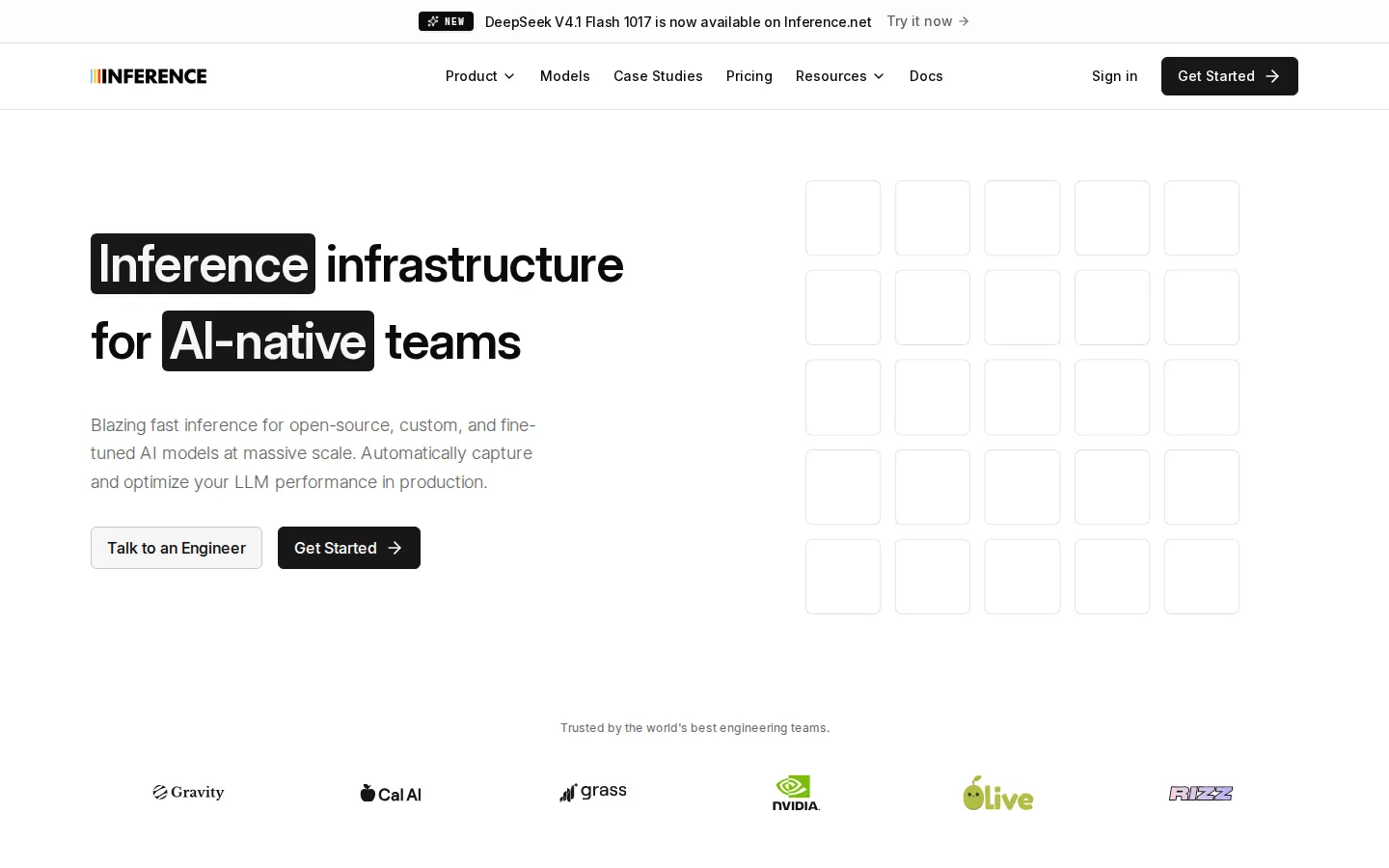
Inference.net is a managed inference platform and LLM gateway for production AI workloads. It serves open-source, custom, and fine-tuned models on optimized GPU infrastructure, adds request-level tracing and observability across any provider, and supports continuous evaluation plus fine-tuning from real production traces. Teams get lower latency, predictable per-token costs, SOC 2 Type II compliance, and 99.99% uptime.
What is Inference.net?
Inference.net is a managed inference and LLM observability platform for AI-native teams that need to run, monitor, and continuously improve production language model workloads. Rather than treating model serving as a single API call, it links four connected surfaces — Deploy, Observe, Train, and Evaluate — so the same production traffic that powers a product also becomes the raw material for making the model cheaper and better.
Deploy hosts open-source and custom models from a catalog spanning GLM, Kimi, MiniMax, GPT-OSS, DeepSeek, and the company's own open workhorse models, Cliptagger and Schematron. Instances run on B200-class GPUs at $9.98 per hour, across public cloud, private cloud, or hybrid environments, with a stated 99.99% uptime target. The practical pitch is substitution: replace OpenAI, Anthropic, or Gemini calls with open-weight equivalents on infrastructure tuned to your traffic, without rewriting application logic.
Observe is the monitoring half. An SDK installs in about five minutes and captures prompts, tool calls, responses, latency percentiles, error rates, payload sizes, and per-request cost, whichever provider served the request. That makes it usable as a neutral layer over a multi-provider stack, and the platform carries SOC 2 Type II certification with a zero data retention option for sensitive workloads.
Train and Evaluate close the loop. Production traces and evaluation failures turn into training datasets automatically, fine-tunes complete in minutes on frontier-level base models, and each new variant is scored against baseline behavior before any user sees it. Customers report concrete results: Cal AI describes a custom model that is more accurate, more affordable, and over 50% faster, while Gravity Ads cut p90 round-trip latency from 900ms to 240ms.
Two details separate it from a plain GPU reseller. The evaluation product is built around your own traces rather than public benchmarks, so scoring reflects real prompts and real failure modes. And the whole stack aims at one economic outcome: move traffic to a smaller fine-tuned model that still clears your quality bar, which cuts latency and cost per request at the same time.
Pricing follows usage rather than seats. A free pay-as-you-go tier includes one million gateway requests, one million tracing spans per month, 14-day retention, and a single seat; Growth is $250 per month with 50 million requests and spans, unlimited retention and seats, and a $50 opening credit; Enterprise adds committed-use contracts, dedicated infrastructure, custom trained models, and a direct support channel. For teams whose LLM bill has grown large enough to matter, the appeal is consolidating serving, observability, and fine-tuning into one vendor instead of stitching together three.
Inference.net Core Features
Model Catalog and Instant Deploy
Launch open-source and custom models including GLM, Kimi, MiniMax, GPT-OSS, and DeepSeek on B200 GPUs at $9.98 per hour, without managing clusters or drivers.
Any-Provider Observability
Capture traces from requests served by OpenAI, Anthropic, Gemini, or Inference.net itself, so one dashboard covers a mixed-provider stack instead of fragments per vendor.
Trace-Level Debugging
Inspect prompts, tool calls, responses, latency percentiles, payload sizes, and cost for every request, then search across events to move from symptom to root cause quickly.
Automated Fine-Tuning
Turn production traces and eval failures into curated training datasets, then fine-tune frontier-quality base models in minutes against your quality, cost, and latency targets.
Continuous Evaluation
Build eval datasets from live traffic, score variants with automated checks plus human review, and detect regressions before a new model reaches users.
Pre-Promotion Validation
Compare each candidate model against baseline behavior automatically, so you know exactly what improved and what degraded before shipping the change.
Flexible Deployment Environments
Run workloads on public cloud, private cloud, or hybrid infrastructure, with dedicated deployment limits and custom trained models on the Enterprise tier.
SOC 2 Type II and Zero Data Retention
Security posture suited to regulated buyers, with a public trust center and an option to keep prompt data out of retention entirely.
Who is Inference.net for?
AI-native startups shipping LLM features inside a real product are the clearest fit. They usually start on a frontier API, watch spend climb as usage grows, and need a like-for-like swap to open-weight models plus the evidence to justify the migration. The free pay-as-you-go tier lets one engineer prove latency and quality before anyone signs a contract, which matters when there is no dedicated platform team yet. Platform and ML infrastructure engineers who own model serving care about throughput, uptime, GPU utilization, and predictable p90 latency. They get a managed endpoint, private or hybrid deployment options, and trace-level visibility into every request path, including tool calls and downstream provider behavior, so incidents are diagnosed from evidence instead of guesswork. The OpenAI-compatible surface means existing client code and retry logic usually survive the move intact. AI product managers use the evaluation surface to answer whether a cheaper model is actually good enough. Building eval sets from production traces and scoring variants against baseline gives them a defensible answer before shipping a swap or a retrain, which is usually where these decisions stall. Companies with narrow, repetitive workloads — classification, extraction, routing, structured output, support triage — often beat general frontier models with a small fine-tune. Automated data curation turns observed traces and eval failures into training sets, so the work does not demand a dedicated ML research team or a long annotation project. Enterprises facing procurement and security review get SOC 2 Type II certification, a public trust center, zero data retention, private and hybrid deployment, unlimited retention and seats on Growth, and custom contracts with committed-use pricing. That combination is usually what unblocks a vendor in a regulated review, and the trust center shortens the questionnaire phase considerably. Agencies and product studios building AI features for several clients can keep multiple workloads in one dashboard, track cost per client, and reuse the same tracing setup across accounts instead of maintaining separate monitoring stacks for each engagement.
Inference.net Use Cases
Cut LLM spend by migrating frontier API traffic to cheaper open-weight models on optimized infrastructure.
Monitor production LLM latency, error rates, and per-request cost across every provider from one dashboard.
Fine-tune a domain-specific model on your own production traces without building a training pipeline.
Build evaluation datasets from real user traffic to prove a cheaper model meets your quality bar.
Debug failing agent workflows by replaying full traces including tool calls and downstream provider responses.
Replace a separate observability vendor by tracing requests served through OpenAI, Anthropic, or Gemini.
Serve a fine-tuned model on dedicated GPUs in public, private, or hybrid cloud with committed-use pricing.
Detect quality regressions automatically after a model or prompt change, before customers notice them.
Inference.net Pros and Cons
Pros
- Serving, tracing, evaluation, and fine-tuning sit in one platform, which removes the usual integration work between an inference vendor and a separate LLMOps tool.
- Pricing is published and legible: $9.98 per hour for B200 instances and a flat $250 Growth plan, with a free tier generous enough to finish a real pilot.
- Provider-agnostic observability, so the same tracing works whether traffic goes to open-weight models or to OpenAI, Anthropic, and Gemini.
- Case studies carry concrete numbers rather than adjectives, including a 900ms to 240ms p90 latency cut and a custom model that is over 50% faster.
- SOC 2 Type II certification, a public trust center, and zero data retention address enterprise security review early in the sales cycle.
Cons
- The public plan ladder is thin: pay-as-you-go and $250 Growth, then Enterprise, with no mid-tier for a team spending a few thousand dollars a month.
- Dedicated GPU deployments start at $9.98 per hour, roughly $7,200 monthly, so the model suits steady high-volume traffic rather than spiky or experimental workloads.
- Documentation and product language assume LLMOps fluency, so teams without an ML engineer may need the sales-led onboarding to get value from evaluation and training.
FAQ About Inference.net
Inference.net Pricing
Usage-based pay-as-you-go with a free tier, a flat $250 per month Growth plan, and custom Enterprise contracts. Self-serve inference capacity is billed at $9.98 per hour for a B200 instance, and monthly plans include credits spendable on fine-tuning, evals, gateway routing, and observability.
Check official pricingPay as you go
Free entry tier for evaluating the platform: 1M gateway requests, 1M tracing spans per month, 14-day retention, 1 seat, 30 req/min rate limit.
Growth
For production teams: $50 one-time opening credit, 50M gateway requests and 50M tracing spans per month, unlimited retention and seats, 250 req/min.
Dedicated GPU deployment
Self-serve hourly rate for hosting catalog or fine-tuned models on an NVIDIA B200 instance in public, private, or hybrid cloud.
Enterprise
Committed-use pricing, dedicated infrastructure and deployment limits, custom trained models, direct support channel, and bespoke contract terms.
Inference.net Alternatives

Lenso
Lenso is an AI-powered reverse image search platform built on content-based image retrieval. Upload any photo and it returns five result categories — People, Places, Duplicates, Similar, and Related — each with source page links, domain and language filters, email alerts, saved collections, and Research Mode for ten times deeper results. A Developer plan adds the face search API.

SiRay
SiRay.AI is an AI infrastructure platform from RUNEX AI that puts 300+ generative models behind one API. Claude, GPT, Gemini, Grok, DeepSeek, Qwen, Flux, Wan, Seedance, Kling and Midjourney are all callable with one key, billed per token, image or video second, with no subscription. It also carries uncensored model variants and claims roughly 30% average savings through intelligent routing.

Z.ai
Z.ai brings Zhipu AI's GLM models into a single workspace, combining a multimodal chatbot, an agent that handles research and data work, document and slides generation, and a full-stack web builder. Developers can plug the same models into editors through the GLM Coding Plan or call them through the model API, with per-token pricing for GLM-5.3 and GLM-5.3-Flash.