
Rool
Rool is a private AI machine in the cloud. Each workspace is a Linux computer hosted in the EU that holds your files, runs software, and keeps memory between tasks, powered by AI models Rool self-hosts. Start from a chat, connect tools through MCP connectors, invite teammates, and upgrade only when you outgrow the free plan.
What is Rool?
Rool is a cloud-hosted private AI workspace built on a simple claim: chat is only the surface, and behind every conversation there should be a real computer. Signing up provisions a Rool Machine, a private Linux computer running in EU data centres that holds your documents, images, spreadsheets, code, PDFs, audio and video alongside the conversation that produced them. Because the files and the assistant live in the same place, the machine can open a file, transform it, run software on it and save the result, without you uploading anything into a separate tool.
The second idea is memory. Chats, files and notes become durable Objects the machine can read, link and build on, so returning to a project weeks later restores the work and its context instead of an empty thread. Rool calls this Full Object Memory, and it is included on every plan, including the free one.
The AI models are self-hosted by Rool on infrastructure the company manages in the EU, so no API keys or third-party provider accounts are needed to begin, and the models work directly against the contents of your machine. Standard accounts get Rool 1; Plus and Pro add Rool 1.5, a stronger model, plus connectors and custom MCP servers that pull outside services into the workspace.
Sharing is built in: you can invite people into the same machine so they see the same files and memory, with real-time sync and undo history instead of emailed copies. Rool frames the business as selling the product, not the data: no ads, no third-party trackers, no training on your files, and the option to export a machine or reach it through the API. The company is Dublin-based and subject to Irish and EU data protection law, with iOS and Android apps so a machine is reachable away from the desk. Free accounts get 240 AI credits a day, refilled hourly; higher tiers raise that to 1,200 or 4,800 credits and add machines and storage, while the coming Team plan puts shared machines on one prepaid balance.
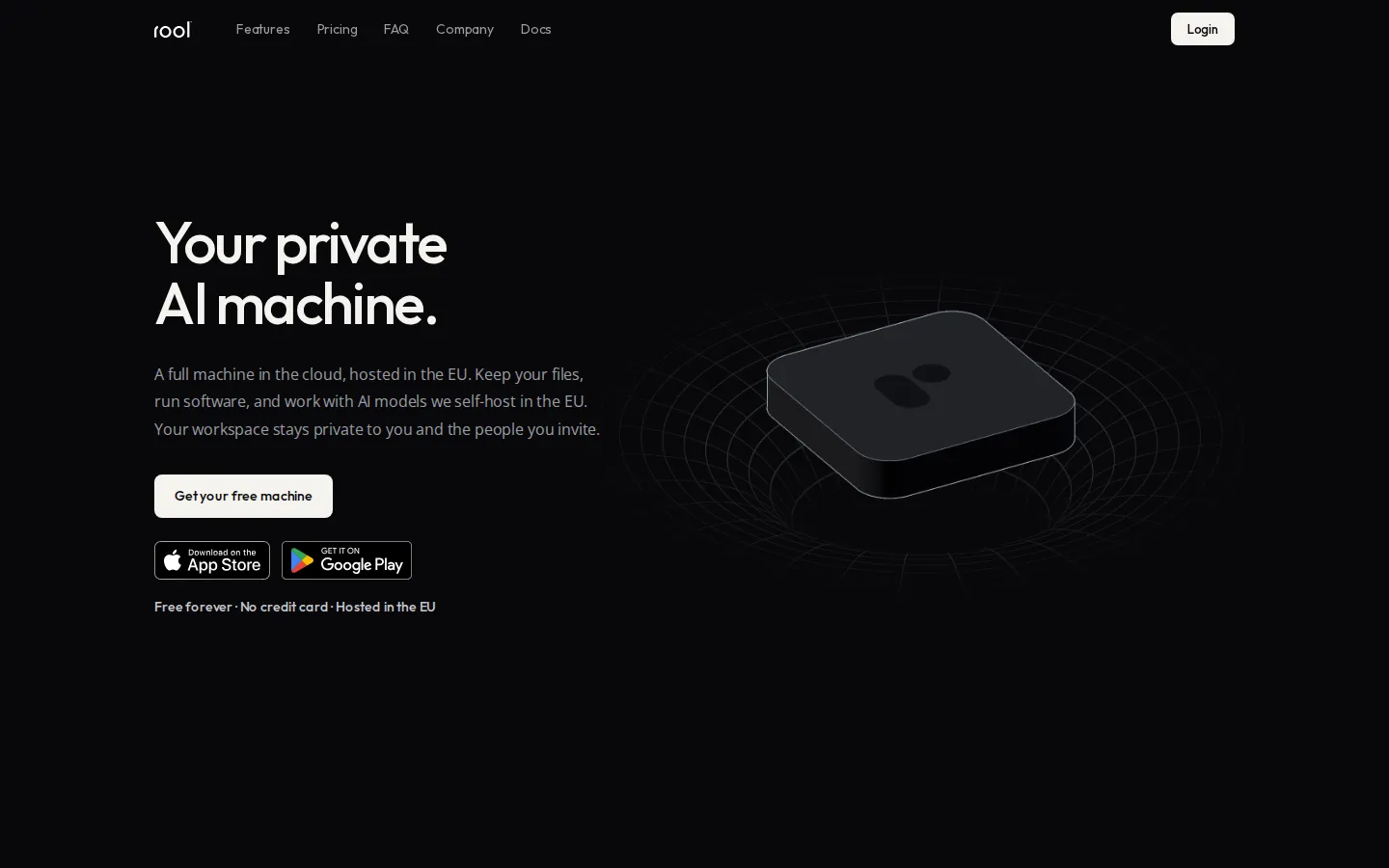
Rool Core Features
Private Rool Machine
Every workspace is a private Linux computer in the cloud that holds your files, runs software and keeps its own persistent state.
Full Object Memory
Chats, files and notes become durable linked Objects, so projects and decisions stay connected when you come back later.
Self-hosted EU AI models
Rool runs its own models, Rool 1 and the stronger Rool 1.5, on infrastructure it manages in the EU, with no API keys needed.
Real files, real output
Work with documents, images, spreadsheets, code, PDFs, audio and video, and have the machine create new files from them.
Connectors and custom MCP
Connect outside services to the machine through built-in connectors and custom MCP servers on the Plus and Pro plans.
Shared machines
Invite people into the same machine with access to the same files and memory, backed by real-time sync and undo history.
Privacy by design
No ads, no third-party trackers, no data sales and no training on your files, all under Irish and EU data protection law.
Mobile and export
Native iOS and Android apps keep the machine reachable, and you can export it or access it through Rool's API.
Who is Rool for?
Rool suits people who want one durable place where the AI and the work actually live together, rather than a chat window that forgets everything once the tab closes. It is less a chatbot with a pleasant interface and more a rented computer that happens to understand language, which shapes who gets the most out of it. Anyone whose day is spent moving between documents, tabs and half-finished drafts is in scope, but the fit is sharpest for the groups below. Freelancers and independent consultants are a natural fit. Client documents, drafts, invoices and notes accumulate in a single private machine that carries context from one engagement to the next, so you are not rebuilding the background every time you come back to the same client. Researchers, analysts and writers working across long projects benefit most from Full Object Memory. A source document, a rough note and a finished report stay linked instead of scattered across drives, bookmarks and chat histories, and returning a month later restores the thread rather than an empty prompt. Privacy-conscious professionals and EU-based organisations get a workspace hosted in the EU, run by a Dublin company under Irish and EU data protection law, with no ads, no third-party trackers and no training on their files. For anyone who has been told to stop pasting contracts into consumer chatbots, that is the whole point. Small teams and studios can invite colleagues into the same machine and share the files and memory inside it, with real-time sync and undo history, instead of emailing versions back and forth and losing track of which copy is current. Technical users who already run their own stack will appreciate connectors and custom MCP servers on Plus and Pro, a machine they can export, and API access when they want to wire Rool into something else entirely. If you have ever wanted a sandbox you can hand to an assistant and stop worrying about, that is close to the pitch here. Mobile-first users who want their workspace on a phone get native iOS and Android apps, so the same machine travels with them and a task started at a desk can be finished on a train. Larger businesses waiting on shared machines, prepaid balances and no per-seat fees are pointed at the Team plan, currently in early access.
Rool Use Cases
Turn a messy pile of meeting notes into a structured report without leaving the workspace.
Batch-process images, spreadsheets or PDFs with software running directly on your machine.
Keep a long research project's sources, drafts and decisions linked across months of work.
Draft, review and proofread client documents in a workspace that retains the earlier context.
Run quick calculations or small scripts against files already stored in the machine.
Share one machine with a small team so everyone works from the same files and memory.
Connect outside tools through MCP so the assistant can pull in services you already use.
Start a task on desktop and continue it from an iPhone or Android phone later.
Rool Pros and Cons
Pros
- A genuinely free tier: 240 AI credits a day refilled hourly, no card and no trial clock.
- Files, memory and the AI sit in one machine, so context survives between separate tasks.
- EU hosting with self-hosted models and a Dublin company under Irish and EU data law.
- Sharing a machine gives real collaboration on the same files, not copies passed around.
- Clear, low pricing: $10 for Plus and $29 for Pro, with cancel anytime and no lock-in.
Cons
- Plus and Pro were flagged as not available in every country at the time of research.
- Connectors, MCP and custom subdomains are locked behind the paid plans, not the free tier.
- The Team plan for businesses is still coming soon, so shared business billing is not live yet.
FAQ About Rool
Rool Pricing
Rool is freemium. Standard is free forever with 240 AI credits per day (refilling hourly to a 1,000 cap), two machines, 1 GB storage each, the Rool 1 model and Full Object Memory. Plus costs $10 per month for 1,200 credits a day, 2 GB per machine, Rool 1.5, a custom subdomain and connectors/MCP. Pro costs $29 per month for 4,800 credits, five machines, 10 GB each and priority support. A 5,000 credit voucher is $5 one-time. The Team plan is coming soon.
Check official pricingStandard
240 AI credits per day refilling hourly to 1,000, the Rool 1 model, 2 Rool Machines with 1 GB storage each, and Full Object Memory. No credit card, no trial clock.
Plus
5x Standard: 1,200 AI credits per day, the stronger Rool 1.5 model, 2 machines with 2 GB storage each, faster hourly refills to a 2,000 cap, custom subdomain, and connectors/MCP.
Pro
20x Standard: 4,800 AI credits per day, Rool 1.5, 5 machines with 10 GB storage each, refills to a 5,000 cap, custom subdomain, connectors/MCP and priority support from the Rool team.
Team
Shared Rool Machines for a business on one prepaid balance, with no seats and no subscription. Machines are billed by the second from $5 to $30 per month, and models are charged per million tokens.
Rool Alternatives

Motion
Motion is a video agent from Mosaic that turns a written brief, raw footage or a reference clip into an edited video. It plans the story, generates or cuts shots, adds music and sound, then lets you refine the result in chat, on the preview or in a timeline before exporting to Premiere Pro, After Effects or DaVinci Resolve.

Cotlet
Cotlet is a hosted MCP server and REST API for apps with no API. Cotlet builds and maintains each integration and fixes it when the app changes. Cotlet is operated by Take Group sp. z o.o., Katowice, Poland.

Buddy
Buddy is a DevOps and platform-engineering automation suite for building, testing and shipping software. It pairs visual and YAML CI/CD pipelines with deployments to thousands of targets, ephemeral cloud sandboxes, tunnels, domains and visual regression tests. Its AI angle is agentic: a hosted MCP server, the bdy CLI and agent skills let Claude Code, Codex and Cursor run pipelines and deploy.