
Pydantic
Pydantic is the company behind Pydantic Validation and a four-part AI engineering stack: Pydantic AI for type-safe Python agents, Logfire for OpenTelemetry traces and evaluations, Pydantic Evals for test datasets, and AI Gateway for one-key model routing with spend caps. Core libraries are open source; the hosted platform is metered with a free tier of 10 million records monthly.
What is Pydantic?
Pydantic is an AI engineering platform built around the Python data-validation library of the same name, and it bundles four products that cover the path from writing an agent to operating one in production.
Pydantic AI is the agent framework. Agents are declared in ordinary Python with a model string, instructions, typed dependencies and tools registered by decorator; JSON schemas are generated from type hints and docstrings, and structured outputs are validated into Pydantic models rather than parsed out of free text. It is model-agnostic, covering OpenAI, Anthropic, Google, Groq, Bedrock, Vertex, Azure and OpenAI-compatible endpoints, and supports MCP servers, streaming over AG-UI and the Vercel AI data stream protocol, graph-based multi-agent workflows, speech-to-speech realtime sessions and seven durable execution backends including Temporal, DBOS, Prefect, Restate and AWS Lambda. Agents can be unit tested without network calls using the bundled test and function models, and typed dependencies are injected so each tool can be exercised in isolation before a real provider is involved.
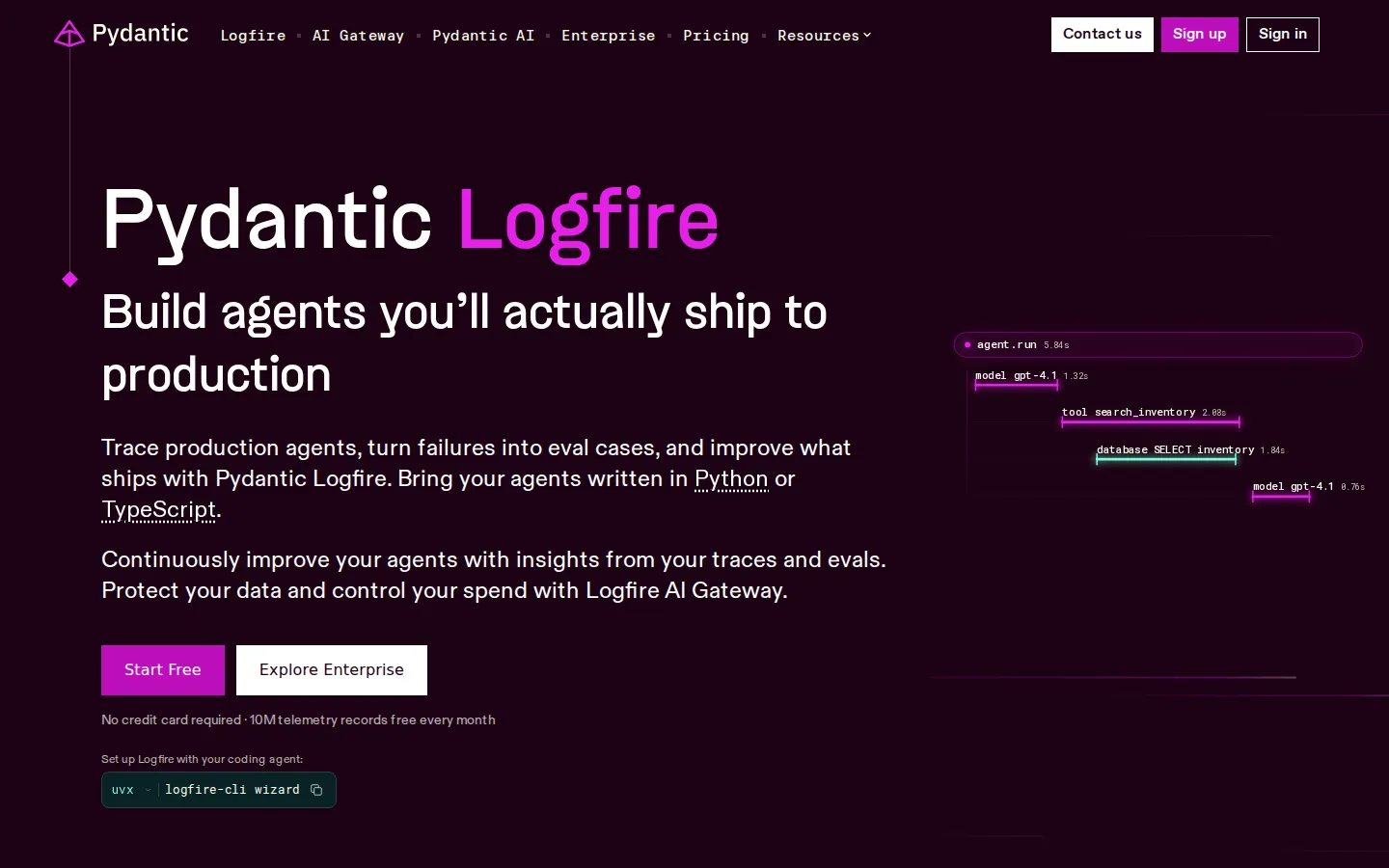
Pydantic Logfire is the observability and evaluation layer. It is built on OpenTelemetry, so a trace can hold the agent step, the model call, the tool invocation, the API request and the database query on one timeline, and it stores that telemetry as queryable data in PostgreSQL-compatible SQL. Because eval results live in the same tables, a question such as whether a new prompt version regressed on refund questions is a SQL query rather than a separate report. Native SDKs exist for Python, TypeScript and Rust, with standard OTel ingestion for everything else, and an MCP server lets a coding agent query production traces directly. Logfire also ships evals: datasets built from real traces, code assertions, LLM-as-a-judge rubrics, human annotation, live evaluation of production traffic, plus dashboards, alerts, cost tracking, feature flags and prompt rollouts without a redeploy.
Pydantic Evals is the open-source evaluation library behind that workflow, used from the CLI or pytest to score datasets and compare a candidate against a baseline. AI Gateway is the routing layer: one key across providers, requests passed through in each provider's native format, and spend limits per project, user or API key, available hosted through Logfire or self-hosted on Cloudflare for enterprise.
The open-source and paid split matters. Pydantic Validation is MIT licensed, Pydantic AI and Pydantic Evals are open source, and the Logfire SDK is MIT, while the hosted Logfire platform, the managed gateway and enterprise features such as SSO, self-hosting and long retention are the commercial products. The company reports 60,000+ GitHub stars and over a billion monthly downloads across its libraries. A fifth open-source project, Monty, provides a sandbox for running model-generated code.
Pydantic Core Features
Type-safe agents
Declare outputs, dependencies and tools as Pydantic models so every model response is validated at runtime and typed in the editor.
Model-agnostic providers
Point one Agent at OpenAI, Anthropic, Google, Groq, Bedrock, Vertex, Azure or any compatible endpoint and swap models with a string.
OpenTelemetry tracing
Logfire keeps agent, model, tool, API and database spans on one timeline, stored as queryable PostgreSQL-compatible SQL.
Production-sourced evals
Turn failed traces into datasets, score them with code assertions, LLM-as-a-judge rubrics or human review, and compare runs.
AI Gateway routing
One key across providers with native request formats, per-project, per-user or per-key spend caps and zero markup on bring-your-own keys.
Durable execution
Persist agent progress across retries and restarts with Temporal, DBOS, Prefect, Restate, AWS Lambda or pgtask backends.
MCP and streaming
Connect MCP servers for external tools, and stream text, tool calls and reasoning to a frontend over AG-UI or the Vercel AI data stream protocol.
Realtime voice
Open speech-to-speech sessions on an existing agent, with server-side tool calls, interruption handling and history handoff to a text run.
Who is Pydantic for?
Pydantic is aimed at engineering teams that build AI features in Python and then have to keep them working in production. The core audience is Python backend and AI engineers who already use Pydantic for request validation and want an agent framework that preserves the same type hints, editor completion and testability instead of a stringly typed prompt wrapper. It also suits platform and ML platform teams standardizing how dozens of services call models: one gateway for credentials and spend caps, one OpenTelemetry pipeline for traces, and one place where evaluation results sit next to the traces that produced them. AI product teams at startups use it to get from prototype to a monitored deployment without assembling four vendors, because the agent framework, tracing, evals and routing share data models and one sign-up. Site reliability and observability engineers like that Logfire is plain OpenTelemetry with Postgres-compatible SQL, so existing dashboards, alerts and retention habits carry over rather than being replaced. Quality and evaluation engineers use Pydantic Evals to turn production failures into datasets and score candidate prompts or models against a baseline, and to keep those suites running as the agent changes. Engineering managers and tech leads value that the same stack answers cost questions, such as which agent or model is burning budget, without a second billing integration. Enterprises in regulated industries, including finance and healthcare, are a strong fit because Logfire offers single-tenant, self-hosted and EU or US data regions plus HIPAA BAAs on higher tiers. It is a weaker fit for no-code teams, for JavaScript-only shops that want a fully managed agent builder, or for anyone expecting a visual prompt IDE rather than code. Solo hobbyists also hit the free tier's 30-day retention quickly once they want to compare a month of runs.
Pydantic Use Cases
Build a support agent whose refund decisions are validated against a typed schema before any action runs.
Trace a failing tool call through the model, the API and the database query in one Logfire trace.
Convert production failures into an eval dataset and prove a prompt change fixed them before deploying.
Route all LLM traffic through one gateway key and cap spend per project, user or API key.
Score candidate models against a baseline with LLM-as-a-judge rubrics and human annotation on the same traces.
Add durable execution so long-running agents resume after an API timeout or container restart.
Instrument an existing LangGraph, CrewAI or Vercel AI SDK app with OpenTelemetry and send traces to Logfire.
Ship a voice agent that streams audio, runs tools server-side and hands history to a structured follow-up.
Pydantic Pros and Cons
Pros
- Tight coherence between framework, tracing, evals and gateway: they share Pydantic models, one sign-up and one trace, removing the usual integration glue.
- Genuinely open core: Pydantic Validation, Pydantic AI and Pydantic Evals are permissively licensed, and the Logfire SDK is MIT with standard OpenTelemetry underneath, so instrumentation stays portable.
- The free tier is unusually usable: 10 million telemetry records a month, hard-capped at zero cost, covering traces, logs, metrics and three projects.
- Pricing is per-record rather than per-seat or per-host, with a spending cap, a money-back guarantee and no charge per evaluation score.
- Strong production credentials: 60,000+ GitHub stars, over a billion monthly downloads, and named customers including Atlassian, Cisco, Duolingo and JPMorgan Chase.
Cons
- The cheapest paid plan is $49 a month and caps teams at 12 seats with 30-day retention, so anyone needing longer history or more collaborators jumps to $249.
- The free Personal plan stops ingesting at 10 million records instead of billing overage, so a traffic spike can silently truncate telemetry.
- Python is clearly first class while TypeScript support is narrower, so JavaScript-only agent stacks get observability but not the full Pydantic AI framework experience.
FAQ About Pydantic
Pydantic Pricing
Freemium. Personal is free forever with 10 million telemetry records a month (a $20 credit), three projects, 30-day retention and one seat plus two read-only guests, hard-capped so it cannot generate a bill. Team costs $49 a month with the same 10 million records, $2 per million after, five seats included ($25 each extra, 12 maximum), evals and human annotation. Growth costs $249 a month with unlimited seats, guests and projects, 90-day retention, priority support and a boilerplate HIPAA BAA. Enterprise is custom with SLOs, SSO, SCIM, data loss prevention and cloud, dedicated or self-hosted deployment. Open-source libraries are free under permissive licences, and the AI Gateway adds no markup on bring-your-own keys.
Check official pricingPersonal
Free forever, no credit card. 10 million logs, spans and metrics a month hard-capped at $0, three projects, 30-day retention, one seat plus two read-only guests, AI Gateway with up to three BYO provider keys and community support.
Team
10 million records included then $2 per million, unlimited agents, services and hosts, AI output evaluations and human annotations at no per-score charge, five seats included with $25 per extra seat up to 12, five projects, 30-day retention, spending cap and money-back guarantee.
Growth
Everything in Team plus unlimited seats, guests and projects, up to 90-day retention, 5,000 query API requests a day, a public API, priority support, self-service GDPR data deletion and a boilerplate HIPAA BAA.
Enterprise
Observability SLOs with burn-rate alerts, SSO and SCIM, custom roles, data loss prevention, custom retention, volume-discounted usage and cloud, dedicated or self-hosted deployment with SLA-backed support.
Pydantic Alternatives

Cotlet
Cotlet is a hosted MCP server and REST API for apps with no API. Cotlet builds and maintains each integration and fixes it when the app changes. Cotlet is operated by Take Group sp. z o.o., Katowice, Poland.

Buddy
Buddy is a DevOps and platform-engineering automation suite for building, testing and shipping software. It pairs visual and YAML CI/CD pipelines with deployments to thousands of targets, ephemeral cloud sandboxes, tunnels, domains and visual regression tests. Its AI angle is agentic: a hosted MCP server, the bdy CLI and agent skills let Claude Code, Codex and Cursor run pipelines and deploy.

Weave
Weave is engineering intelligence software that scores every merged pull request in expert hours, tracks quality, review health and DORA delivery metrics, and attributes output to AI or human authorship. Wooly, its research agent, answers questions about the org with cited sources, while Token Intelligence ties AI spend to shipped work and benchmarks cost per merged PR.