
Openship
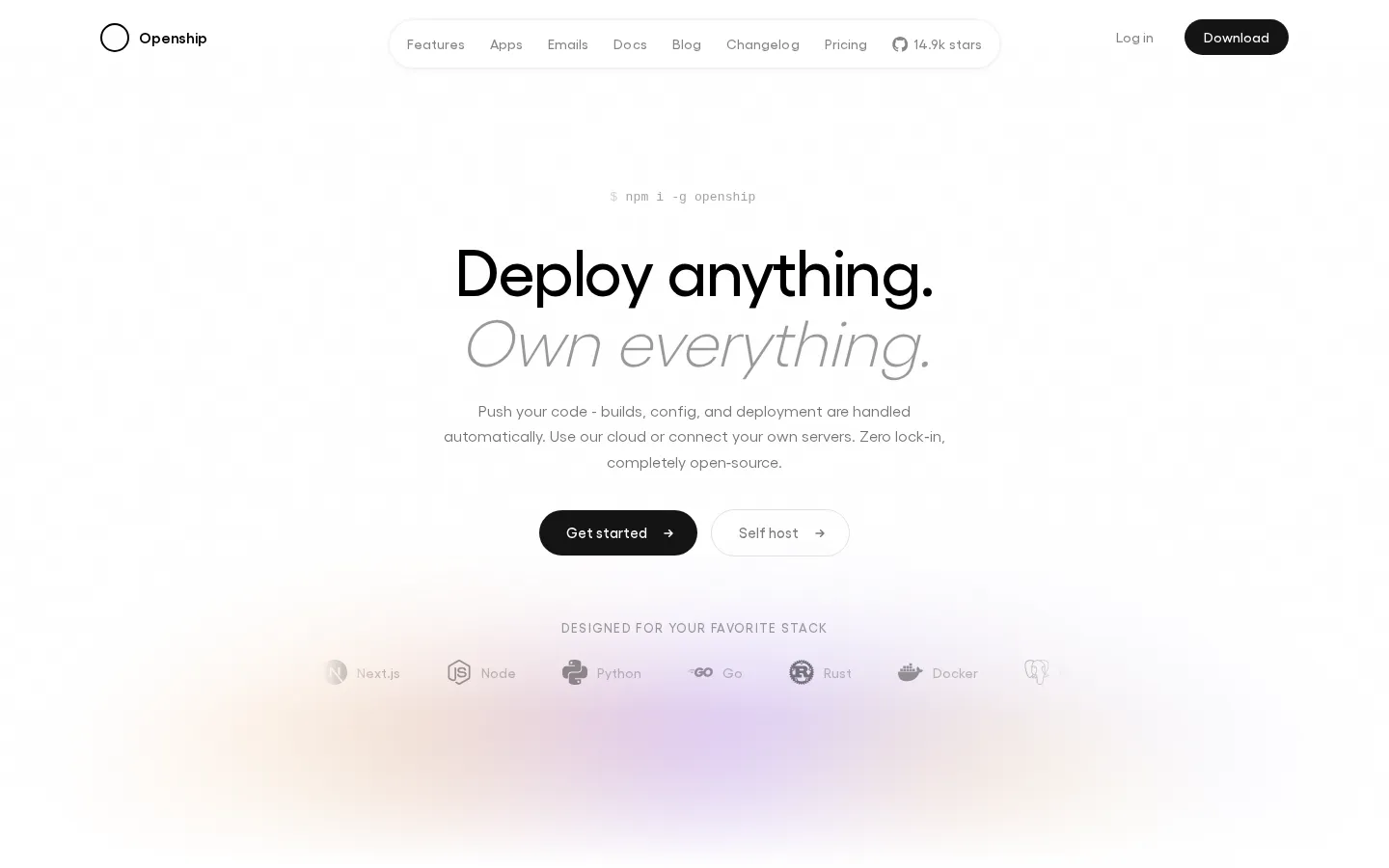
Openship is an open-source deployment platform with a CLI, web dashboard, and desktop app for macOS and Windows. It connects a git repository or local folder, detects your stack, builds an immutable image on your machine, ships it over SSH, and serves it with automatic HTTPS. Apps run on Openship Cloud or your own VPS, and any retained version restores in one click.
What is Openship?
Openship is an open-source deployment platform, licensed Apache 2.0 and built by Oblien LLC, that builds and runs web applications on Openship Cloud or on machines you already own. The problem it addresses is the trade-off most teams face: managed platforms such as Vercel and Netlify run everything for you but give you no way to take it back, while self-hosted control panels want a long-lived control-plane box that holds your source code and claims ports 80 and 443. Openship splits the work differently. The build happens on your machine or in the cloud, the resulting image streams to the target over plain SSH, and nothing is installed on the production host: no agent, no daemon, no dashboard. The source is public, telemetry is off by default, and the repository carries 14.9k GitHub stars.
You can start a deploy four ways: push to a connected branch, run openship up from the CLI, use the desktop app, or ask an AI agent over MCP to do it from Claude, Cursor, or any MCP client. Openship detects the stack, covering Node, Python, Go, Rust, PHP, Ruby, Java, .NET, Docker, and monorepos, runs the build, and tags the output as an immutable, versioned artifact. Project settings can live in openship.json, so build commands, environment variables, domains, services, and resource limits are reviewed in a pull request like the rest of the code. Each deployment joins managed Postgres, Redis, mail, and S3-compatible object storage on an isolated private network the internet cannot reach, while the OpenResty edge terminates domains with automatic Let's Encrypt certificates and swaps traffic to the new container without downtime. Previous versions stay warm, so rollback is one click and no rebuild.
Beyond deploying, the platform documents 45 capabilities grouped into deploy, run, connect, data, manage, secure, and collaborate. That covers streaming logs and live metrics, cron-like scheduled jobs, preview environments per branch, clusters with explicit replica counts, per-route rate limits and country or user-agent blocks, backups with chosen retention, a real mail server with the SPF, DKIM, and DMARC chain configured and outbound relay through Amazon SES or your own SMTP, plus 42 ready-to-deploy templates including Supabase, n8n, Ghost, PostgreSQL with pgAdmin, Gitea, Nextcloud, Umami, MinIO, and NocoDB. On the management side there is a documented HTTP API and TypeScript SDK, scoped access tokens, an audit trail, passkeys and two-factor sign-in, workspaces with owner, admin, and member roles, and per-resource permissions. Self-hosted installs also support instance export and transfer, moving the control plane between machines with reviewed credential handling. Pricing starts at $12 per month for a Hobby Cloud Space, self-hosting is free, and a $5 per month Manage plan drives your own servers from the hosted control plane.
Openship Core Features
Four deploy entry points
Start a build from a git push, the openship CLI, the macOS and Windows desktop app, or an AI agent over MCP, all against the same project configuration.
Build locally, ship over SSH
Images build on your machine or in the cloud, stream to the target as immutable versioned artifacts, and run without an agent or daemon installed on the host.
Stack detection and config as code
Node, Python, Go, Rust, PHP, Ruby, Java, .NET, Docker, and monorepos are detected, while openship.json keeps build, env, domain, and resource settings under review.
Private service network
Postgres, Redis, mail, and S3-compatible object storage join each app on an isolated network, reachable by the app but not by the internet.
Edge routing with automatic TLS
Domains resolve through OpenResty with Let's Encrypt certificates, per-route rate limits, country and user-agent filters, and zero-downtime traffic swaps.
Built-in mail server
One-click SPF, DKIM, and DMARC setup, unlimited sending domains, webmail, and outbound relay through Amazon SES or any SMTP provider, with open and click webhooks.
Operations and rollback
Streaming logs, live metrics, cron-like jobs, per-branch preview environments, explicit cluster replica counts, and one-click restore of any retained image.
API, SDK, and access control
A documented HTTP API and TypeScript SDK, scoped tokens for agents, audit history, passkeys or two-factor sign-in, workspaces, and per-resource permissions.
Who is Openship for?
Openship suits developers and small teams who want push-to-deploy convenience without handing their infrastructure to a managed platform. The clearest fits are: Solo developers and indie hackers running a side project or a handful of small apps, who would rather pay $12 a month, or nothing at all on their own VPS, than assemble a pipeline by hand. Small engineering teams of two to fifteen people who want preview environments, staging and production kept apart, and shared visibility into logs without hiring a platform engineer. Agencies and freelancers hosting client sites, who need per-project access control, custom domains with automatic certificates, and a handover where the client keeps running containers after the relationship ends. Teams with servers already in use, because Openship can adopt containers running on the box and coexist with an existing Traefik, nginx, or Caddy proxy instead of claiming those ports. Privacy- or compliance-sensitive teams in health, finance, or EU jurisdictions that must keep source code and data on machines they control, including a homelab or bare-metal rack. Developers working with AI agents who want Claude, Cursor, or another MCP client to trigger and inspect deploys through scoped tokens rather than a shared root credential. It is a weaker fit for non-technical users who want a website builder, and for teams that need a fully managed database with a contractual support SLA and no server of their own. Expect a short learning curve on the CLI and the SSH-based server connection before the first production deploy.
Openship Use Cases
Deploy a Next.js side project to a $12 Cloud Space without writing Docker or Compose files.
Adopt containers already running on a VPS instead of recreating each app by hand.
Roll back a bad release in one click while the previous container stays warm and ready.
Give every branch its own preview environment so reviewers can test changes before merge.
Host client sites with per-project permissions and custom domains that renew certificates automatically.
Self-host Supabase, n8n, or Ghost from the app catalog on a homelab or bare-metal server.
Send transactional email from your own domain with SPF, DKIM, and DMARC configured in one step.
Let Claude or Cursor trigger and inspect deployments through an MCP connection with scoped tokens.
Openship Pros and Cons
Pros
- Genuine portability: apps run as plain Docker containers on standard manifests, and on your own servers removing a project deletes the Openship record while containers, data, and config keep serving traffic.
- No always-on control plane on production hosts: builds happen on your machine and ship over SSH, so there is no agent or daemon to patch on the servers themselves.
- Unusually broad scope for one tool, covering deploys, managed databases, mail with the full SPF, DKIM, and DMARC chain, edge traffic rules, backups, and team permissions instead of four separate vendors.
- Free self-hosting under Apache 2.0, with 14.9k GitHub stars and an auditable codebase, so the entry cost is your own server bill.
- Unlimited team members, unlimited custom domains, and audit logs on every Cloud plan, with no per-seat pricing.
Cons
- Cloud plans meter a single Cloud Space, so projects and builds compete for the same CPU, RAM, and disk, and managed proxy transfer plus backups are billed separately.
- Managed email is listed as coming soon on Cloud plans, so the mail server currently needs a self-hosted target on your own machine.
- The product assumes comfort with SSH, containers, and DNS, and the 45-capability surface takes time to learn before a team can use it confidently.
FAQ About Openship
Openship Pricing
Self-hosting is free under Apache 2.0. Openship Cloud costs $12, $24, $47, or $119 per month for the Hobby, Starter, Pro, and Scale Cloud Spaces, while Manage costs $5 per month per workspace to run your own servers from the hosted control plane.
Check official pricingSelf-hosted
Full open-source platform under Apache 2.0; you operate the control plane, servers, updates, and backups, and pay your infrastructure provider directly.
Hobby
One Cloud Space with 1 vCPU, 4 GB RAM, 50 GB storage, 3 projects, 4 running services, 1 concurrent build, and email support.
Starter
One Cloud Space with 2 vCPU, 8 GB RAM, 128 GB storage, 10 projects, 15 running services, 4 concurrent builds, and email support.
Pro
One Cloud Space with 4 vCPU, 16 GB RAM, 250 GB storage, 25 projects, 40 running services, 8 concurrent builds, and priority support.
Scale
One Cloud Space with 8 vCPU, 32 GB RAM, 600 GB storage, 50 projects, 100 running services, 20 concurrent builds, and priority support.
Manage
Hosted control plane for your own servers, includes two customer-owned servers with $3 per month for each additional one; compute and storage are yours.
Dedicated
Physical hardware with managed deployment and support; hardware, region, capacity, and support terms are confirmed in a quote.
Openship Alternatives

Multica
Multica is a project management workspace for teams working alongside AI coding agents. Connect the CLIs you already use, assign them issues, and follow progress on a shared board. Workflows, scheduled autopilots, shared skills and chat integrations keep humans and agents on the same task lifecycle.

Cotlet
Cotlet is a hosted MCP server and REST API for apps with no API. Cotlet builds and maintains each integration and fixes it when the app changes. Cotlet is operated by Take Group sp. z o.o., Katowice, Poland.

Pydantic
Pydantic is the company behind Pydantic Validation and a four-part AI engineering stack: Pydantic AI for type-safe Python agents, Logfire for OpenTelemetry traces and evaluations, Pydantic Evals for test datasets, and AI Gateway for one-key model routing with spend caps. Core libraries are open source; the hosted platform is metered with a free tier of 10 million records monthly.