MCPJam
MCPJam is an open-source inspector and continuous testing platform for Model Context Protocol servers. It replays the same prompts across 16+ real AI clients, traces every tool call, debugs OAuth handshakes, runs simulated user swarms and scored evaluation suites, and gates pull requests so broken MCP servers never reach production. The company is based in San Francisco.
What is MCPJam?
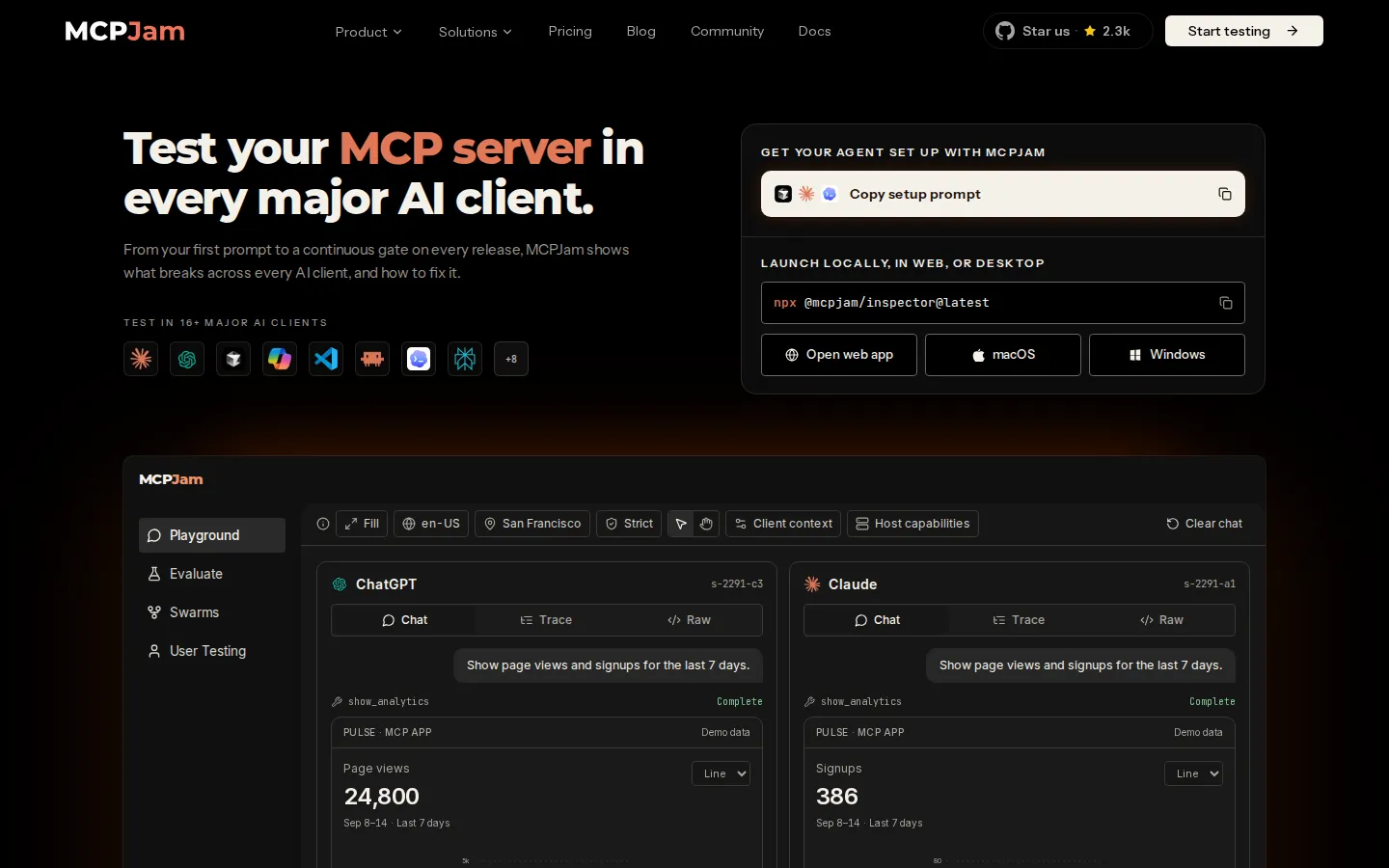
MCPJam is a testing, debugging and evaluation platform for servers that implement the Model Context Protocol, the open standard that lets AI assistants call external tools, read resources and load prompts. The core problem it addresses is fragmentation: the same MCP server can behave correctly in one host application and fail silently in another, because each client negotiates capabilities, formats tool output and handles authentication differently. A tool schema that Claude renders cleanly may confuse Cursor's argument generation, and an OAuth flow that passes in one host can stall in another at the redirect step. MCPJam puts several real client behaviors side by side so a single prompt can be compared across ChatGPT, Claude, Cursor, Copilot, VS Code, Claude Code, Codex and Perplexity in one view, with the trace for each displayed next to the rendered result.
The product ships as four connected surfaces. The Inspector is the local entry point, launched with one npx command, as a hosted web app at app.mcpjam.com, or as a macOS or Windows desktop build; it offers a Playground for calling tools and reading raw requests and responses, plus an OAuth and XAA debugger that steps through each stage of a handshake to show exactly where authorization breaks. Evaluation adds durable suites that score tool choice, arguments and goal completion over repeated runs, with run history, pass rates, latency and token counts. Swarms generate simulated user personas from a plain-language description of your users, then walk realistic journeys across selected clients and score every session. User Testing turns the same flows into shareable sandboxed sessions where invited testers rate individual responses. Finally, CI/CD checks run suites inside GitHub Actions, failing a required check when the model-behavior score drops below threshold and blocking the merge.
The engineering surface is deliberately open. The Inspector, CLI, SDK, local evals and conformance checks are open source on GitHub under the MCPJam organization, free to run locally or in CI, and the hosted app adds shared projects, longer trace retention, team roles and credit-based access to hosted models. Users can bring their own LLM provider keys so inference is billed by their own provider rather than in MCPJam credits. MCPJam Inc. is based in San Francisco and reports adoption by more than 106,000 developers and 280 enterprises, with published customer stories from Asana and Jeppesen ForeFlight. The company frames the product as continuous reliability infrastructure for agent-facing software rather than a general-purpose LLM observability tool, and its comparison pages argue the distinction directly against Datadog, Braintrust and LangSmith. Adoption claims are self-reported, but the free local Inspector makes the core claims easy to check before committing budget. The hosted product bills in credits that cover both feature usage and model inference, and every plan includes unlimited seats and projects.
MCPJam Core Features
Cross-client playground
Send one prompt to ChatGPT, Claude, Cursor, Copilot, VS Code, Claude Code, Codex and Perplexity, then compare tool calls, rendered output and traces side by side.
OAuth and XAA debugger
Step through every stage of an authorization handshake, inspect tokens and redirects, and pinpoint the exact request where authentication breaks.
Evaluation suites
Score tool selection, argument accuracy and goal completion across repeated runs, with pass rates, latency, token counts and run-over-run history.
Swarm simulation
Generate agent personas from a plain-language description of your users, then run hundreds of scripted journeys across selected clients and review scored sessions.
User testing sessions
Share a sandboxed conversation link with invited testers, collect star or thumbs ratings per turn, and surface usability gaps before customers find them.
CI/CD gating
Run suites inside GitHub Actions on every pull request, publish MCPJam checks, and block merges when model behavior falls under a required threshold.
CLI and SDK
Exercise MCP servers from the terminal, scripts or application code, so the same assertions run locally, in CI and inside product test harnesses.
Open-source core
The Inspector, CLI, SDK, local evals and conformance checks are free on GitHub, with the hosted app adding shared projects, trace retention and roles.
Who is MCPJam for?
MCPJam is built for the people who ship Model Context Protocol servers and agent-facing integrations. That starts with backend and full-stack developers writing MCP tools, who need to see raw JSON-RPC requests, tool schemas and error payloads without redeploying to a host client every two minutes just to check a change. It extends to AI platform and developer-experience leads who own one quality bar across many servers and teams, and to engineering managers who would rather see a failing check on a pull request than hear about a broken flow from a customer after release. QA and release engineers use it to turn manual exploratory testing into repeatable evaluation suites with pass rates, latency and token figures they can track from build to build. Product managers and marketers use the sandboxed User Testing sessions to watch real people attempt a task inside a simulated ChatGPT or Claude conversation, and to rate how each turn felt, which surfaces usability gaps that no protocol-level test catches. Enterprise security reviewers get single sign-on, advanced role-based access control, audit log retention, a signed data processing agreement and a pre-production posture in which MCPJam never touches live customer traffic. Teams building their own MCP client also use the published client-capability comparisons to keep pace with the major host applications. Open-source maintainers benefit too, because the local Inspector documents protocol conformance without requiring a vendor account and without any test data leaving their own machine. It is a weaker fit for someone who only needs a one-off smoke test of a single tool, or for teams wanting a general LLM observability suite that monitors production inference and spend; MCPJam deliberately stays in the pre-release lane. It is, however, a strong fit for any organization whose MCP server is a product surface that other people's agents depend on, and where a silent regression costs real customer trust.
MCPJam Use Cases
Debug why an MCP tool call succeeds in Claude but returns malformed arguments inside ChatGPT.
Trace an OAuth handshake that fails after the token exchange and find the rejected redirect URI.
Build a regression suite of realistic prompts and run it before every release candidate.
Simulate support agents and finance users to stress-test multi-step refund and reconciliation flows.
Share a sandboxed session with five real testers and collect per-turn satisfaction ratings.
Gate pull requests on model behavior so a tool schema change cannot silently break tool choice.
Compare how a new client version negotiates capabilities against your existing server baseline.
Run MCP conformance checks in CI to verify protocol compliance across every deployment.
MCPJam Pros and Cons
Pros
- Genuinely open-source core that runs locally with one npx command, so developers can inspect servers without an account or a credit card.
- Cross-client comparison against 16+ real hosts addresses the failure mode that generic LLM evals and observability tools miss entirely.
- Covers the whole lifecycle in one product: playground debugging, OAuth tracing, evals, simulated swarms, human testing and CI gating.
- Transparent credit-based pricing with unlimited seats and projects on every plan, plus a bring-your-own-key escape hatch for model inference.
- Strong published comparisons, docs and customer write-ups from companies such as Asana and Jeppesen ForeFlight.
Cons
- Hosted credits are consumed by model inference and by each feature's per-prompt charge, so heavy evaluation runs can exhaust allowances quickly.
- The free tier caps hosted models at 200 credits per day and limits trace history to 30 days, pushing regular CI users toward paid plans.
- Enterprise necessities such as SSO, audit log retention and a signed DPA are locked behind custom sales-negotiated contracts.
FAQ About MCPJam
MCPJam Pricing
Free and open source: $0 with 200 credits per day, unlimited seats and projects, all core features and 30-day trace history. Pro costs $24 per month billed annually ($288 per year) for 5,000 credits and unlimited traces. Team costs $199 per month billed annually ($2,388 per year) for 50,000 credits and basic RBAC. Enterprise is custom with SSO, audit logs and a DPA.
Check official pricingFree
Open-source core with Playground, OAuth Debugger, Evals, Swarms, User Testing, CI/CD checks, Skills and WebMCP. 200 credits per day, unlimited seats and projects, 30-day trace history, community support, no credit card required.
Pro
For individual developers in production. 5,000 credits per month, unlimited trace history, rollover up to 10,000 credits, extra credits at $10 per 1,000, email support. $288 billed yearly.
Team
For teams optimizing live servers. 50,000 credits per month, basic RBAC, rollover up to 100,000 credits, extra credits at $9 per 1,000, priority support. $2,388 billed yearly.
Enterprise
Advanced RBAC, SSO, audit retention and logs, custom credit volumes, contractual uptime SLA, DPA and dedicated support. Priced with sales.
MCPJam Alternatives

Cotlet
Cotlet is a hosted MCP server and REST API for apps with no API. Cotlet builds and maintains each integration and fixes it when the app changes. Cotlet is operated by Take Group sp. z o.o., Katowice, Poland.

Pydantic
Pydantic is the company behind Pydantic Validation and a four-part AI engineering stack: Pydantic AI for type-safe Python agents, Logfire for OpenTelemetry traces and evaluations, Pydantic Evals for test datasets, and AI Gateway for one-key model routing with spend caps. Core libraries are open source; the hosted platform is metered with a free tier of 10 million records monthly.

Buddy
Buddy is a DevOps and platform-engineering automation suite for building, testing and shipping software. It pairs visual and YAML CI/CD pipelines with deployments to thousands of targets, ephemeral cloud sandboxes, tunnels, domains and visual regression tests. Its AI angle is agentic: a hosted MCP server, the bdy CLI and agent skills let Claude Code, Codex and Cursor run pipelines and deploy.