
Maximem
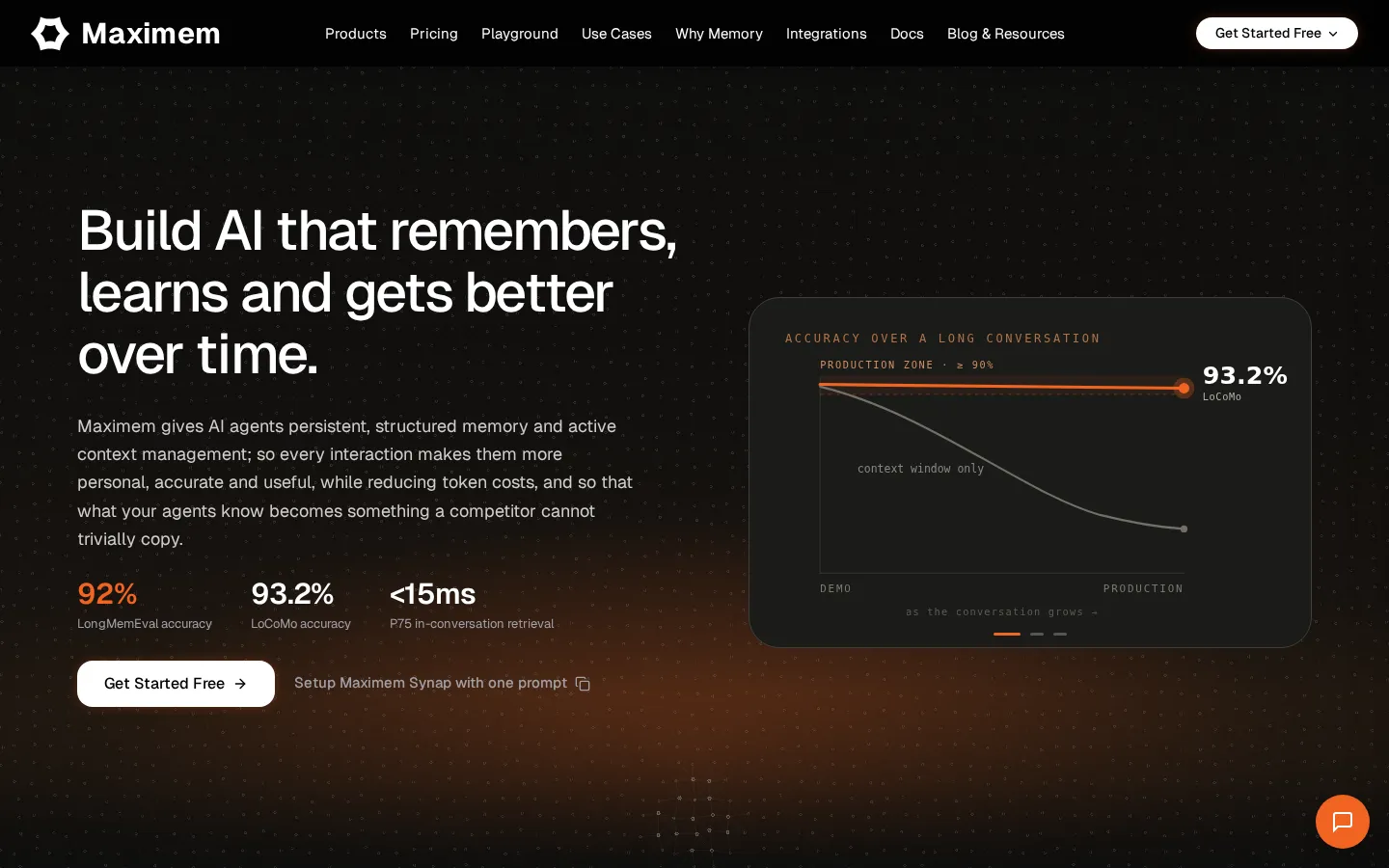
Maximem is memory infrastructure for AI agents: its Synap platform stores each conversation turn as structured memory across vector, graph and file stores, then retrieves context anticipatorily, reporting 92% on LongMemEval and 93.2% on LoCoMo under 15ms at P75. A second product, Vity, gives individuals an encrypted personal memory vault that carries context across apps.
What is Maximem?
Maximem is an AI memory infrastructure company building two products that give AI systems persistent, structured memory instead of leaning on a single expanding context window. Its developer platform, Maximem Synap, is a context management stack for the agents teams build, while Maximem Vity is a private personal memory vault for individuals who use AI across many apps.
Synap works as a pipeline rather than a plain database. Each conversation turn is ingested asynchronously, so the write call returns immediately and never blocks the agent. The system extracts meaning into structure instead of storing raw text, then writes it across three stores at once: a vector store for semantic similarity, a graph store for entity relationships, and a file store for documents and raw material. A custom context architecture is generated per agent and governs extraction, scoping and retention. Retrieval is anticipatory, so most reads never leave the process because context is pre-fetched while the conversation is still running; the company reports under 15ms at P75. Background consolidation cycles handle conscious forgetting.
Maximem publishes its benchmark numbers openly. On the LongMemEval harness it reports 92% accuracy, against 73.8% for Mem0, 71.3% for Supermemory and a self-reported 71.2% for Zep; on LoCoMo it reports 93.2%. The comparison notes that runs used the same hardware, prompts, conversations and scoring, and that vendor self-reported figures are listed separately.
The company frames the problem in terms of alternatives that fall short: bigger context windows do not fix long-conversation accuracy, vector search alone is not memory, flat files do not scale, and letting the model platform own memory is a dependency rather than an asset. Its library works through the loudest objections to agent memory with benchmark evidence and compares Synap against Mem0, Zep, Letta, Supermemory, Cognee and Evermind.
Pricing is credit-based and every tier carries the full capability set: all retrieval modes (FAST, ACCURATE, HYBRID), custom memory schemas, agentic compaction, anticipatory retrieval, consolidation, A2A protocol support, REST and WebSocket APIs, webhooks and event streams. Tiers differ only in volume, agent count, support level and audit-trail length. A free Trial gives 12,500 credits a month and one agent; Starter runs 62,500 credits, Pro 375,000 with bring-your-own-key, Scale 1,875,000 with a Slack SLA, and Enterprise adds unlimited agents plus an on-premise option.
The stated business case is that anticipatory retrieval and agentic compaction roughly halve context tokens per turn, which Maximem estimates at about 20% of a typical LLM bill. The company also argues memory is a moat: what an agent knows becomes something a competitor cannot trivially copy. The platform is model-agnostic, shipping 23 native agent framework integrations, an SDK on GitHub, and plugin builds for OpenClaw and Hermes. Supporting material includes an open evaluation harness, a free seven-lesson course on building agents that remember, and research digests.
Maximem Core Features
Triple-store memory
Every turn is written to a vector store for semantic similarity, a graph store for entity relationships and a file store for documents, then retrieved across all three at once.
Anticipatory retrieval
Context is prefetched while the conversation is still running, so most in-conversation reads never leave your process; Maximem reports under 15ms at P75.
Async ingestion pipeline
The write call returns before extraction and storage finish, so memory writes never block the agent's response path.
Custom context architecture
A per-agent configuration governs extraction rules, entity scoping, retention policy and consolidation behavior rather than forcing one global schema.
Automatic entity resolution
Duplicate and related entities are reconciled on every tier, including the free Trial, rather than being gated behind a higher-priced plan.
Agentic compaction and consolidation
Background cycles compact long histories and perform conscious forgetting, which the vendor says roughly halves context tokens per turn.
Developer surface
REST and WebSocket APIs, webhooks, event streams, an SDK on GitHub, 23 native framework integrations, A2A protocol support and a hosted playground.
Compliance and control
Credit-based billing with hard caps, BYOK on Pro and above, tiered audit trails up to 180 days, and an on-premise deployment option at Enterprise.
Who is Maximem for?
Maximem is aimed at two distinct audiences, and the split matters when judging fit. The first is engineering teams shipping agents into production: people who already have a working prototype and have hit the point where a longer prompt or a bigger context window stops helping. Backend and AI engineers, platform teams and technical founders at startups sit here. They need retrieval that does not block a live turn, entity resolution that works on the entry tier rather than behind a $249 upgrade, and an API that drops into an existing stack. Maximem lists 23 native framework integrations plus an SDK and REST and WebSocket APIs, so teams running graph-style orchestrations or custom loops have a path in. Regulated buyers get audit trails, bring-your-own-key and an on-premise option at Enterprise. The second audience is individual power users: consultants, founders, analysts and other professionals who move between ChatGPT, Claude and a browser all day and retype the same background every time. Vity targets them with a private, encrypted vault and a Chrome extension that carries context across apps. It is a weaker fit for teams that want a zero-configuration memory add-on with no schema thinking, and for anyone needing a self-hosted free tier, since self-hosting sits behind Enterprise. Hobbyists who only need conversation history inside one product will find the free Trial sufficient. Researchers comparing memory layers will get the most value from the open eval harness and comparison pages rather than the product itself.
Maximem Use Cases
Ship an agent that remembers user preferences, past decisions and project state across sessions instead of restarting cold each time.
Cut context token spend by prefetching only the memories a turn needs rather than resending full history to the model.
Power customer support agents that recall a customer's tickets, plan tier and prior resolutions before the first reply.
Run sales copilots that keep account history, objections and commitments straight across long multi-threaded deal cycles.
Support voice AI assistants that need sub-15ms memory lookups to stay inside conversational latency budgets.
Coordinate multi-agent systems where separate workers read and write a shared, structured memory instead of passing transcripts.
Build healthcare or regulated assistants that need scoped retention, audit trails and entity-level separation of patient context.
Give an individual professional one encrypted memory layer that follows them across every AI app they use daily.
Maximem Pros and Cons
Pros
- Benchmarks are published on an open harness with competitor figures shown side by side, which is more auditable than a single marketing number.
- Every pricing tier includes the full capability set, so cheap plans are not stripped of graph memory, compaction or retrieval modes.
- Sub-15ms P75 retrieval with anticipatory prefetching is designed for live conversational agents rather than batch lookups.
- Broad integration surface: SDK, REST and WebSocket APIs, 23 framework integrations, plus OpenClaw and Hermes plugins.
- Transparent unit economics: per-operation credit costs are published, overage rates are fixed per tier, and annual billing saves 17%.
Cons
- Credit accounting is indirect: retrieval, ingestion and compaction all consume different amounts, so cost forecasting needs monitoring rather than simple per-seat math.
- Self-hosting is Enterprise-only, and the free tier is capped at one agent, which limits evaluation for teams that must run on their own infrastructure.
- Benchmark claims come from the vendor's own harness, and Zep was not run on it, so cross-vendor comparisons still rest partly on self-reported numbers.
FAQ About Maximem
Maximem Pricing
Credit-based pricing with a genuinely free Trial tier: 12,500 credits and one agent per month, hard-capped with no overage and no card required. Paid tiers are Starter at $19/month on launch offer ($49 list, 62,500 credits, 3 agents), Pro at $249 (375,000 credits, 10 agents, BYOK), Scale at $999 (1,875,000 credits, 50 agents, Slack 4-hour SLA) and custom Enterprise with unlimited agents and an on-premise option. Overage runs $1.00, $0.88 and $0.75 per 1,000 credits respectively; annual billing saves 17%. Every plan includes all retrieval modes, custom schemas, agentic compaction, anticipatory retrieval and consolidation.
Check official pricingEnterprise
Volume-based credits, unlimited agents, any-provider BYOK, a dedicated customer success manager, negotiated overage, custom audit trail and an on-premise deployment option.
Maximem Alternatives

Cotlet
Cotlet is a hosted MCP server and REST API for apps with no API. Cotlet builds and maintains each integration and fixes it when the app changes. Cotlet is operated by Take Group sp. z o.o., Katowice, Poland.

Pydantic
Pydantic is the company behind Pydantic Validation and a four-part AI engineering stack: Pydantic AI for type-safe Python agents, Logfire for OpenTelemetry traces and evaluations, Pydantic Evals for test datasets, and AI Gateway for one-key model routing with spend caps. Core libraries are open source; the hosted platform is metered with a free tier of 10 million records monthly.

Buddy
Buddy is a DevOps and platform-engineering automation suite for building, testing and shipping software. It pairs visual and YAML CI/CD pipelines with deployments to thousands of targets, ephemeral cloud sandboxes, tunnels, domains and visual regression tests. Its AI angle is agentic: a hosted MCP server, the bdy CLI and agent skills let Claude Code, Codex and Cursor run pipelines and deploy.