Kitool.AI
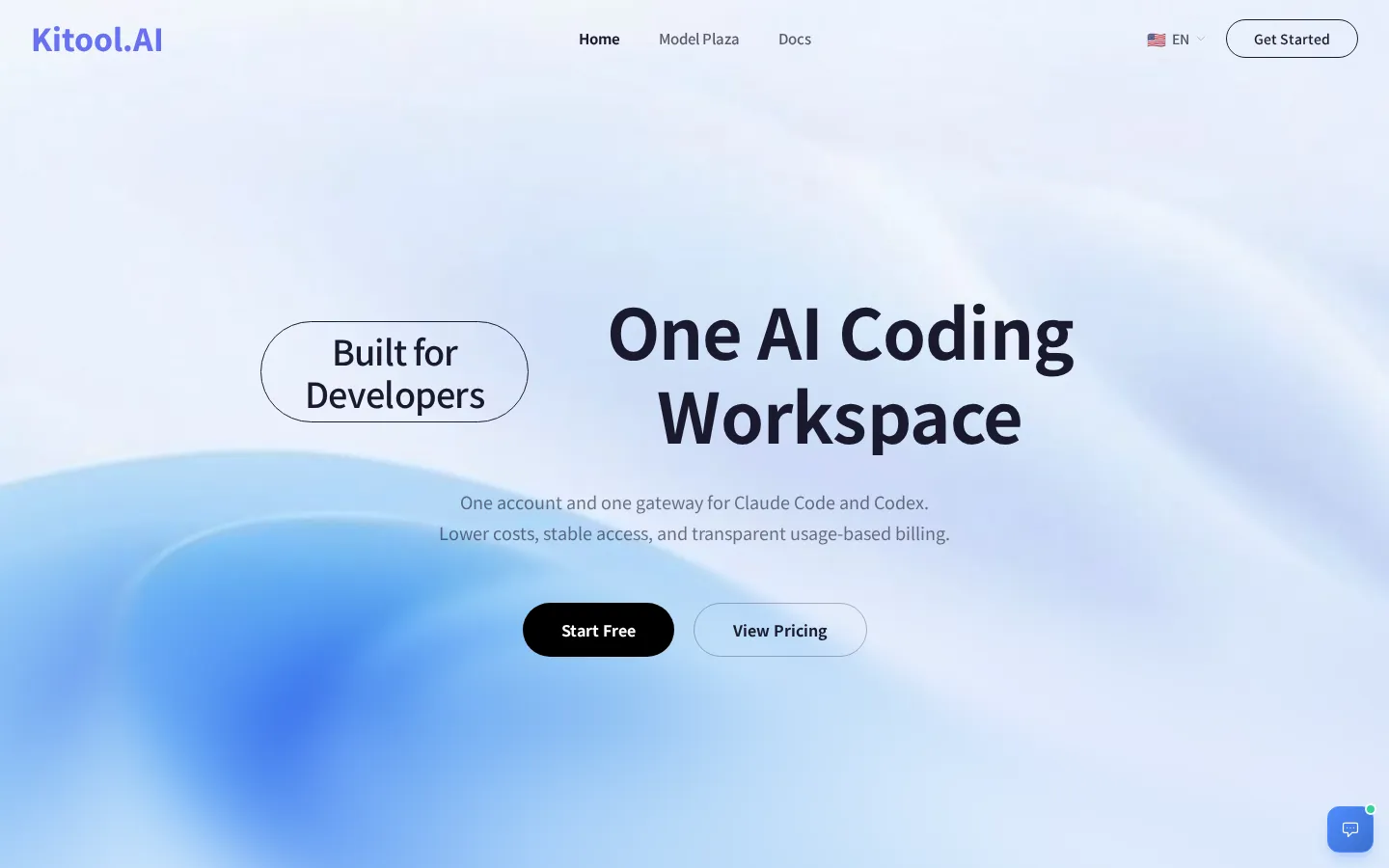
Kitool.AI is an AI coding workspace that puts Claude Code and Codex behind one account and one API key. It offers transparent usage-based billing, a model plaza with per-million-token prices, and routing that can cost less than paying each vendor directly. Configure it once in VS Code, JetBrains, or the terminal on macOS, Windows, or Linux.
What is Kitool.AI?
Kitool.AI is an AI coding gateway and workspace that unifies several leading coding assistants behind a single account, a single API key, and one stable network route. Instead of subscribing to Anthropic and OpenAI separately and juggling multiple keys, developers sign up once and point Claude Code, Codex, Gemini CLI, and other compatible clients at the same shared endpoint.
The product is built around a "one gateway, multiple tools" idea. The same domain and the same key format work across popular CLI tools and IDE plugins, including VS Code and JetBrains, so setup takes minutes rather than an afternoon of documentation reading. Kitool states that a consistent domain and key format works across popular IDE plugins and CLI tools, and that the environment can be configured in one step. A dedicated documentation area walks through Node.js setup, an automatic configuration tool, and quick starts for Claude Code, Codex, OpenClaw, Hermes, Cherry Studio, Claude Desktop third-party providers, and a VS Code graphical walkthrough.
Two things distinguish Kitool.AI from a plain API reseller. The first is the billing model: usage is metered the way official providers meter it, and every request is traceable. The console shows detailed usage and cost records, so a developer can see which model consumed which tokens and what that cost, rather than reconciling a flat subscription fee against an opaque quota. The second is the routing layer. Kitool maintains several upstream groups, including Codex Pro, Claude Max, Claude AWS Kiro, Gemini, Grok, DeepSeek, GLM, Qwen, and Kimi, each carrying its own discount rate against official list prices, and the platform says it continuously optimizes routing and reliability for coding workloads.
The Model Plaza page is the transparency center. It lists every model group with the price paid per one million tokens in CNY and the corresponding official price in USD, split into input, output, and cache read and write rates, alongside a discount multiplier such as 0.4x, 0.65x, 0.8x, or 2.2x. Cache writes and cache reads are priced separately, and long-context surcharges are called out where they apply. Because the multiplier sits next to the official reference price, a buyer can verify the savings instead of trusting a marketing claim; the page advertises savings of roughly 60 to 94 percent depending on the group.
Kitool.AI targets coding workflows specifically rather than trying to be a general-purpose chat aggregator. It curates models for two complementary roles: Claude for architecture, system design, code review, and multi-step reasoning, and ChatGPT-family models for implementation, feature work, debugging, and repairs. Developers can mix the two and route each task to whichever model handles it best. Reported traction on the homepage includes more than 2,000 developers served, over one million total requests, and an average latency of 16.3 seconds. Accounts are created with Google, GitHub, Telegram, or email.
Kitool.AI Core Features
One Gateway for Multiple Agents
Claude Code, Codex, Gemini CLI, and compatible clients share a single endpoint and key format, so one configuration serves every tool in your stack.
Transparent Usage-Based Billing
Metering follows official provider semantics, and the console exposes detailed usage and cost records so any charge can be traced back to a specific request.
Model Plaza Price Transparency
The public Model Plaza table lists each model group's CNY price paid and official USD reference price per million tokens, split into input, output, and cache read and write rates.
Multi-Platform Coverage
Kitool.AI documents setup for macOS, Windows, and Linux, covering CLI agents as well as IDE plugins such as VS Code and JetBrains.
Grouped Model Routing
Codex Pro, Claude Max, Claude AWS Kiro, Gemini, Grok, DeepSeek, GLM, Qwen, and Kimi groups each carry their own discount multiplier, letting you trade cost against stability.
Cache-Aware Token Pricing
Prompt cache writes and cache reads are billed separately at published rates, which keeps long agent sessions cheaper whenever context is reused.
Guided Onboarding Library
Quick-start guides cover Node.js installation, an automatic configuration tool, Claude Code, Codex, OpenClaw, Hermes, Cherry Studio, Claude Desktop, and a VS Code GUI tutorial.
Team Account Management
Multi-user access, groups, and subscription management let a team share one workspace while tracking token consumption per member.
Who is Kitool.AI for?
Kitool.AI is aimed at working developers who already lean on AI coding agents and want to stop juggling separate vendor accounts. The typical user runs Claude Code or Codex from a terminal or an IDE every day, hits rate limits or regional access problems with official endpoints, and wants one key instead of four. Freelancers and solo builders benefit most from the cost side. When an agent session can burn millions of tokens a day, a 0.65x or 0.8x multiplier on the same models turns into real money saved, and the per-request cost log makes it easy to attribute spend to a client or a project. Small product teams get the same economics plus shared visibility. Group and subscription management let a lead issue keys to several developers, watch consumption, and keep everyone on one endpoint and one configuration. Teams that standardize on AI-assisted development often struggle with onboarding, because every new hire has to reproduce someone else's local setup. A single documented domain and key format removes that step entirely. Engineering organizations evaluating AI gateways will care most about the audit trail. Metering that matches official provider semantics means finance can verify charges, and traceable request records answer the question of which model produced which output and at what price. Coding-focused curation matters too: rather than a sprawling catalog of general chat models, Kitool.AI keeps the list to models that behave well inside agentic coding loops. It is less suited to people who want a chat interface for general writing, image editing, or research, since Kitool.AI positions itself around coding workflows, IDE plugins, and CLI agents. Developers who need a strictly first-party contract with Anthropic or OpenAI, or who require published enterprise compliance certifications, should look elsewhere. Anyone comfortable editing environment variables, or willing to follow the quick-start guides for Claude Code, Codex, and VS Code, will find setup straightforward.
Kitool.AI Use Cases
Run Claude Code and Codex from one account and one API key instead of maintaining separate vendor subscriptions.
Cut AI coding spend by routing the same models through groups priced at multipliers from 0.4x to 0.8x of official list rates.
Configure an IDE plugin or CLI agent once with a single gateway domain and key format, then reuse it across every machine.
Track and attribute token spend across a team using per-request usage and cost records.
Compare model economics before committing by reading CNY paid prices against official USD reference prices in Model Plaza.
Keep coding agents productive when first-party endpoints throttle requests or are hard to reach from your region.
Standardize a team's AI coding setup so new developers onboard with one documented endpoint rather than a copied local configuration.
Mix planning and implementation models in one session, sending architecture work to Claude and feature work to ChatGPT-family models.
Kitool.AI Pros and Cons
Pros
- One key and one endpoint cover both Claude Code and Codex, removing multi-vendor key management and separate billing relationships.
- Published per-million-token prices sit next to official reference rates, so advertised savings can be verified rather than taken on faith.
- Cross-platform support with documented setups for macOS, Windows, Linux, VS Code, JetBrains, and several CLI agents lowers setup friction.
- Per-request usage and cost records support cost attribution and invoice checking, which flat-rate subscriptions usually cannot provide.
- Discount multipliers as low as 0.4x against official list prices make high-volume agentic coding noticeably cheaper.
Cons
- Kitool.AI is a gateway rather than a model owner, so availability, latency, and future pricing depend on upstream supply instead of a first-party contract.
- Pricing and documentation lean China-centric: Model Plaza quotes paid prices in CNY and a large share of the documentation library is written in Chinese.
- Prices and available models shift often, and some entries are marked as pricing pending, so budgets and model choices need periodic rechecking.
FAQ About Kitool.AI
Kitool.AI Pricing
Kitool.AI uses prepaid, usage-based pricing: you top up one account and pay per million tokens for each model, with Model Plaza publishing the CNY price paid next to the official USD list price and a discount multiplier that ranges from 0.4x to 2.5x depending on the model group you choose.
Check official pricingGemini-3.8-Flash (Gemini group, 0.8x)
Cheapest listed input rate on the plaza, against a USD 0.75 official input price; cache reads bill at CNY 0.06 per 1M tokens.
DeepSeek-V4-Flash (DeepSeek Flash group, 0.75x)
Budget reasoning model with cache reads at CNY 0.15 per 1M tokens; the dated 0731 variant is priced higher with a 50 percent time-based premium.
Grok-4.5 and Grok-4.6 (Grok group, 0.4x)
Deepest published discount multiplier, 0.4x of an official USD 2.00 input rate; above 200K tokens the input, output, and cache rates double.
Claude-Sonnet-5 (Claude AWS Kiro group, 0.65x)
Discounted mainstream Claude tier with million-token context, against USD 2.00 input and USD 10.00 output official rates; cache writes CNY 1.625 per 1M tokens.
GPT-6.1-Sol (Codex Pro group, 0.8x)
Entry Codex Pro option with platform content moderation, against official USD 2.00 input and USD 10.00 output; cache reads CNY 0.08 per 1M tokens.
GLM-5.2 (GLM group, 0.6x)
0.6x multiplier against official USD 8.00 input and USD 28.00 output rates, with cache writes and reads published separately.
Claude-Opus-5.5 (Claude Max group, 1.8x)
Premium Claude Max routing for non-Claude-Code clients with platform moderation, against official USD 4.00 input and USD 20.00 output rates.
Claude-Fable-5 (Claude Max dedicated-line group, 2.5x)
Highest listed multiplier, positioned as enterprise-grade stability, against official USD 10.00 input and USD 50.00 output rates; cache writes CNY 31.25 per 1M tokens.
Kitool.AI Alternatives

claude-mem
claude-mem keeps structured project memory outside the chat. An open-source engine captures decisions, discoveries, and fixes locally, while CMEM Pro adds hosted observation, cloud sync, and a private MCP link. Recall synced notes from Claude Code, Cursor, Codex, Gemini CLI, Windsurf, or ChatGPT, or keep everything local-first on your own machine.

GetLayers
GetLayers is Textura's library of design foundations for AI coding workflows. Browse templates, motion sections, 3D scenes, backgrounds, and gradients, then copy structured prompts into your preferred assistant. Paid plans include commercial licensing, while Full Stack adds source files and private Discord support. Full Stack Lifetime also connects the library directly to compatible assistants through MCP.

Verboo
Verboo Code is an AI coding agent that runs in your terminal, powered by a dedicated GPU and an OpenAI-compatible endpoint. It offers flat monthly plans priced per developer, a free trial with no charge at signup, nine models you can switch mid-conversation, native and third-party CLI integrations, and a prepaid usage-based API. Runs on Brazilian servers.