
IrisGo
IrisGo is an AI butler for Windows from Irixion that records a workflow while you do it once, converts the observed steps and decision logic into a reusable skill, and then runs that skill autonomously across your desktop apps. It pairs a community skill library with cross-app context and local NPU or GPU inference, and is currently offered as a free public beta.
What is IrisGo?
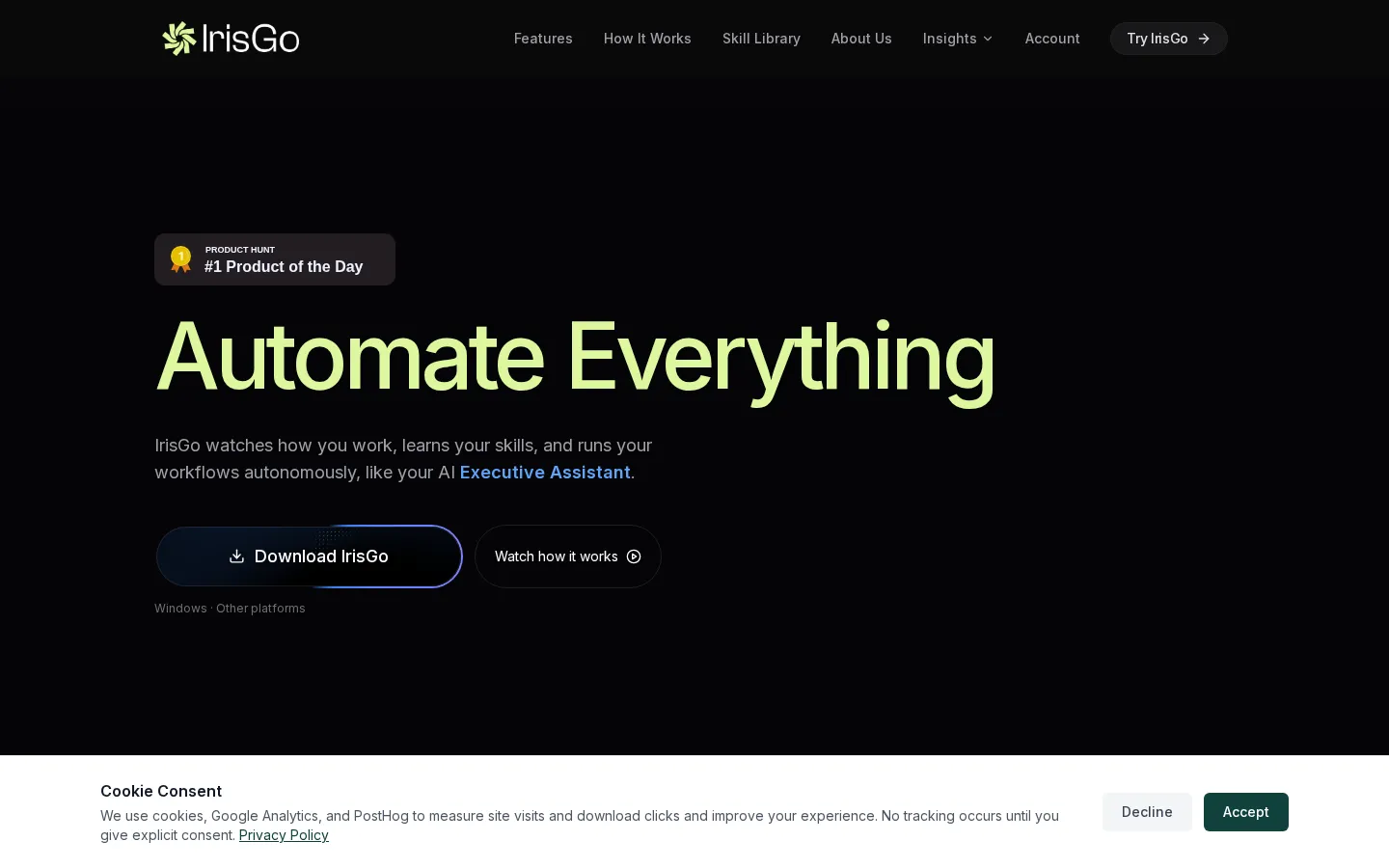
IrisGo is a desktop AI agent for Windows, made by Irixion Corp, that is positioned as an AI butler rather than another chat assistant. Instead of asking you to write prompts or assemble no-code flows, it watches how work actually happens on your machine, learns the sequence and the decision logic behind it, and then executes that workflow autonomously. The company summarizes the loop in three stages: Watch, Learn, and Act.
During Watch, IrisGo captures real workflow context across screens, apps and systems while you do a task normally. During Learn, it uses AI to convert that observed behavior into a reusable workflow, including execution plans and the intent behind individual steps, without manual configuration. During Act, those learned skills run on their own, triggered by events, routed across tools, and adjusted over time. A demonstration on the site shows a "Daily Morning Brief" skill that digests Hacker News, summarizes a podcast episode, checks a stock watchlist, adds groceries to a cart and drafts an email.
A central idea is the Skill Library: a catalog of ready-to-run workflows contributed by the community, covering areas such as support, sales, data, finance, legal, DevOps, HR and marketing. Examples include Email Triage, Lead Scoring, Invoice Processing, Contract Summary, Deploy Monitor and Web Scraper. You can import a skill, teach IrisGo your own variation, and let it run.
IrisGo also emphasizes local hardware. It is built for AI PC hardware and can use a machine's NPU and GPU for private, fast inference, so your PC acts as the engine rather than relying entirely on the cloud. The site describes partnerships with Intel and AI PC makers such as Acer, and lists AI Fund (Andrew Ng), Pegatron Ventures, Intel, Google for Startups and NVIDIA Inception among its backers.
Because learned skills are stored rather than re-derived each time, the pitch is cumulative: every demonstration adds a capability you can rerun, hand to a colleague, or chain with other skills. The site explicitly mentions chaining skills with event triggers, so a morning routine can kick off a report, which in turn notifies a channel. Everything is packaged as a desktop application rather than a browser tab, which is what lets it act inside native Windows software and not only web tools.
IrisGo is currently in public beta on Windows, was named a Product Hunt #1 Product of the Day, and has been covered by TechCrunch, Fast Company, The Information and Tech in Asia. Apple and Mac support is listed as coming soon rather than available, and no public API or self-hosted deployment is documented. The value proposition therefore rests on how reliably the watch-and-learn loop captures the nuances of a real workflow, which is exactly what a hands-on trial should test before you depend on it for anything important.
IrisGo Core Features
Watch and learn
Show IrisGo a workflow once and it records the screen, app and system context, then turns the sequence into an autonomous skill instead of a fragile macro.
Cross-app context
It gathers context across the apps you use and connects models, APIs and tools into a single intelligence layer, so a skill can move between browser, mail and CRM.
Local NPU and GPU inference
IrisGo is built for AI PC hardware and can run inference on your machine's NPU or GPU for faster, more private processing.
Event-driven execution
Learned workflows can run autonomously on triggers, route work across tools and keep optimizing without someone babysitting each step.
Skill Library
A community catalog of ready-to-run skills spans support, sales, data, finance, legal, DevOps, HR and marketing, and each one can be imported and adapted.
Decision logic capture
Beyond clicks, IrisGo learns the intent and branching logic behind a task, so learned workflows can handle variation rather than only one exact path.
Windows AI PC ecosystem
IrisGo ships for Windows with Intel and Acer partnership messaging, positioning autonomy at the system level rather than inside one app.
Who is IrisGo for?
IrisGo targets people whose work is spread across many desktop apps and who are tired of rebuilding the same routine by hand or maintaining brittle automation scripts. It suits several distinct groups. Solopreneurs and one-person businesses are a natural fit: they run sales, support, marketing and admin themselves, so a skill that drafts follow-ups or assembles a weekly report returns hours rather than minutes. The site's Product Hunt launch is explicitly aimed at solopreneurs, and the skill catalog is organized around exactly the jobs a small team cannot staff. Operations and support staff who repeat multi-step routines inside a browser, a CRM, a ticketing tool and email can record one clean run and hand the repetition to the agent. Sales teams can use skills such as Lead Scoring, Customer Research, Follow-up Sender and Pipeline Update to keep pipeline data current without manual entry. Analysts and finance teams benefit from Report Builder, Invoice Processing and Expense Approval style skills, especially when the work means copying figures between live dashboards and spreadsheets. IT, DevOps and security teams can monitor deployments, consolidate alert noise and flag policy violations with scheduled, event-driven skills. Product managers, consultants and agency account leads often juggle notes, tickets and client reporting across a dozen tools; they are a good match because the value shows up in recurring ceremonies rather than one-off tasks. HR and recruiting teams can lean on onboarding and screening style skills where the same sequence repeats for every candidate or new hire. Founders and knowledge workers who already use several AI assistants will find the value in persistence: IrisGo keeps cross-app context and remembers a workflow instead of forgetting it between sessions. Privacy-conscious users on AI PC hardware also matter here, because local NPU and GPU inference keeps more processing on the device. It is a weaker fit for teams standardized on macOS, for people who need a documented public API for custom integrations, or for anyone who needs published enterprise pricing before procurement. The product is in public beta and Windows-only today, with Apple and Mac listed as coming soon, so it is best treated as an individual or small-team pilot rather than a company-wide rollout.
IrisGo Use Cases
Record a morning routine once and have IrisGo assemble a daily briefing from news, podcasts, watchlists and email.
Hand off email triage so incoming messages are sorted, prioritized and queued for reply before you open the inbox.
Automate lead scoring and follow-ups by ranking prospects on engagement and fit, then scheduling personalized outreach.
Generate weekly reports from live data without copying figures between dashboards, spreadsheets and slide decks.
Process invoices by extracting and validating document data, flagging mismatches for a human before payment.
Monitor deployments and consolidate noisy alerts into one digest that reaches the right channel each morning.
Keep a CRM, sheets and databases in sync by running a data sync skill on a schedule you define.
Summarize meetings and assign action items automatically, so decisions leave the call with an owner attached.
IrisGo Pros and Cons
Pros
- Learning by demonstration removes the setup tax of traditional automation: one recorded run can become a reusable skill, with no scripting or node graph required.
- The Skill Library gives newcomers a starting point and gives experienced users a way to share and adapt workflows across departments.
- Local NPU and GPU inference on AI PC hardware is a credible answer to privacy and latency concerns that cloud-only agents struggle with.
- Strong validation for an early product: Product Hunt #1 Product of the Day, TechCrunch and Fast Company coverage, plus AI Fund, Intel and NVIDIA Inception backing.
Cons
- Windows only today, with macOS listed merely as coming soon, so Mac-based teams cannot standardize on it.
- Pricing is not published; the site pushes a public beta download and an account area, which makes budget approval and plan comparison difficult.
- There is no documented public API, so custom integrations and programmatic control depend on what the desktop app exposes.
FAQ About IrisGo
IrisGo Pricing
IrisGo does not publish pricing. The site offers a public beta you can download and try, and points visitors to a download page and an account area rather than a plan table; the pricing URL currently returns a not-found page. No tiers, seat limits or paid amounts are listed, so cost after the beta is unconfirmed and should be confirmed with Irixion before adoption.
Check official pricingPublic Beta
Free public beta download for Windows. No published limits, no card details shown on the site, and no stated end date for beta access.
Pro
A paid tier is implied by the beta framing, but no price, quota or feature split has been published, so terms are unconfirmed.
IrisGo Alternatives

Motion
Motion is a video agent from Mosaic that turns a written brief, raw footage or a reference clip into an edited video. It plans the story, generates or cuts shots, adds music and sound, then lets you refine the result in chat, on the preview or in a timeline before exporting to Premiere Pro, After Effects or DaVinci Resolve.

Cotlet
Cotlet is a hosted MCP server and REST API for apps with no API. Cotlet builds and maintains each integration and fixes it when the app changes. Cotlet is operated by Take Group sp. z o.o., Katowice, Poland.
Buddy
Buddy is a DevOps and platform-engineering automation suite for building, testing and shipping software. It pairs visual and YAML CI/CD pipelines with deployments to thousands of targets, ephemeral cloud sandboxes, tunnels, domains and visual regression tests. Its AI angle is agentic: a hosted MCP server, the bdy CLI and agent skills let Claude Code, Codex and Cursor run pipelines and deploy.