
CoreSpeed
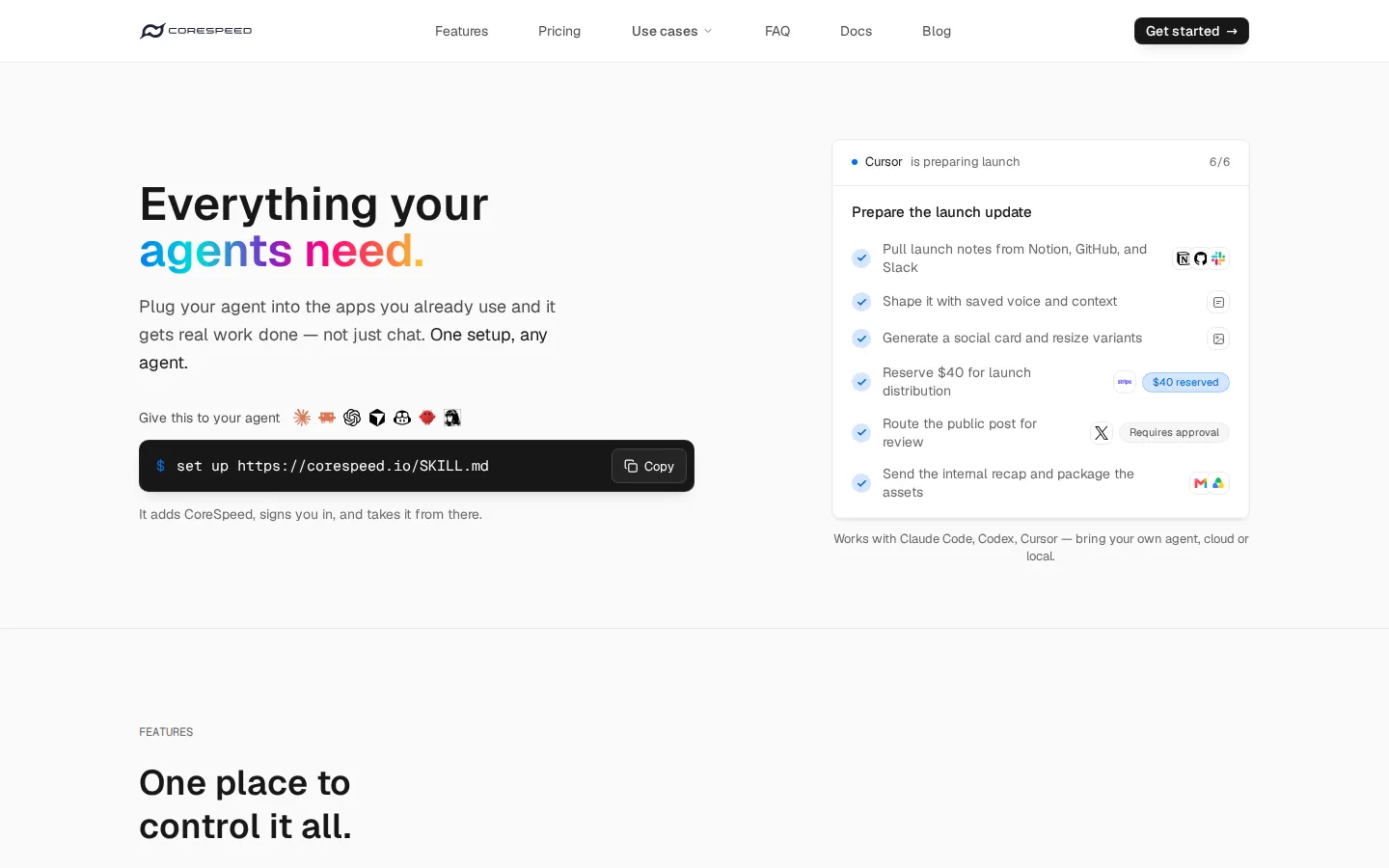
CoreSpeed is an MCP endpoint that connects Claude Code, Codex, Cursor, Copilot, Hermes and other agents to the apps you already use, such as Gmail, Slack, GitHub, Notion and Linear. It adds durable team memory, media generation, web search and social research, plain-English approval rules, per-key spend caps and an itemized activity log, on a free tier or a $20 monthly team plan.
What is CoreSpeed?
CoreSpeed is an MCP server that acts as the server side of an AI agent. Instead of wiring credentials into each agent, a user authorizes an app once in the CoreSpeed dashboard and every agent they run reaches it through one authenticated endpoint, https://api.corespeed.io/mcp. CoreSpeed Inc., founded in January 2025, sells the product self-serve with a free tier and a $20 per month team plan, priced on a single public rate card.
The endpoint is a streamable HTTP MCP server. Claude Code adds it with one command, Codex with `codex mcp add corespeed`, and Cursor or any client that reads an mcpServers map gets the same JSON entry; Copilot in VS Code and the Claude apps are documented too. Sign-in happens through the browser with OAuth, or with an API key for headless agents and CI. Connected apps and built-in tools then appear in tools/list as namespaced tools such as notion__search, memory__remember, media__generate, web__search and social__x_search, and only apps the user connected show up.
The connector catalogue covers several dozen services, including Gmail, Slack, Notion, GitHub, X, Google Calendar, Drive, Sheets, Outlook, HubSpot, Discord, Figma, Dropbox, Microsoft Teams, Jira, Salesforce, Stripe, Linear, Asana, Airtable, Shopify, Supabase, Sentry, Snowflake and DocuSign. Each is an OAuth grant held by CoreSpeed, so the agent holds no key and no refresh token. Built-in tools add image, video and audio generation and analysis, transcription, web search and scraping, listing data from Google Maps, Airbnb, Amazon, Zillow and TripAdvisor, and read-only social data from nine platforms.
Governance is the differentiator. An approval policy is written in plain English, and an action the user said to check pauses for sign-off in the dashboard, by email or in Slack, with a chosen default for anything the policy does not mention. Usage is metered in credits at a fixed 1,000 credits to $1, an organization wallet funds it, and API keys can carry a monthly spend cap. Every metered call lands in one ledger showing what ran, what it cost and whether it worked.
Memory is stored on the account rather than in the agent, so a second agent recalls what the first saved, and switching from Claude Code to Codex keeps connections, memory, writing voice and policy intact. An npx @corespeed/cs CLI handles login, keys, connector lists and usage from a terminal.
CoreSpeed Core Features
One Authenticated MCP Endpoint
A single streamable HTTP server at api.corespeed.io/mcp serves every client, with browser OAuth for interactive agents and sk-cs API keys for headless jobs.
OAuth Connector Catalogue
Several dozen apps including Gmail, Slack, Notion, GitHub, X, Jira, HubSpot, Linear, Stripe, Figma and Snowflake connect in one tap, with no developer application and no key stored in the agent.
Built-in Media, Web and Social Tools
Image, video and audio generation and analysis, transcription, web search and scraping, listing data from Google Maps, Airbnb, Amazon and Zillow, plus read-only social data from nine platforms.
Portable Team Memory
Facts, people, projects, writing voice and past decisions live on the account, so any agent recalls them and reads are free at one credit per saved memory.
Plain-English Approval Policy
Describe what needs sign-off, and matching actions pause for approval in the dashboard, email or Slack, with a chosen floor for anything the policy leaves out.
Spend Caps and One Ledger
Credits are fixed at 1,000 to $1, the organization wallet funds every call, API keys carry monthly caps, and each charge lands itemized in one activity log.
Agent Portability
Connections, memory, voice and policy travel between Claude Code, Codex, Cursor, Copilot, OpenClaw and Hermes, so switching clients resets nothing.
CLI and Agent Self-Setup
`npx @corespeed/cs` covers login, key minting, connector listing and usage, while the hosted SKILL.md lets an agent install and authenticate itself.
Who is CoreSpeed for?
CoreSpeed is aimed at people whose agents have outgrown a single laptop: running in the cloud, unattended, several at once, or on behalf of a team. That is the point where built-in agent memory stays on one machine, connector keys end up in environment variables, and nobody is watching what the agent spends. Developers running Claude Code, Codex, Cursor, Copilot, OpenClaw or Hermes are the primary users. They use the endpoint to reach Gmail, Slack, GitHub, Notion or Linear without registering an OAuth application per service, and they keep their setup when they switch clients. Small teams and startups use the Pro plan for shared memory, up to 25 members, one invoice and per-key spend caps, which makes an unattended agent safe enough to leave running against a real budget. Revenue, marketing and support teams use the role pages and connectors for work that crosses tools: enriching HubSpot leads, drafting outreach in a saved voice, scheduling social posts, or triaging tickets with context from past replies. Founders and creators use it for inbox clearing, call booking and turning ideas into posts, with media generation for the assets. Analysts and researchers use the built-in web and social tools for public data from X, Reddit, TikTok, YouTube, Instagram, Facebook, Threads, Xiaohongshu and Douyin without connecting an account. It fits organizations that want SSO, custom audit retention and a support SLA least well on self-serve plans, since those sit behind Enterprise and a sales call.
CoreSpeed Use Cases
Run unattended cloud agents against Gmail, Slack and GitHub without putting refresh tokens in environment variables.
Enrich HubSpot leads with live web and LinkedIn lookups, then draft and log a first touch in your saved voice.
Schedule and publish social posts while a policy pauses anything public and a spend cap limits paid actions.
Triage support tickets in Slack with memory of past replies, approved response templates and an escalation rule.
Research competitors from public posts, profiles, comments and ads across nine social platforms without connecting an account.
Generate launch images, resize variants and package assets inside one agent run, then email the recap.
Hand a working agent from Claude Code to Codex, Cursor or Hermes without losing memory, connections or policy.
Give a five-person team one shared memory, up to 25 seats, per-key budgets and a single monthly invoice.
CoreSpeed Pros and Cons
Pros
- Setup is genuinely one line: the hosted skill adds the MCP server, signs the user in and connects apps, and every major client has documented steps.
- Credentials stay out of the agent entirely; OAuth grants sit with CoreSpeed, so a leaked config or a switched client exposes no refresh token.
- Governance is concrete rather than aspirational, with English approval rules, per-key spend caps, a credit ledger at a fixed 1,000 credits to $1, and new credit first repaying any amount a call ran over.
- The free tier is usable: 3,000 credits for 90 days, no card, and standard connectors plus memory reads cost nothing.
Cons
- Usage is quoted in credits rather than dollars, and the $1-per-1,000-credits conversion lives in the billing docs, so cost per action takes arithmetic; a single post with a link bills 250 credits.
- The $20 Pro plan includes 10,000 credits, about $10 of metered usage at the published rate, and the Free plan cannot top up at all, so heavier use means paying above the sticker price.
- Some advertised pieces are not shipped: Agent Pay, agent mail and a code sandbox are marked coming soon, and SSO, custom audit retention and a support SLA require an Enterprise call.
FAQ About CoreSpeed
CoreSpeed Pricing
Free to start with 3,000 credits over 90 days, no card required, one member, standard connectors and 200 MB of memory. CoreSpeed Pro is $20 per month for 10,000 credits monthly, up to 25 members, 2 GB of memory, one-year history, extra usage and top-ups from $5 to $1,000. Enterprise is custom with SSO, custom retention and a support SLA. Credits are fixed at 1,000 per $1, standard connectors are free, and premium connector actions plus built-in tools bill per use.
Check official pricingFree
For individuals running their first agent: 3,000 credits over 90 days, 1 member, standard connectors, 200 MB of memory and 30-day activity history, with no card required and no top-ups.
CoreSpeed Pro
For teams running agents daily: 10,000 credits per month, up to 25 members, 2 GB of memory, one-year history, additional metered usage and top-ups of $5 to $1,000 per checkout.
Enterprise
For organizations needing compliance and control: everything in Pro plus custom team size, credits, memory and audit retention, SSO options, a custom support SLA and deployment planning.
CoreSpeed Alternatives

Multica
Multica is a project management workspace for teams working alongside AI coding agents. Connect the CLIs you already use, assign them issues, and follow progress on a shared board. Workflows, scheduled autopilots, shared skills and chat integrations keep humans and agents on the same task lifecycle.

Cotlet
Cotlet is a hosted MCP server and REST API for apps with no API. Cotlet builds and maintains each integration and fixes it when the app changes. Cotlet is operated by Take Group sp. z o.o., Katowice, Poland.

Pydantic
Pydantic is the company behind Pydantic Validation and a four-part AI engineering stack: Pydantic AI for type-safe Python agents, Logfire for OpenTelemetry traces and evaluations, Pydantic Evals for test datasets, and AI Gateway for one-key model routing with spend caps. Core libraries are open source; the hosted platform is metered with a free tier of 10 million records monthly.