
Consensus
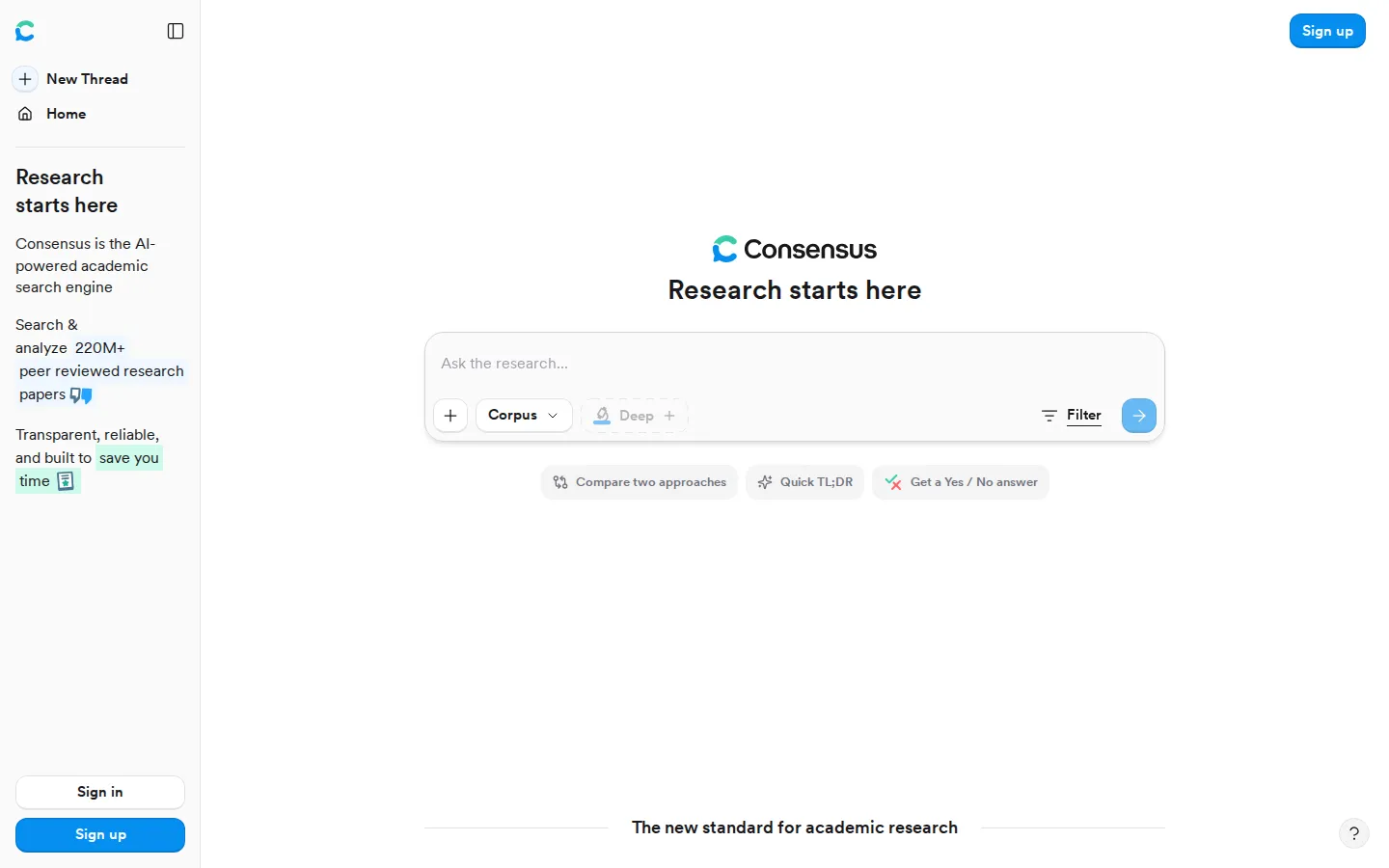
Consensus is an AI-powered academic search engine built on more than 250 million peer-reviewed papers. Instead of guessing, it answers research questions with cited findings, a Consensus Meter that visualizes scientific agreement, Deep Search literature reviews, Medical mode, natural-language filters, and a library for organizing what you find. Pro unlocks unlimited AI analysis, 15 Deep reviews monthly, and API plus MCP access.
What is Consensus?
Consensus is an AI academic search engine and research workspace that sits on top of more than 250 million peer-reviewed papers, including licensed full text from major publishers such as Taylor & Francis, SAGE, the American Chemical Society, and the AAAS Science family of journals. Instead of generating an answer from model memory, every response is tied back to real studies, so you can see which paper supports which sentence. The product ships several ways of interrogating the literature. Plain Papers search is free and unlimited, returning ranked studies with abstracts, journal names, citation counts and study metadata. Pro Analysis uses AI to summarize key findings from the top papers in a search and produce a high-level synthesis with inline citations, typically drawing on up to 20 papers per query. Deep Search, sold on its own Deep plan, automates a full literature review: it builds a search strategy, expands key terms, follows the citation graph, surfaces conflicting findings, and works across up to 50 papers in one pass, turning days of manual screening into minutes. The Consensus Meter answers yes-or-no research questions by classifying papers as supporting, opposing or neutral and visualizing the balance of evidence, which makes it obvious when a field is split rather than settled. Medical mode narrows results to roughly 50,000 clinical guidelines and about 8 million articles from the top 1,000 medical journals. Natural-language filters let you specify timeframes, populations and study designs directly in your prompt, so Consensus applies the right filters without a structured query builder. Supporting tools include Study Snapshot, which extracts methodology, sample size, duration and outcomes from a paper; Chat with Full Text for asking questions across a paper, a collection or your own uploads; Citation Grounding, which shows the exact quoted passage and highlights it in the PDF; My Library and shared collections for saving papers; Threads for follow-up questions; a Research Agent that plans and executes multi-step tasks; and a Research Gaps Matrix that maps under-covered combinations of population and method. Consensus also runs inside ChatGPT, Claude and Microsoft 365 Copilot, and its API and MCP server are out of beta with a self-serve dashboard, so developers can wire the same corpus into their own agents.
Consensus Core Features
Search 250M+ peer-reviewed papers and preprints with plain-language questions instead of keywords
Consensus Meter visualizes how much of the literature supports, opposes or stays neutral on a yes/no question
Deep Search automates literature reviews across up to 50 papers, expanding terms and following the citation graph
Pro Analysis summarizes key findings from the top papers with citations grounded in real studies
Medical mode restricts results to about 50,000 clinical guidelines and 8M top-tier medical journal articles
Natural-language filters apply timeframe, population and study-design filters straight from your prompt
Study Snapshot extracts methodology, sample size, duration and outcomes from individual papers
Citation Grounding shows the exact quoted passage and highlights it in the original PDF
Who is Consensus for?
Consensus is built for anyone who has to base a claim on published science instead of opinion or a chatbot's memory. Its core audience is academic researchers, PhD candidates and graduate students writing literature reviews, theses and dissertations, who need to map an unfamiliar field quickly, spot where the evidence conflicts, and collect citations strict enough to survive a committee review. Health professionals are a second major group: clinicians, nurses and medical students use Medical mode to restrict results to clinical guidelines and top-tier medical journals when they want a fast, defensible read on a treatment question. Faculty and university librarians adopt Consensus as a teaching tool, pointing students at a tool whose answers always route back to a real paper rather than a hallucinated reference list, and more than 170 university libraries already offer it to their communities. Research organizations, biotech teams, consultancies and evidence-focused policy groups use the Pro and Deep plans to run repeated literature reviews without waiting on a specialist search service. Product managers, journalists, lawyers, clinicians writing grants and even curious general readers turn to it when they want the current scientific state of a topic: supplements, nutrition, exercise, mental health, drug safety, or anything where the popular narrative and the literature may not match. Because the free tier keeps basic paper search open, students can start with no budget and upgrade only when they need unlimited AI analysis, deeper reviews, or API and MCP access for their own workflows.
Consensus Use Cases
Screen a new research field and identify the studies that actually define its consensus
Draft a dissertation or thesis literature review with citable, verifiable sources
Check whether a health claim is supported, contested or unsupported by clinical evidence
Answer clinical questions quickly using guidelines and top medical journals only
Find research gaps worth studying by mapping coverage across populations and methods
Fact-check AI-written content and replace hallucinated references with real papers
Onboard a new lab member or analyst onto a topic faster than a manual search would allow
Build internal research workflows by wiring the Consensus API or MCP server into your own tools
Consensus Pros and Cons
Pros
- Every AI answer links back to a real paper, and Citation Grounding shows the exact quoted passage in the source PDF
- The free tier keeps unlimited basic paper search open, with no credit card required to start
- Deep Search genuinely compresses a multi-day literature review into minutes by building its own search strategy
- Built-in academic integrations (ChatGPT, Claude, Microsoft 365 Copilot, API and MCP) fit existing research workflows
- Fast-growing licensed full-text corpus from major publishers, including the AAAS Science family, plus a Medical mode for clinicians
Cons
- The free tier is deliberately limited to 10 Pro messages and up to 3 Deep reviews per month, so real analytical work usually needs a paid plan
- Deep Search leans on quality rather than exhaustiveness, so a systematic review for publication still requires manual database searching
- Coverage is strongest in English-language, well-indexed journals, which can underrepresent regional, non-English or very recent gray literature
FAQ About Consensus
Consensus Pricing
Freemium: the Free tier costs $0 with basic paper search, 10 Pro messages and up to 3 Deep reviews per month; Pro is $20/month standard (or $144/year, equivalent to $12/month, saving $96/yr) and Deep is $65/month (or $540/year, equivalent to $45/month, saving $240/yr), with Teams and Enterprise priced custom and up to 40% off for verified students, faculty and US clinicians.
Check official pricingFree
Unlimited basic paper searches, 10 Pro messages per month, up to 3 Deep reviews per month, 10 Study Snapshots and 30 API and MCP calls monthly.
Pro
Unlimited Pro messages, 15 Deep reviews per month, unlimited access to every research tool and 500 included API and MCP calls. $144 per year, equivalent to $12/month and saving $96 annually.
Deep
Everything in Pro plus 200 Deep reviews per month and 2,000 included API and MCP calls. $540 per year, equivalent to $45/month and saving $240 annually.
Teams
Per-seat pricing depending on team size: all Pro features plus 50 Deep reviews per user per month, centralized billing, account management and discounts for up to 200 seats.
Enterprise
For universities and organizations with more than 200 users: all Team features, greater volume discounts, library integrations, product training and a development partner program at 500+ users.
Consensus Alternatives

Metaso
Metaso (秘塔AI搜索) is an AI search engine built for research-grade answers rather than link lists. It searches the open web, document libraries, and academic indexes such as PubMed, SCIE, EI, and JCR, then writes a structured, cited answer. Extra modes produce mind maps, slides, interactive web pages, and deep-research reports, and a paid Search API exposes the same index to developers.
Trooly
Trooly is an AI-native qualitative research platform. It writes the research plan, screens and recruits participants, moderates one-on-one multimodal voice interviews, and synthesizes transcripts into themed reports. Product and research teams can bring their own users at $10 per interview, or let Trooly recruit from a network of 180M+ respondents, with every interview quality-checked before delivery.
QwQ AI
Search the live web, research complex topics, and make sense of financial data with traceable sources.