
Bloom
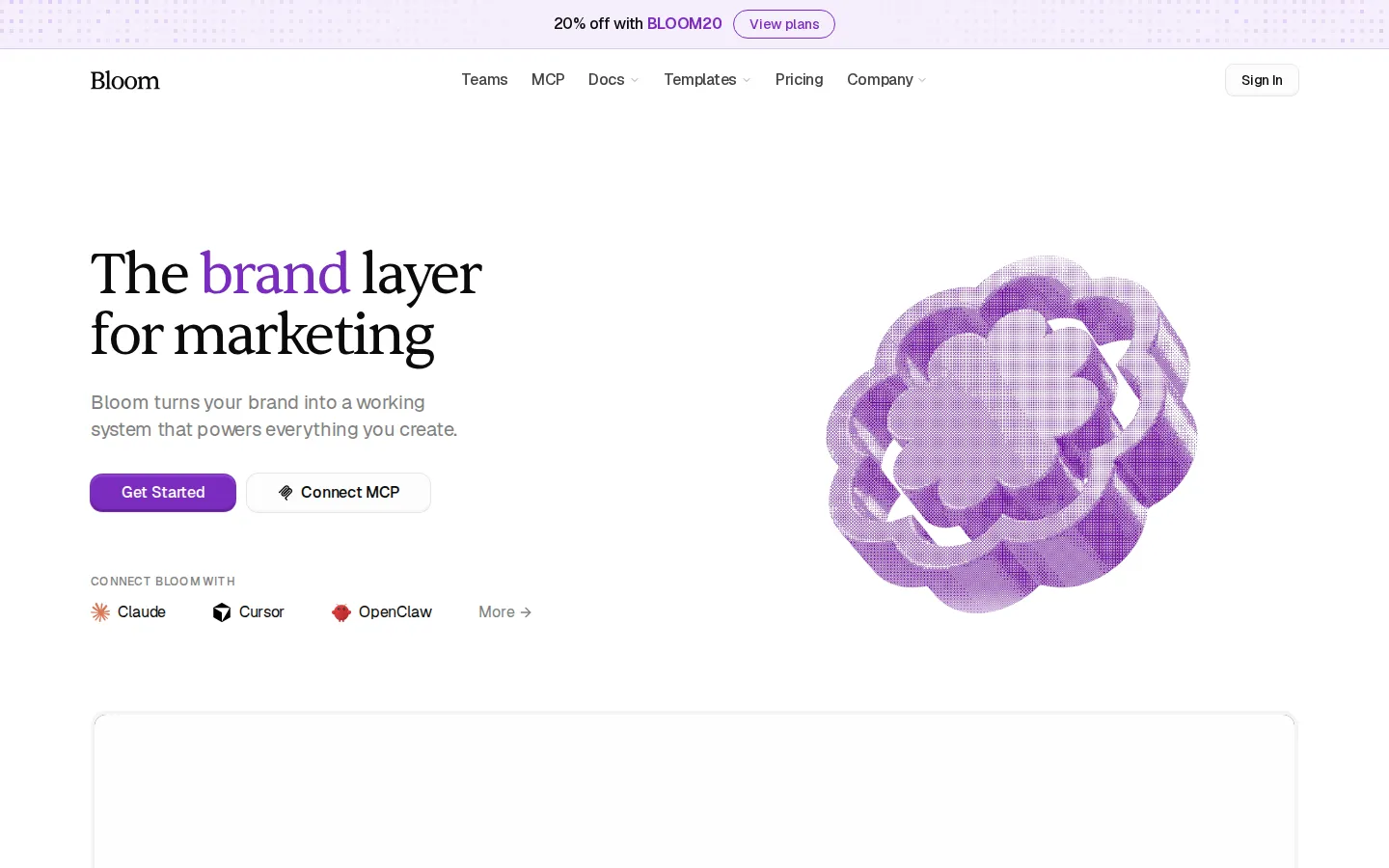
Bloom turns a brand into a working system. Upload decks, sites, Figma files, social posts, and images, and Bloom unifies aesthetics, voice, references, and products into one canonical brand. Teams then generate images, video, copy, and campaigns from it, in the app or through API and MCP, so emails, social posts, and agent output stay on-brand automatically.
What is Bloom?
Bloom is the brand layer for agents: a workspace that turns a brand into a working system, then serves that system to everything creating on its behalf. You upload what defines the brand, including decks, websites, Figma files, social profiles, images, video, and documentation, and Bloom unifies it into one canonical brand covering aesthetics, voice, references, and products. Every asset generated afterwards is called from that single source rather than re-briefed from scratch.
The workflow runs in three steps. Ingest from any source, bringing in brand guidelines, hero images, Figma homepages, launch videos, decks, product photography, voice notes, colour files, and fonts. Systemise your brand, where Bloom arranges that material into one structure spanning aesthetics, voice, references, and products. Then start creating, generating image, video, copy, campaigns, and formats such as ads, reels, headlines, banners, logos, covers, Lottie animations, OG images, carousels, posters, and icon sets.
The feature set keeps the system usable day to day. Brand updates propagate, so changing a logo, palette, or voice means every asset created from the brand reflects it. Brands are unlimited, for yourself or your clients, in a single workspace. Natural-language search lets you describe what you need and have Bloom surface it from your library, in the app or through the API and MCP. An asset toolkit covers generating, editing, resizing, producing variants, and building carousels. A Reference Library holds curated high-quality references you can pick and re-create on-brand. Documentation covers both the API and MCP.
Bloom MCP is the agent-facing half. It connects to Claude Desktop and claude.ai, ChatGPT, Claude Code, OpenCode, Cursor, VS Code, OpenAI Codex, and Manus through a single endpoint at trybloom.ai/api/mcp, with setup that amounts to opening connectors, adding a custom connector, pasting the URL, and signing in. Templates show the intended patterns: on-brand email with Resend, cross-channel marketing with n8n, social publishing with Postiz, and agents that stay on-brand with Hermes, alongside Cofounder and other partners.
For teams, brands, references, and assets are shared, members are unlimited at no extra cost, and billing is unified into one subscription and invoice with pooled credits rather than per-member caps. API and MCP access is included in every plan, including the entry tier.
Bloom Core Features
Brand ingestion
upload decks, sites, Figma files, social posts, images and video from any source
Brand system
unifies aesthetics, colours, fonts, voice, tone, references and products into one canonical source
Seamless brand updates
change a logo, palette or voice and every generated asset reflects it
Plain-English search
describe what you need and Bloom surfaces it from your brand library
Asset toolkit
generate, edit, resize, create variants and build carousels from one place
API and MCP access
plug Bloom into Claude, ChatGPT, Cursor, VS Code or your own stack
Reference Library
a curated set of high-quality references you can pick and re-create on-brand
Unlimited brands and members
add brands and teammates without paying per seat
Who is Bloom for?
Bloom is built for teams whose output has to look and sound like one company. Marketing teams are the primary audience: the site describes every team member and every channel staying on-brand, which covers campaign assets, ad variants, social posts, banners, and email creative without a designer in the loop for each format. Founders and small startups are a second fit. There is usually no brand infrastructure at an early-stage company, and Bloom's pitch of dropping in your brand and generating assets in minutes replaces the informal folder of logos and loose style notes that most small teams run on. Design and brand teams use Bloom as the system of record rather than a generator. Ingesting brand guidelines, Figma files, decks, and voice documents into one structure, then updating a logo, palette, or voice in one place with every asset following, is aimed at people who own brand consistency across a growing library. Software companies are addressed as a distinct audience: the site tells platforms to embed Bloom and skip building brand infrastructure themselves. With API and MCP access in every plan, product teams can add brand-aware generation to their own interface instead of training models on their customers' assets. Agencies and consultants fit the multi-brand design. Brands are unlimited, members are unlimited at no extra cost on Pro and above, and Scale adds shared workspaces, pooled credits, volume discounts, and single invoice billing, which suits a studio managing several client identities at once. Development and agent teams are the newest group, because Bloom exposes an MCP server at a single endpoint that plugs into Claude, ChatGPT, Cursor, VS Code, Codex, and Manus, plus templates for Resend, n8n, Postiz, Hermes, and Cofounder. Anyone shipping agents that write copy or generate images is the intended consumer of the brand layer.
Bloom Use Cases
Generate on-brand email that a Resend workflow sends dynamically to customers
Repurpose one piece of content across channels with an n8n marketing workflow
Keep agent-written copy and imagery consistent by letting agents call Bloom over MCP
Keep social publishing on-brand and scheduled using the Postiz template
Onboard a new client brand and generate campaign assets from the same workspace
Resize and adapt one campaign visual into every ad, story and banner format
Produce launch assets for a new product without re-briefing a designer
Embed brand-aware generation into your own software product through the Bloom API
Bloom Pros and Cons
Pros
- The MCP server gives agents a real brand source, so Claude, ChatGPT, Cursor and Codex can generate assets that follow your palette, fonts and tone instead of guessing
- Assets come from one canonical brand, and updating the brand propagates to everything created from it rather than leaving stale files behind
- Brands and team members are unlimited rather than metered, which is what agencies managing several client identities need
- Templates for Resend, n8n, Postiz and Hermes show the intended integration pattern, so you are not left to invent how brand-aware generation fits your stack
- API and MCP access is included in every plan, including the $16 entry tier, so the agent path is not gated behind an enterprise deal
Cons
- Output is metered as monthly assets, running from 50 on Plus to 200 on Max, so heavier production means moving up a tier or onto Scale volume pricing
- The entry Plus plan includes no team seats, so shared brands and assets require the Pro tier or above
- There is no free plan: the cheapest tier starts at $16 per month, and several FAQ answers, including ownership of generated assets, are collapsed on the live site
FAQ About Bloom
Bloom Pricing
Subscription pricing with no free plan: Plus is $16 per month from $20 with 50 assets and no team seats, Pro is $28 from $35 with 100 assets and unlimited seats, Max is $39 from $49 with 200 assets, and Scale starts at $100 per month for 500 pooled credits with volume pricing up to 8,000 credits, with API and MCP access included in every plan.
Check official pricingPlus
50 assets per month, unlimited brands, and no team seats. API and MCP access are included, and annual billing is advertised as two months free. Best for an individual creating a steady stream of on-brand assets.
Pro
The most popular tier: 100 assets per month, unlimited team seats included, priority support, and unlimited brands. Adds shared brands and assets plus unified billing with pooled credits for a working team.
Max
Listed as best value for running at volume: 200 assets per month, unlimited team seats, priority support, and unlimited brands, with the same API and MCP access as the lower tiers.
Scale
Volume pricing for individuals, teams and agencies that need more credits at lower per-credit rates. Includes shared workspaces and brand assets, pooled team credits, volume discounts, single invoice billing, unlimited team seats, and a credit slider from 300 up to 8,000 credits per month.
Custom volume and enterprise
For integrating at scale, the site offers API, MCP and custom volume arrangements through its contact channel rather than a listed price.
Bloom Alternatives

scvd.store
Free conformance checking for any issuer’s x402 signed offers and receipts including our competitors’ a weekly signed Bitcoin-anchored corpus.

Hypit
Hypit is an open-source video programming language and runtime for AI agents. A coding agent installs the skill, reads a reference video or a written brief, and rebuilds the shots, dialogue, B-roll, captions and effects with your material, producing many variants per run. Hosted generation runs on credit plans, and your own model keys can be used instead.

T3 Code
T3 Code is an open-source control plane for coding agents. It runs Claude Code, Codex, Antigravity, OpenCode, Cursor and Grok from one desktop app, keeps every agent thread on its own Git branch, and commits, pushes and opens a pull request with one button. iOS and Android apps steer the same work remotely. The app is free and MIT licensed; you bring your own agent subscriptions.