
BlazeSQL
BlazeSQL is an AI data analyst for SQL databases and warehouses. Ask a question in plain language and it writes the SQL, runs it against your data and returns charts, dashboards and PDF reports. It supports Snowflake, BigQuery, PostgreSQL, MySQL, SQL Server, Redshift, Databricks and more, with a desktop app that keeps query results local, plus ChatGPT, Claude, Slack and Microsoft Teams integration.
What is BlazeSQL?
BlazeSQL is an AI data analyst that lets anyone query a SQL database in plain language and get back charts, dashboards and reports. Instead of waiting on a BI team or writing SQL by hand, a business user types a question, and BlazeSQL translates it into a query, runs it against the connected database and visualises the result. The company calls it the only AI data analyst that truly learns your SQL database, and says it has answered over 2 million questions for teams including eBay, Siemens, Yamaha, Amazon and Flixbus.
Setup is deliberately fast. You enter your database credentials, choose the tables BlazeSQL should use, and start chatting; the site claims you can get insights in under one minute. On connection, BlazeSQL automatically extracts your schema, categorical values, column relationships and comments, so its technical mode can begin querying immediately without manual modelling. A knowledge base then lets you add descriptions for schemas, tables and columns, example queries, terminology and business context, which helps the AI understand company-specific language. The product also learns from feedback and measures its own accuracy, so teams can onboard non-technical colleagues with more confidence.
BlazeSQL supports a broad range of SQL databases and warehouses, including Snowflake, BigQuery, Microsoft SQL Server, PostgreSQL, MySQL, MariaDB, Oracle, Redshift, Databricks, Amazon Athena, ClickHouse and SAP SQL Anywhere. A single database is capped at 300 tables to encourage users to select only relevant tables; you can add the same database multiple times with different table selections, or add several databases and pick one when chatting.
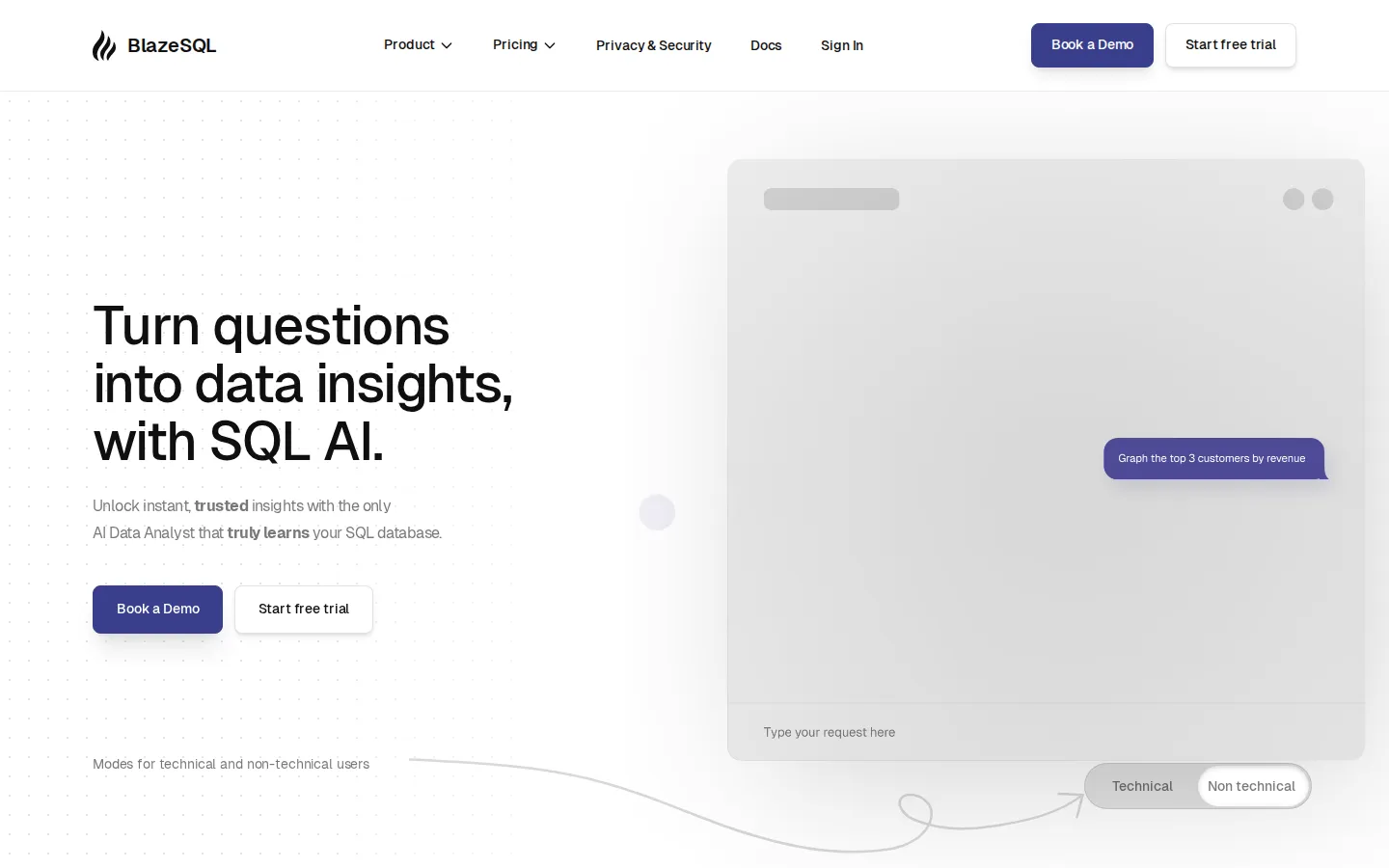
There are two broad user experiences. Technical mode suits analysts and engineers who want to inspect and refine the generated SQL, while non-technical mode gives business users a simpler chat that produces answers, graphs and dashboards. Insights can be added to personal dashboards directly from the chat, and everyone can drag and drop to build views for their own needs.
Beyond chat, BlazeSQL offers autonomous reporting that suggests insights tailored to a user's job and priorities and sends weekly updates. An agent can research context, query the database and turn the answer into shareable PDF and interactive reports. Delivery extends into everyday tools, with integrations for ChatGPT, Claude, Slack and Microsoft Teams so teams can ask questions without leaving their normal work environment. White-label and embed options, plus an API, let partners re-sell or embed BlazeSQL inside their own product.
Security is a headline feature. BlazeSQL states that no models are trained on customer data, and its desktop app has an offline mode where query results travel only between the database and the user's computer. It is a paid product from Blaze Analytics, offering a free trial but no permanently free tier.
BlazeSQL Core Features
Natural-language to SQL
Ask a question in plain English and BlazeSQL writes the SQL, runs it against your database and returns the answer with a chart or table.
Self-learning setup
BlazeSQL automatically extracts schema, categorical values, column relationships and comments, then learns from feedback and measures its own accuracy.
Knowledge base
Add descriptions for schemas, tables and columns, plus example queries, terminology and business context, so the AI understands company-specific language.
Dashboards
Add insights to a dashboard straight from the AI chat and drag and drop to build personal or shared views.
Autonomous reporting
BlazeSQL suggests insights tailored to your role and priorities and sends weekly updates, with agents that produce PDF and interactive reports.
Broad database support
Connect Snowflake, BigQuery, SQL Server, PostgreSQL, MySQL, MariaDB, Oracle, Redshift, Databricks, Amazon Athena, ClickHouse and SAP SQL Anywhere.
Private desktop app
An offline mode keeps query results flowing only between your database and your computer, and no models are trained on your data.
Native integrations and API
Ask questions from ChatGPT, Claude, Slack and Microsoft Teams, and use the API or MCP to embed, white-label or manage users and databases.
Who is BlazeSQL for?
BlazeSQL is aimed at companies that store data in a SQL database or warehouse and need technical or non-technical people to pull insights from it. Its clearest fit is a growing business where ad hoc data requests pile up on a small BI team or on engineers, and where business users want answers without learning SQL or filing a ticket. Analysts and data engineers get a technical mode that exposes and refines the generated SQL, while sales, support, operations and product colleagues get a simpler chat mode that returns answers, graphs and dashboards. Specific roles map onto it well. Heads of BI use BlazeSQL to scale a function without hiring, letting business users self-serve instead of queueing for reports. Analytics managers use it to clear recurring ad hoc requests, with one customer reporting a saving of at least a day and a half per week. Customer success and onboarding teams use it to troubleshoot and diagnose issues independently, even when they are not technical. Founders and small teams without a data function use it to test hypotheses and understand customers quickly. E-commerce and marketing teams build dashboards from order, revenue and campaign data. It is also positioned for companies that want insight delivered where they already work, through ChatGPT, Claude, Slack and Microsoft Teams, and for partners who want to white-label or embed an AI analyst inside their own product using the API. Crucially, it is a paid product for organisations with a real SQL database: it is not a free spreadsheet tool, and the FAQ states there is no permanently free tier, only a trial. It is a weaker fit for teams with no SQL database at all, for pure consumer users, or for anyone who needs a fully on-premise deployment, since BlazeSQL only keeps query results local through its desktop app rather than hosting the model on your own hardware.
BlazeSQL Use Cases
Answer business questions from a SQL database without writing SQL or waiting on the BI team.
Clear recurring ad hoc data requests so analysts reclaim hours each week for deeper work.
Give non-technical sales, support and ops staff self-service analytics in plain language.
Build personal and shared dashboards from chat answers with drag-and-drop editing.
Automate weekly insight emails and PDF reports tailored to each role's priorities.
Troubleshoot and diagnose customer or product issues from data without engineering help.
Embed or white-label an AI data analyst inside your own product using the API.
Query Snowflake, BigQuery, PostgreSQL and other warehouses from Slack, Teams, ChatGPT or Claude.
BlazeSQL Pros and Cons
Pros
- No manual modelling is needed: BlazeSQL extracts the schema automatically and can start querying for technical users almost immediately.
- Separate technical and non-technical modes let analysts inspect the generated SQL while business users get a simple chat experience.
- Strong privacy posture, with a desktop app whose offline mode keeps query results local and a stated policy that no models are trained on your data.
- Insights arrive where teams already work through integrations with Slack, Microsoft Teams, ChatGPT and Claude, plus an API for embedding and white-labelling.
- Broad database coverage, spanning Snowflake, BigQuery, SQL Server, PostgreSQL, MySQL, Redshift, Databricks, ClickHouse and more.
Cons
- There is no permanently free tier: the FAQ states BlazeSQL offers only a free trial and is not a free product.
- It is priced for organisations, starting at $150 per month for an individual Pro seat and $400 per month for a three-user team, which is steep for hobbyists or single users.
- Each connected database is limited to 300 tables, so very large schemas must be split across multiple connections or trimmed before use.
FAQ About BlazeSQL
BlazeSQL Pricing
BlazeSQL is paid with no permanent free tier, though a free trial is offered. Individuals pay $150/month for Pro or $250/month for Advanced. Teams pay $400/month for Blaze Team (3 users, $50 per extra user) or $800/month for Blaze Team Advanced (3 users, $75 per extra user), and Enterprise is custom with SSO, access groups and self-hosted query-result storage. Every user gets unlimited AI requests.
Check official pricingPro
For individual professionals. Includes a specialized AI Data Analyst, graphs and dashboards, the desktop version with a private database connection, and the knowledge base. Unlimited requests.
Advanced
For individuals who need more intelligence. Everything in Pro plus AI-generated reporting emails, an advanced analytics AI that can run Python, public and embeddable dashboards, and priority support.
Blaze Team
Standard plan for teams, including 3 users with $50 per extra user. Adds all Blaze Pro features, shared dashboards, dashboards and agent reports, ChatGPT, Claude, Slack and Microsoft Teams integration, unlimited requests, and a no-code chatbot. 14-day free trial available.
Blaze Team Advanced
Enhanced plan for teams, including 3 users with $75 per extra user. Adds dynamic integration, the advanced AI model with forecasting and statistical analysis, a computer agent for deep research and PDF generation, unlimited agent reports, API and MCP access, and white labeling.
Enterprise
Dedicated support and infrastructure. Adds SSO login via SAML or OpenID Connect, unlimited access groups to restrict table and column access, self-hosting storage for query results, SLAs and dedicated support, and bulk seat pricing tiers.
BlazeSQL Alternatives

Trooly
Trooly is an AI-native qualitative research platform. It writes the research plan, screens and recruits participants, moderates one-on-one multimodal voice interviews, and synthesizes transcripts into themed reports. Product and research teams can bring their own users at $10 per interview, or let Trooly recruit from a network of 180M+ respondents, with every interview quality-checked before delivery.

Vert
Vert is a computer-vision parking operations platform for property managers, municipalities and parking operators. It pairs smartphone-based automatic license plate recognition with digital permits, guest registration, hourly and monthly payments, violation ticketing, appeals and reporting in one branded system. Teams scan plates on foot or by vehicle, check infractions against live permit and payment records, and issue digital or printed notices without separate camera hardware.

MapGO
How far is this point from the sea? From the nearest border? Which country, region and district are it in? MapGO answers those in one click.