
Arcjet
Arcjet is a security SDK for production web apps and AI agents. Instead of sitting at the network edge, it runs inside your handler or tool call and returns a typed decision - allow, block, redact, or hold - so an unsafe action never executes, with an audit record of what each run did that a security team can actually read later.
What is Arcjet?
Arcjet is a runtime security SDK for web applications and AI agents, built by the company of the same name. Its argument is positional: identity tells you who is asking, but not what happens next, and the action that actually makes the call is the new boundary. So instead of sitting in a gateway or scanning prompts from outside, Arcjet runs inside your existing handler or tool function and returns a decision before execution - allow, block, redact, hold for review - that your own code branches on. There is no gateway, no proxy and no sidecar to run.
The building blocks are composable. On the agent side there is prompt injection detection across user input, API responses and tool output; sensitive information and data loss prevention that strips names, addresses, national IDs, bank and card numbers before they reach model context; typed agent tool controls scoped by identity, role, route and input; token and spend budgets held per run rather than per endpoint; and LLM-based content moderation. On the classic web side there is Shield WAF for SQL injection, XSS and traversal, bot detection drawing on real time threat feeds across 25 categories and 600+ bot types, rate limiting, signup form protection and email validation, including disposable domain checks. Everything returns the same decision object.
It is LLM and framework agnostic, with 20 SDKs covering Astro, Next.js, Nuxt, SvelteKit, Remix, Express, Fastify, Hono, NestJS, Deno, Bun, Node.js, FastAPI, Flask and Go, plus guards for Claude Agent SDK, LangChain, LangGraph, CrewAI, Mastra, OpenAI Agents, Microsoft Agent Framework, Vercel AI SDK, Google ADK, Genkit, TanStack AI, Strands Agents and Cloudflare Think. Coding agents including Claude Code, Codex, Copilot and Cursor are covered through hooks, a plugin, skills and an MCP server. Rules can live in code next to the handler, version controlled and unit testable, or in remote policies the security team changes without a deploy. Because Arcjet is a package rather than infrastructure, coverage rolls out service by service and your failure domain does not grow.
The published numbers are specific: local decision overhead under 1ms, 20 to 30ms when the cloud API is needed, roughly 100ms added by the prompt injection model, and SOC 2 Type II with an unqualified opinion. Every decision is retained with its policy version, actor, inputs and run history as audit evidence, kept in Arcjet cloud, a single tenant private VPC, or your own storage. Teams typically start in dry run on one route or one tool handler, read the decisions, then move the rules to live.
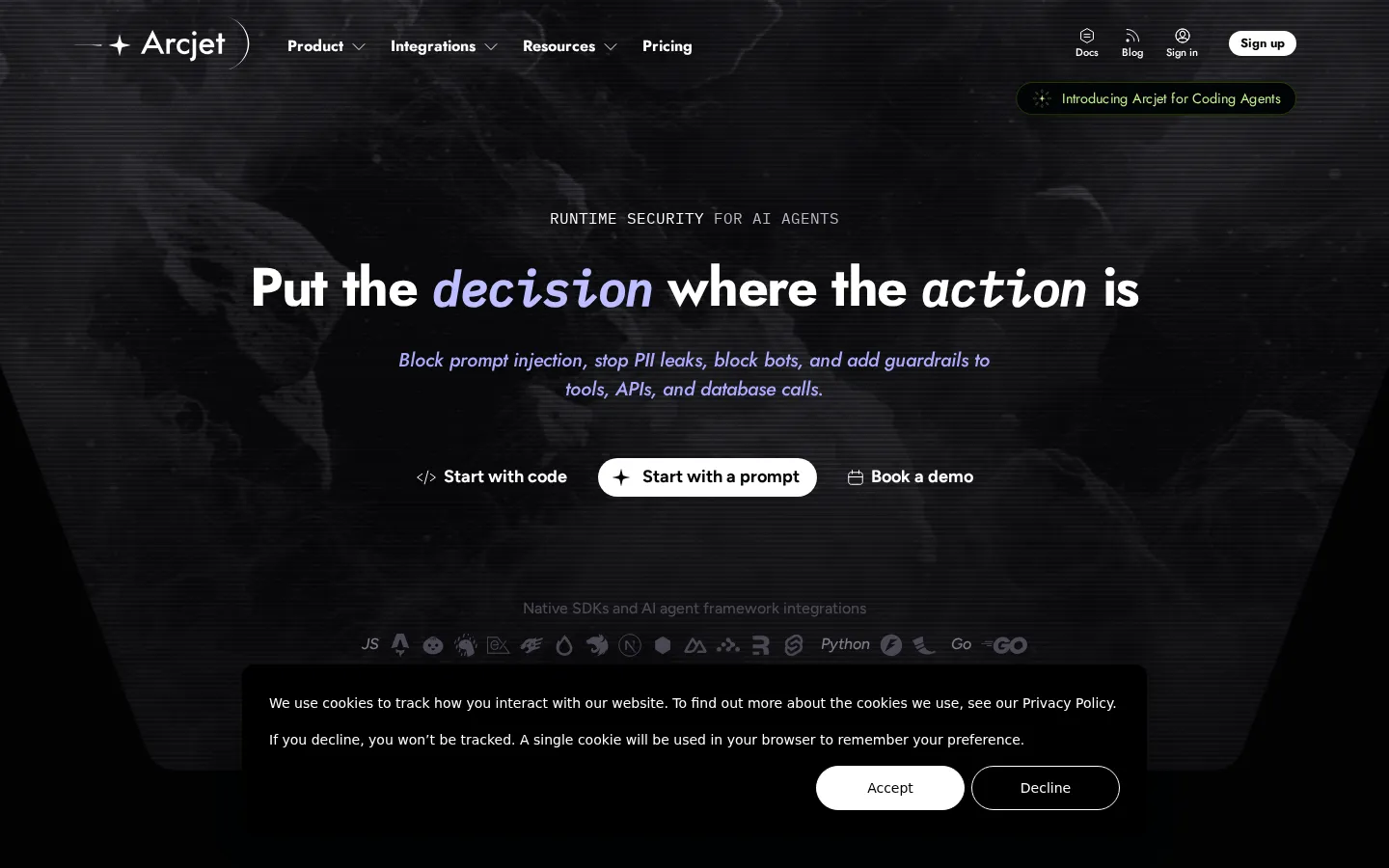
Arcjet Core Features
Shield WAF
blocks SQL injection, cross-site scripting and path traversal inside the request path that handles them, with live and dry run modes.
Bot protection
detects 600+ bot types across 25 tracked categories using real time threat feeds, and does it without serving a CAPTCHA.
Prompt injection detection
a specialist model screens user input, API responses and tool output before either reaches the model, adding around 100ms.
Sensitive information and DLP
finds and strips names, addresses, national IDs, bank and card numbers before they reach model context, logs or a third party.
Agent tool controls
guardTool scopes every call by identity, role, route and typed input, and a denied tool never runs.
Token and spend budgets
a token bucket per user, org or agent run, so a runaway loop cannot reset its count by touching a different endpoint.
Remote policies plus audit trail
security changes thresholds in the console with no deploy, while each decision keeps its policy version and run history.
Coding agent controls
finds Claude Code, Codex, Copilot and Cursor on developer machines, then blocks unapproved MCP servers and credential exfiltration through hooks.
Who is Arcjet for?
Arcjet is aimed at teams that ship software and also have to defend it, which usually means two buyers in the same room. Platform and backend engineers do the integration, because the product is a package you add to the code that takes the action rather than a proxy someone else operates. Security engineers and DevSecOps leads own the policy layer, and they get the part they usually lack: thresholds they can tighten in a console without waiting for a release, plus decisions recorded with actor, inputs and run history for audits. AI engineers building production agents are the newer half of the audience. Anyone running tool calls, MCP servers, queue consumers or workflow steps against a model needs the checks that a prompt alone cannot enforce - prompt injection in fetched content, PII leaving through a tool result, a refund call that exceeds what the session's role should allow, or a loop that spends a month of tokens in an afternoon. Teams shipping customer-facing signup forms and public API routes use the web protections for bot and abuse control without adding a CAPTCHA. The company also names engineering managers and founders of small product teams, who like that one engineer can ship the first protected route the same day with no gateway, sidecar or migration. Security leadership at larger organizations fits through the coding agent controls, since Claude Code, Cursor and Copilot on developer laptops are otherwise invisible in any inventory. It is a weaker fit for teams that want a network appliance they configure once and never touch code for, and for anyone with no budget at all, since the cheapest published plan is paid.
Arcjet Use Cases
Block prompt injection arriving through fetched pages or tool output before an agent acts on it.
Keep customer PII out of model context by redacting names, addresses and bank numbers on the way in.
Cap token spend per user and per agent run so a runaway loop stops before the invoice does.
Deny refunds or deletes outside a role's policy, evaluated at the tool call instead of in the prompt.
Protect a signup form from disposable emails, bots and scripted abuse without adding a CAPTCHA.
Rate limit an expensive API route per user or organization with one bucket shared across services.
Inventory coding agents on developer laptops and block connections to MCP servers security never approved.
Prove what an agent did during an incident using decision records, actor, inputs and run history.
Arcjet Pros and Cons
Pros
- Enforcement happens at the action boundary, so the decision has the actor, the typed arguments and the run history rather than just a request on the wire.
- Rollout is one import: no gateway, no proxy, no sidecar and no migration, and nothing new to keep running at 3am.
- Rules live in code, version controlled and unit testable with a dry run mode, while remote policies let security tighten thresholds without a deploy.
- Published performance and compliance numbers are concrete: under 1ms local overhead, 20 to 30ms with the cloud API, SOC 2 Type II with an unqualified opinion.
- Breadth is unusual for one client: agents, HTTP routes, MCP servers, queue consumers and coding agents all return the same decision object.
Cons
- There is no free tier: the cheapest plan is $25 per month after a 15 day trial, so hobby projects and pre-revenue experiments pay from day one.
- Coverage depends on you instrumenting paths yourself, so an unprotected handler or tool call simply has no policy until an engineer wraps it.
- Agent requests are billed at $50 per 1M versus $5 per 1M for web requests, so token-heavy agent workloads need real volume modelling first.
FAQ About Arcjet
Arcjet Pricing
Arcjet publishes three plans: Individual at $25 per month for one team member with one hour log retention, Startup at $299 per month for two team members with 24 hour retention and Slack support, and Enterprise as custom pricing with unlimited members, SIEM export and priority support. Both self-serve plans start with a 15 day trial. On top of the subscription, usage is metered at $5 per 1M web requests and $50 per 1M agent requests, with discounts for committed usage and no free tier listed.
Check official pricingIndividual
One team member, one hour log retention and email support, with a 15 day trial and usage billed separately at $5 per 1M web requests and $50 per 1M agent requests.
Startup
For growing teams: two team members, 24 hour log retention and email plus Slack support, on the same 15 day trial and metered usage fees.
Enterprise
Unlimited team members, SIEM export and priority support, with committed usage discounts; booked through a demo rather than self-serve checkout.
Arcjet Alternatives
Cotlet
Cotlet is a hosted MCP server and REST API for apps with no API. Cotlet builds and maintains each integration and fixes it when the app changes. Cotlet is operated by Take Group sp. z o.o., Katowice, Poland.

Pydantic
Pydantic is the company behind Pydantic Validation and a four-part AI engineering stack: Pydantic AI for type-safe Python agents, Logfire for OpenTelemetry traces and evaluations, Pydantic Evals for test datasets, and AI Gateway for one-key model routing with spend caps. Core libraries are open source; the hosted platform is metered with a free tier of 10 million records monthly.
Buddy
Buddy is a DevOps and platform-engineering automation suite for building, testing and shipping software. It pairs visual and YAML CI/CD pipelines with deployments to thousands of targets, ephemeral cloud sandboxes, tunnels, domains and visual regression tests. Its AI angle is agentic: a hosted MCP server, the bdy CLI and agent skills let Claude Code, Codex and Cursor run pipelines and deploy.