
Anara
Anara is an AI workspace for scientific research. It searches over 300 million academic papers, connects to libraries like PubMed and ClinicalTrials.gov, and works across your own uploaded PDFs, notes and datasets. Every answer links to the exact passage it came from, so researchers can check any claim in one click, extract data into cited tables, and draft with formatted references.
What is Anara?
Anara is an AI research assistant built for science, developed by Anara Labs, Inc. as a workspace where researchers find, understand and synthesize the literature. From one chat interface you can search more than 300 million academic papers across every field, filter results by journal, year, citation count or open-access availability, resolve any DOI, arXiv or PubMed identifier straight to the paper, and screen candidates against your own inclusion criteria. Results show whether full text is available and can be sorted by most cited or most recent. Beyond search, Anara keeps a persistent library of your own sources. You upload PDFs, notes, slides, spreadsheets and recordings, or import by DOI, PMID or URL, and it indexes everything with automatic metadata, OCR for scanned documents, and folders and tags. You can then ask questions across one paper, a folder or your entire collection. Every answer is a cited answer, pointing to the exact passage it used and highlighting it inside the source, so a claim can be verified in one click instead of trusted blindly. Anara also does the downstream work. It turns a folder into a cited extraction table with one row per paper and one column per question, supports PICO and GRADE frameworks, and exports to CSV or Excel. Its writing tools draft in notes with citations suggested from your library and export to Word, LaTeX or BibTeX in any citation style, with a Microsoft Word add-in for drafting in place. The product markets itself on accuracy, publishing benchmarks that claim higher answer correctness, page recall and document recall than general-purpose tools such as ChatGPT, Claude and Perplexity. Anara connects to Zotero, Mendeley, Google Drive, OneDrive, Slack and Microsoft Word, is SOC 2 Type II and ISO 27001 certified, and is HIPAA and GDPR compliant. Every plan shares one usage meter, with optional credits for heavy weeks. A developer API adds paper search and citation resolution with instant, standard and deep-search modes, and Anara runs on the web, on Mac, on iPhone and iPad, inside Microsoft Word, and from coding agents through an MCP server.
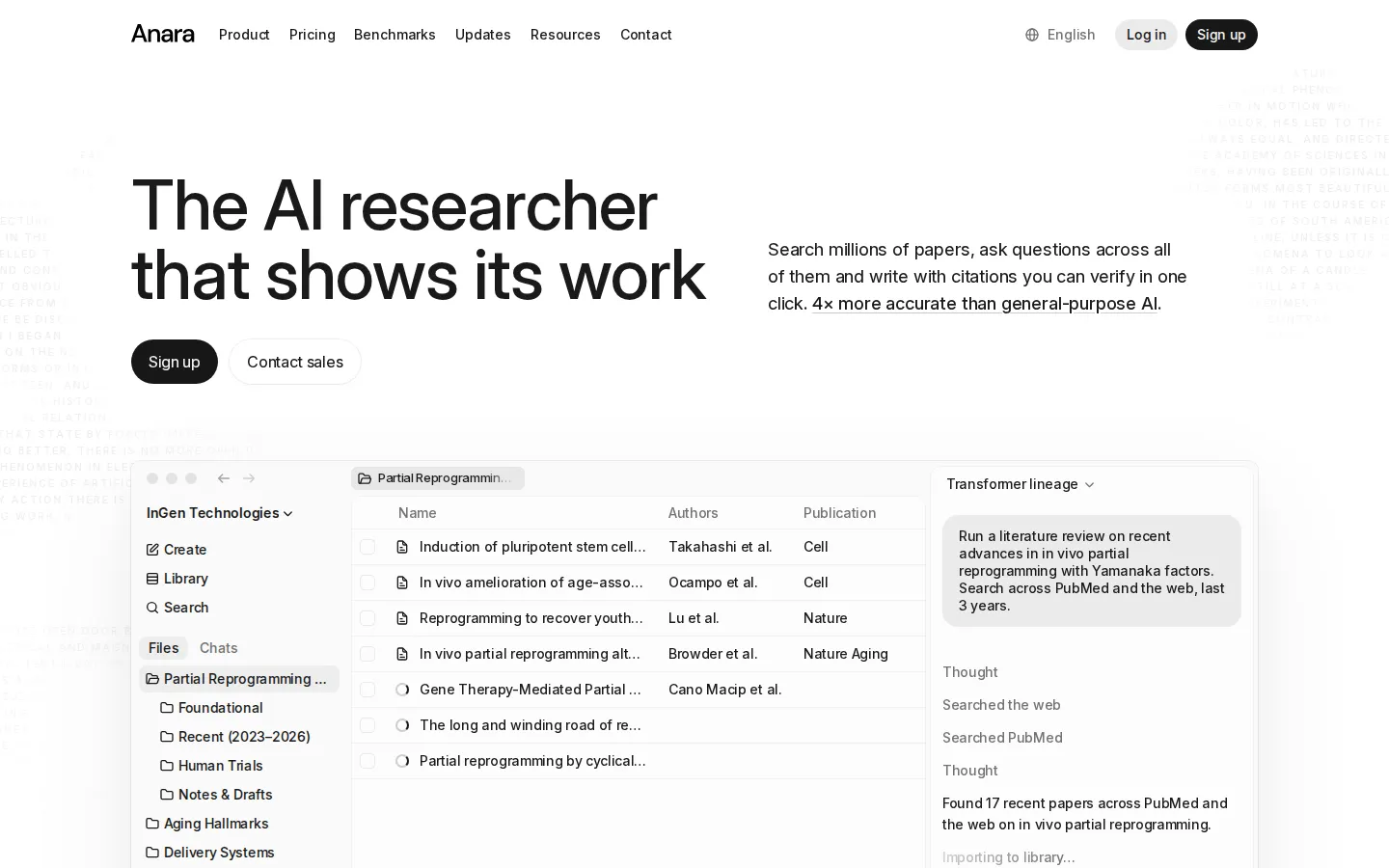
Anara Core Features
Literature search
Queries over 300 million papers across every field and filters results by journal, year, citations or open-access availability.
Persistent library
Uploads PDFs, notes, slides and recordings with automatic metadata, OCR for scans and folders, and imports sources by DOI, PMID or URL.
Cited answers
Every response links to the exact passage it came from, highlighted in the source, so any claim can be verified in one click.
Cited extraction tables
Turns a folder into a table with one row per paper and one column per question, with every cell cited and exportable to CSV or Excel.
Writing and citation
Drafts in notes with citations suggested from your library and exports to Word, LaTeX or BibTeX in any citation style.
Science and workspace connectors
Links to Zotero, Mendeley, PubMed, ClinicalTrials.gov, Google Drive, OneDrive, Slack, Teams, Benchling and Microsoft Word.
Developer API
Offers search and resolve endpoints with instant, standard and deep modes for papers, plus an MCP server for coding agents.
Deep Search and Model Council
Higher tiers add multi-step research workflows and let you pose one question to several models at once.
Who is Anara for?
Anara is aimed at researchers who cannot afford to get the facts wrong. That includes academic researchers, PhD students and postdocs who need a defensible literature review; life-sciences and biotech scientists screening papers for a target, pathway or assay; medical and regulatory specialists assembling evidence for clinical study protocols, FDA filings and systematic reviews; and industry R&D teams that must trace every claim back to a source. It also suits consultants running rapid evidence reviews under tight deadlines, and anyone who already keeps a large personal library in Zotero or Mendeley and wants to question it in plain language rather than rereading it. Journal-facing researchers use it to check a draft against its sources before submission, and lab teams use it to turn a shared folder of papers into an agreed evidence table. Because answers are cited to the exact passage and can be scoped to a folder or file, Anara fits workflows where a hallucinated reference is unacceptable, such as manuscript preparation, grant applications and compliance review. The free tier and the low-cost Plus plan make it practical for individual students and early-career researchers, while teams can share folders, invite collaborators and buy seats together. Enterprise and regulated buyers get SAML SSO, SCIM provisioning, admin controls, HIPAA business associate agreements and audit-friendly security certifications.
Anara Use Cases
Run a literature review on a topic and collect the key papers with metadata.
Screen hundreds of uploaded PDFs against inclusion criteria and extract fields into a cited table.
Ask questions across a large personal library and get answers traced to the exact passage.
Verify a claim or citation before it goes into a manuscript, preprint or grant application.
Draft a review or regulatory report with citations formatted in the required journal style.
Compare several papers side by side on methods, outcomes or reported model species.
Search PubMed, trial registries and other science databases for the most recent or most cited work.
Resolve DOIs, arXiv and PubMed identifiers from a developer workflow or a coding agent.
Anara Pros and Cons
Pros
- Passage-level citations make every answer checkable in one click, which matters in regulated and academic work.
- Searches over 300 million papers and connects to science databases such as PubMed and ClinicalTrials.gov.
- Cited extraction tables and PICO or GRADE support speed up systematic reviews and evidence synthesis.
- A free tier and a low-cost Plus plan keep it accessible to students and individual researchers.
- SOC 2 Type II, ISO 27001, HIPAA and GDPR compliance suit teams in medicine and biotech.
Cons
- Free and low tiers cap AI usage and upload size, with the allowance resetting daily or weekly.
- The strongest models, Deep Search and Model Council are reserved for the higher-priced plans.
- There is no student discount, and premium models consume usage faster than standard ones.
FAQ About Anara
Anara Pricing
Freemium. The free plan needs no credit card and covers limited usage and small uploads. Paid seats are billed per person: Plus costs $8 per month billed yearly ($10 monthly), Pro is $16 ($20 monthly), Max 5x is $80 ($100 monthly) and Max 20x is $160 ($200 monthly). Enterprise pricing is custom.
Check official pricingFree
No credit card required. Limited AI usage and uploads, 20MB or 120 pages per upload, Zotero and Mendeley connectors.
Plus
Billed yearly, $10 month-to-month. Extended AI usage, credits, 100MB or 600 pages per upload, PubMed and ClinicalTrials.gov connectors, 5 collaborators per folder.
Pro
Billed yearly, $20 month-to-month. 4x more usage than Plus, access to top models, OCR for scanned documents, 300MB or 10,000 pages per upload, Drive, Notion and OneDrive connectors, 50 collaborators per folder.
Max 5x
Billed yearly, $100 month-to-month. 5x Pro usage, Deep Search, Model Council, uploads with no size or page limit, unlimited collaborators, priority access and early features.
Max 20x
Billed yearly, $200 month-to-month. The same features as Max 5x with 20x Pro's weekly usage; you can switch between Max 5x and Max 20x in Settings.
Anara Alternatives

Metaso
Metaso (秘塔AI搜索) is an AI search engine built for research-grade answers rather than link lists. It searches the open web, document libraries, and academic indexes such as PubMed, SCIE, EI, and JCR, then writes a structured, cited answer. Extra modes produce mind maps, slides, interactive web pages, and deep-research reports, and a paid Search API exposes the same index to developers.
Trooly
Trooly is an AI-native qualitative research platform. It writes the research plan, screens and recruits participants, moderates one-on-one multimodal voice interviews, and synthesizes transcripts into themed reports. Product and research teams can bring their own users at $10 per interview, or let Trooly recruit from a network of 180M+ respondents, with every interview quality-checked before delivery.
QwQ AI
Search the live web, research complex topics, and make sense of financial data with traceable sources.