
Zencoder
Zencoder is an AI orchestration platform for software teams, combining planning, coding, testing, and code-review agents in one subscription. It routes every task to the best frontier model, from Claude Opus for architecture planning to Gemini for implementation and Codex for review, while supporting bring-your-own-key usage. Teams get multi-repository indexing, parallel agent execution, scheduled automation, and built-in quality gates, with desktop apps, IDE plugins, and CI/CD integrations.
What is Zencoder?
Zencoder is an AI coding agent platform that orchestrates frontier models to plan, build, test, and review software. It provides AI orchestration for code and work through a single subscription that gives access to every major frontier model, including Claude Opus for planning, Google Gemini for implementation, and OpenAI Codex for review. The platform includes Zenflow Code, a desktop application where agents work through pre-built workflows for features, bugs, and refactors; Zenflow Work, which extends agents to workplace tasks; and IDE agents that integrate into existing development environments. Zencoder indexes multiple repositories to give agents full codebase context, architectural awareness, and dependency mapping before they write code. Agents execute in parallel in isolated environments, and every change passes built-in quality gates, including tests, linting, and automated code review. Teams can schedule automation for daily bug triage, pull-request reviews, and dependency updates. Zencoder offers a marketplace of workflows and more than 2,000 integrations with tools such as GitHub, Slack, Google Workspace, Microsoft 365, Notion, and HubSpot. Its workflow engine follows a plan-build-verify loop: a reasoning model drafts a spec with architecture decisions and verification criteria, a fast model implements it, and a different model reviews the result, keeping the source of truth consistent across every step. Pricing is credit-based, with free and paid plans that support bring-your-own-key usage so calls through personal API keys do not consume bundled credits. Enterprise customers can deploy privately with prepaid usage plans, unlimited multi-repository indexing, and a dedicated success manager. The platform targets both individual developers and large organizations, with pricing designed to scale from a free BYOK tier to enterprise agreements. Users can also browse the Zencoder marketplace for community workflows, read detailed documentation and a public changelog at docs.zencoder.ai, and join the active Discord community for support and feature discussion. The result is a unified agentic development environment rather than a patchwork of separate AI tools.
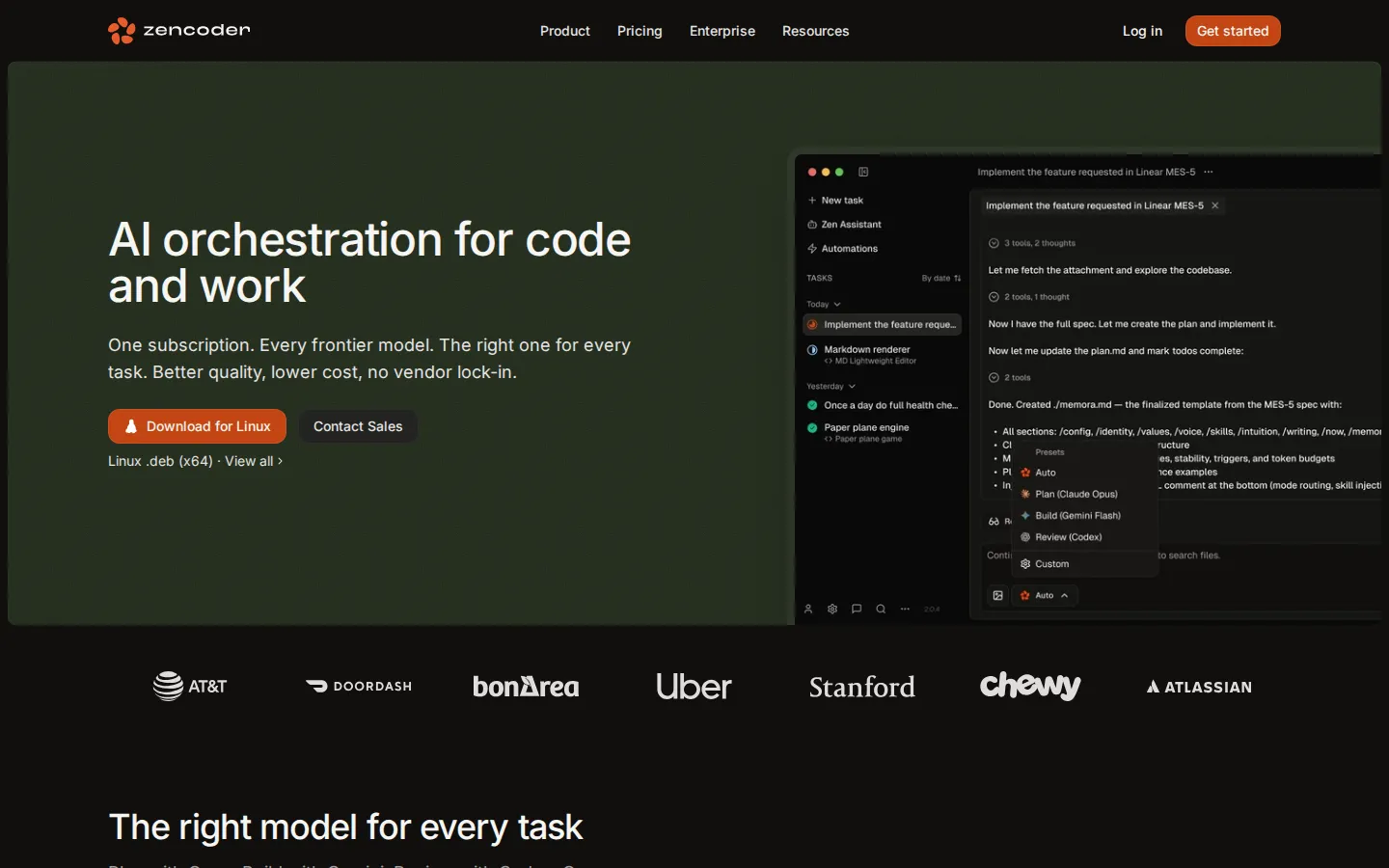
Zencoder Core Features
Multi-model orchestration
Routes planning, building, and review tasks to the best frontier model, including Claude Opus, Gemini, and Codex.
Full codebase context
Multi-repository indexing, architectural awareness, and dependency mapping give agents deep project understanding.
Agentic autonomy
Agents plan, build, test, and verify across your codebase, with parallel execution in isolated environments.
Built-in quality gates
Tests, linting, and automated code review run on every change before you review.
Scheduled automation
Daily bug triage, pull-request reviews, and dependency updates run on your schedule.
Workflow marketplace
Pre-built workflows for features, bugs, and refactors, with the ability to define custom specs.
2,000+ integrations
Connect GitHub, Slack, Google Workspace, Microsoft 365, Notion, HubSpot, and more.
Bring-your-own-key
Use your OpenAI, Anthropic, or Gemini API keys without consuming bundled credits.
Who is Zencoder for?
Zencoder serves software engineers, engineering managers, and development teams who want AI agents to handle planning, implementation, testing, and code review across large codebases. Engineering managers use it to enforce quality gates, review pull requests, and track agentic work across multiple repositories. Full-stack developers rely on it to generate features, fix bugs, and refactor code with automated verification at every step. DevOps engineers benefit from scheduled automation for dependency updates and daily bug triage. Technical leads appreciate the multi-model orchestration, which assigns Claude Opus, Gemini, and Codex to the tasks each model handles best. Platform teams use multi-repository indexing to keep agents aware of architecture and dependencies before any code is written. Organizations with strict compliance needs use the Enterprise plan, which offers SSO, audit logs, private deployment, and dedicated support. Startup teams and individual developers can start free with bring-your-own-key pricing, making frontier-model coding agents accessible without large budgets. Teams that value model flexibility also benefit, since the subscription removes the need to choose a single vendor and lets each task run on the model best suited to it. Security-conscious teams can rely on private deployment options and audit logging available at enterprise level. Agencies and consultancies that ship code for many clients find the multi-repository indexing and workflow marketplace especially useful for standardizing delivery practices across projects.
Zencoder Use Cases
Generate new product features from a written spec while agents verify the implementation with tests.
Fix bugs across multiple repositories with agents that read architecture context before changing code.
Refactor legacy codebases safely using cross-agent review and automated linting on every change.
Run daily bug triage and dependency updates automatically through scheduled automation.
Review pull requests with a different model than the one that wrote the code for fresh perspective.
Plan large architectural decisions with a reasoning model that produces specs and verification criteria.
Standardize team workflows through a marketplace of shareable agent workflows and custom specs.
Zencoder Pros and Cons
Pros
- Access to all major frontier models under one subscription with no vendor lock-in.
- Built-in verification via tests, linting, and cross-agent code review on every change.
- BYOK support lets developers use their own API keys without spending plan credits.
- Used by large enterprises including Microsoft, Uber, Oracle, Nvidia, and Salesforce.
Cons
- Credit-based pricing means heavy usage can require Pro Plus or Pro Max tiers.
- Plan credits expire monthly and do not roll over, which may surprise intermittent users.
- Advanced team features like SSO, audit logs, and shared credit pools start at the higher-priced Pro Plus plan.
FAQ About Zencoder
Zencoder Pricing
Freemium: Free BYOK plan, Pro from $45/user/month (or $40 billed annually) with 30,000 monthly credits, Pro Plus $95, Pro Max $195, Enterprise custom.
Check official pricingFree
Bring-your-own-key plan with access to frontier models using your own API keys.
Pro
30,000 monthly credits, 7-day trial, 2,000+ integrations, desktop and IDE plugins, unlimited BYOK.
Pro Plus
80,000 monthly credits, shared team credit pool, multi-repo indexing, SSO and audit logs.
Pro Max
180,000 monthly credits, priority support, all Pro Plus features.
Enterprise
Prepaid usage, unlimited multi-repo indexing, private deployment, dedicated success manager.
Zencoder Alternatives
Kitool.AI
Kitool.AI is an AI coding workspace that puts Claude Code and Codex behind one account and one API key. It offers transparent usage-based billing, a model plaza with per-million-token prices, and routing that can cost less than paying each vendor directly. Configure it once in VS Code, JetBrains, or the terminal on macOS, Windows, or Linux.

claude-mem
claude-mem keeps structured project memory outside the chat. An open-source engine captures decisions, discoveries, and fixes locally, while CMEM Pro adds hosted observation, cloud sync, and a private MCP link. Recall synced notes from Claude Code, Cursor, Codex, Gemini CLI, Windsurf, or ChatGPT, or keep everything local-first on your own machine.
GetLayers
GetLayers is Textura's library of design foundations for AI coding workflows. Browse templates, motion sections, 3D scenes, backgrounds, and gradients, then copy structured prompts into your preferred assistant. Paid plans include commercial licensing, while Full Stack adds source files and private Discord support. Full Stack Lifetime also connects the library directly to compatible assistants through MCP.