
claude-mem
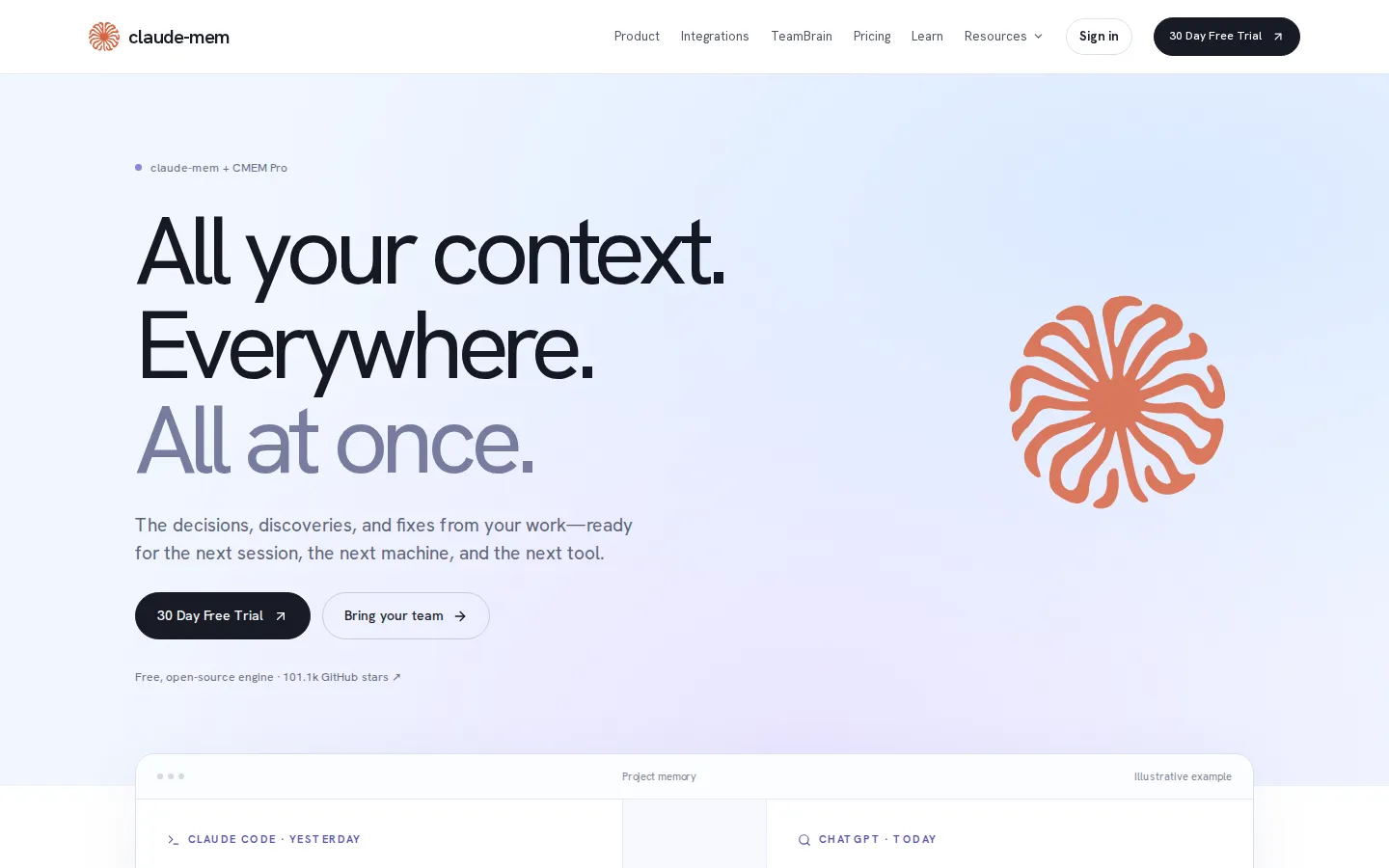
claude-mem keeps structured project memory outside the chat. An open-source engine captures decisions, discoveries, and fixes locally, while CMEM Pro adds hosted observation, cloud sync, and a private MCP link. Recall synced notes from Claude Code, Cursor, Codex, Gemini CLI, Windsurf, or ChatGPT, or keep everything local-first on your own machine.
What is claude-mem?
claude-mem is an open-source memory layer for AI coding agents. While your agent works, a second observer model turns the session into structured notes, so the decisions, discoveries, and fixes behind your code survive the chat window and are ready for the next session, the next machine, and the next tool. The engine runs locally: lifecycle hooks notice prompts, tool calls, and session endings, a compression step turns that noisy activity into observations, SQLite stores them with FTS5 search, and the next agent reads a small index before fetching only the detail it needs.
Setup starts with the open-source plugin for Claude Code and other supported integrations, which handles capture and recall inside your coding sessions. Memory lives in a local store such as ~/.claude-mem and stays on your machine by default. Progressive recall keeps token use deliberate by exposing a compact map of memory first and full observation text only when it helps, which the project frames as a defence against context rot: a large context window is not the same as clear attention.
CMEM Pro is the hosted layer. It adds memory generation on a hosted observer, real-time bi-directional cloud sync across the machines you own, and a private MCP link that lets compatible clients recall your synced project history from anywhere. Capture and recall are separate capabilities: capture requires a supported integration, while MCP connections provide recall only, and connecting ChatGPT does not automatically record ChatGPT conversations or backfill local-only history.
Pricing follows that split. The engine is free and open source, the project is built by Alex Newman (@thedotmack) with its contributors, and the site displays 101.1k GitHub stars. CMEM Pro begins with a 30 Day Free Trial, then $30/month, with Heavy at $70/month and CMEM Max at $100/month for larger included observation allowances. TeamBrain, a shared-memory offering for teams, is still in development with a design-partner cohort and has no announced public pricing.
The pitch is continuity rather than automation: your agent still forgets, but the notes, their sources, and the reasoning behind a change stay searchable, portable, and reusable across sessions and tools.
claude-mem Core Features
Automatic capture
Supported agent hooks pass session activity to an observer, which turns prompts, tool calls, and endings into structured observations without extra prompting.
Progressive recall
Your agent scans a compact index of memory first and opens full detail only when it helps, keeping token spend deliberate.
Local-first storage
Memories, index, settings, and logs live in a local store such as ~/.claude-mem, so search and recall work on your own machine.
Cloud sync with CMEM Pro
Real-time bi-directional sync keeps captured project memory consistent across the computers you have connected.
Private MCP link
A personal connection endpoint lets compatible MCP clients read synced notes from anywhere, including Cursor, Codex, Gemini CLI, and Windsurf.
Hosted observation
CMEM Pro moves memory generation to a hosted observer, so those model calls do not run on your primary agent subscription.
Searchable history
Search decisions, discoveries, and fixes by meaning, keyword, or timeline, and return to the session that produced each note.
TeamBrain pilot
A shared-memory programme for teams covering handoffs and access questions, shaped with design partners rather than sold as a public plan.
Who is claude-mem for?
claude-mem is aimed at developers who run AI coding agents every day and are tired of re-explaining the same project, retracing the same debugging path, or re-reading a long transcript to find one decision. It fits people who work across more than one machine, where context lost between a laptop and a desktop costs real time. It also suits engineers who want memory without giving up control of their data. The engine is local-first and open source, so anyone comfortable installing a plugin and running a local database can keep notes on their own hardware, inspect them, and search them. Because the engine is free, hobbyists and students can adopt it without a subscription, and individual professionals can upgrade to CMEM Pro only when they want hosted observation and cross-machine sync. The hosted tier targets heavier users: consultants and small product teams who want the same project history available from Claude Code, Cursor, Codex, Gemini CLI, Windsurf, or a compatible MCP client, and who want memory generation moved off their primary agent subscription. It is a reasonable fit for anyone already paying for a coding agent plan and looking to reduce repeated setup work. Teams evaluating shared memory are a separate audience. TeamBrain is in development with a design-partner cohort, so groups that want shared project context, handoffs, and access control are being onboarded through a pilot rather than self-serve checkout. It is less relevant for people who never use agent tooling, who prefer a fully managed cloud product with no local component, or who need guaranteed compliance certifications today.
claude-mem Use Cases
Resume a project on a different machine without re-explaining architecture, conventions, or past fixes to your agent.
Recover the reason behind an earlier change by reading the observation and its source instead of re-reading an entire session transcript.
Hand off unfinished work to a teammate or a later session with the open questions and decisions already written down.
Reduce token spend by loading a small memory index first and fetching only the observations a task actually needs.
Recall synced project context from a read-only MCP client such as ChatGPT, Cursor, or Gemini CLI when you are away from your main setup.
Keep code-review and debugging knowledge as structured notes, so repeated faults and their fixes stay searchable.
Move memory generation off your coding agent subscription to a hosted observer while keeping search and retrieval in your own client.
Track project history for research or tooling projects where the reasoning matters as much as the resulting code.
claude-mem Pros and Cons
Pros
- The engine is free and open source, with a public repository and a large star count, so the capture core can be self-hosted and inspected.
- Local-first design keeps memory, index, and search on your own machine unless you deliberately enable cloud sync.
- Progressive recall is built for token discipline, showing an index before full observations rather than replaying whole transcripts.
- CMEM Pro connects the same project history to Claude Code, Cursor, Codex, Gemini CLI, Windsurf, and ChatGPT through one private MCP link.
- A 30 Day Free Trial with included usage lets you test hosted observation and sync before paying.
Cons
- Capture depends on installing a supported integration, and MCP connections are recall-only, so not every tool records automatically.
- The paid tiers sit on top of agent subscriptions you already pay for, and the effect on total token cost depends on your workflow.
- TeamBrain has no public pricing or self-serve plan, so shared team memory is only available through a design-partner pilot.
FAQ About claude-mem
claude-mem Pricing
The claude-mem engine is free and open source, while CMEM Pro's hosted observation and cloud sync start with a 30 Day Free Trial at $30/month, with Heavy at $70/month and CMEM Max at $100/month.
Check official pricingclaude-mem (open source)
Free local engine: automatic capture in supported integrations, searchable local memory and session history, and bundled skills with open-source code.
CMEM Pro
Hosted observation, cloud sync across connected machines, a private MCP recall link, and searchable project history; 30 Day Free Trial then $30/month.
Heavy
The same product with a larger included observation usage allowance than Pro, selectable through the upgrade flow and managed in the dashboard.
CMEM Max
The largest included observation allowance, plus billed overages above the allowance, subject to a safety ceiling.
CMEM TeamBrain pilot
In development with a design-partner cohort; pilot seats, onboarding, scope, and price are agreed on a fit call, and public team pricing is not announced.
claude-mem Alternatives

FastRouter
FastRouter is a unified LLM gateway that gives developers one OpenAI-compatible API for 200+ models from providers such as OpenAI, Anthropic, Google, and xAI. It adds automatic model routing, fallbacks, caching, spend caps, role-based access, guardrails, and per-request observability, while passing provider token prices through with no markup on any plan, including the free tier.

Cindy
Cindy is an open-source desktop AI agent from XD Inc. that unifies Claude Code, Codex and Pi harnesses with 20+ tools, persistent memory and reusable skills. Use it free with your own API key or existing Coding Plan, or pay for the optional managed model service that works the moment you sign in. No setup project required.

MyToolster
MyToolster packs 41 free utilities into one browser-based site, sorted into Audio & Video, Text, Data, Web, Color, QR Code and Image. Beyond the usual encoders, formatters and generators it runs OpenAI Whisper transcription, AI text and image detection, background removal and subtitle export locally, with no uploads, account or installation, and every tool page does its work client-side.