
Winston AI
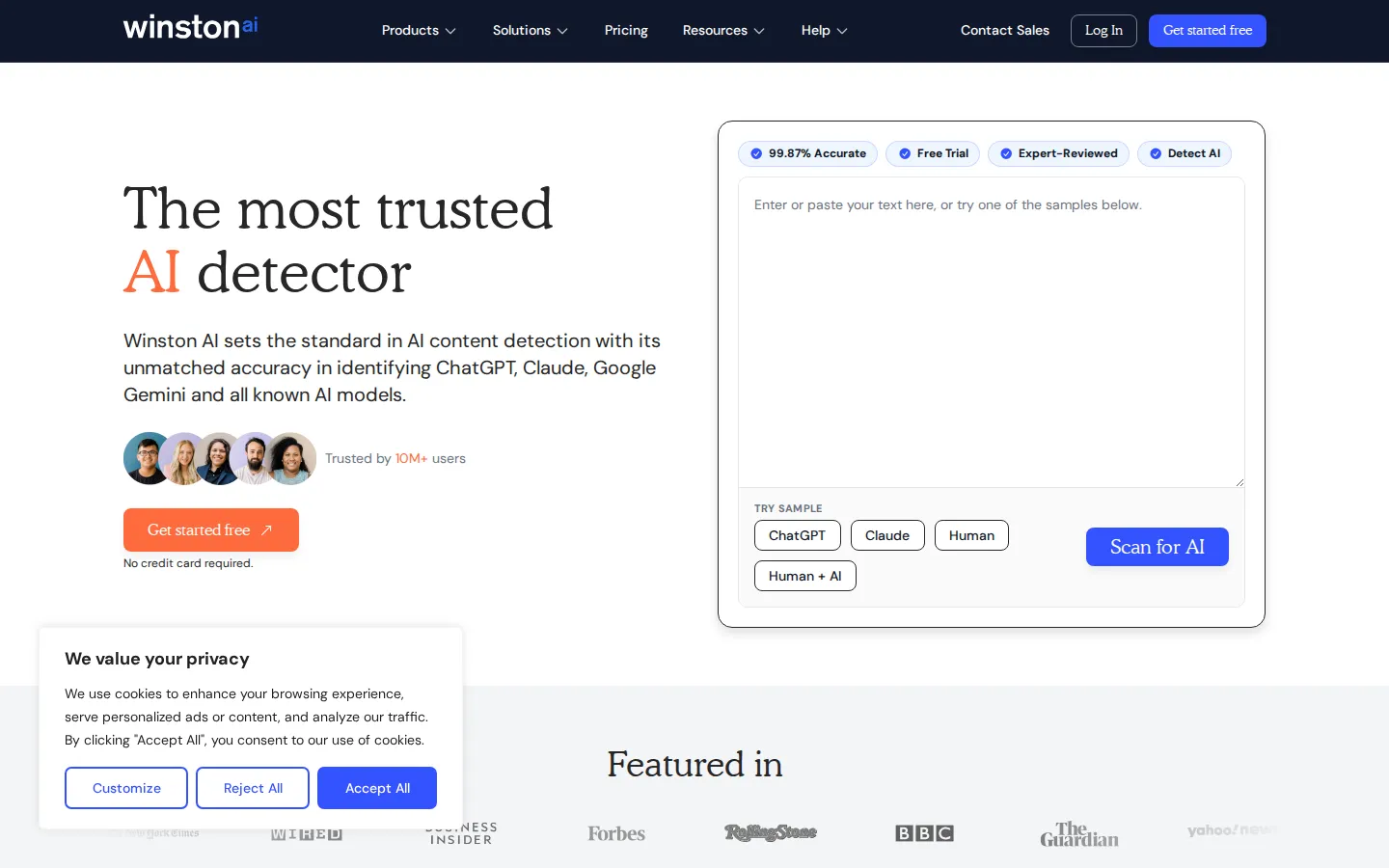
Winston AI scans text, documents, and images for signs of machine generation and copied material, returning a 0-100 human-versus-AI score with sentence-level highlighting. It detects output from ChatGPT, Claude, Gemini, and Llama across fourteen languages, checks plagiarism against web sources, reads handwriting through OCR, and exports shareable PDF reports. Education, publishing, and SEO teams use it for integrity checks.
What is Winston AI?
Winston AI is an AI content detector and plagiarism checker built by Winston AI Inc., a Montreal-based company. It answers one question that schools, publishers, and SEO teams keep running into: was this text written by a person or generated by a large language model? You paste text, upload a .docx file, or drop in a photo or scan, and the detector returns a score from 0 to 100 describing how likely the content is machine-written. A prediction map then colors individual sentences so a reviewer can see exactly where the writing turned synthetic, and a plagiarism pass can run in the same report.
Winston AI markets a 99.87% accuracy figure and says the model is retrained weekly to keep pace with new LLM releases. It reports first place on the RAID benchmark at a 1% false-positive rate, 100% accuracy on the Chicago Booth set of 8,697 documents, and zero false positives across 25,996 authentic PERSUADE 2.0 student essays. Those are vendor-published results rather than independent audits, and the company presents them on a dedicated research and validation page.
Detection covers ChatGPT, Claude, Google Gemini, Llama and other models, including paraphrased or humanized text, in fourteen languages: English, French, Spanish, German, Portuguese, Dutch, Polish, Italian, Romanian, Indonesian, Tagalog, Russian, Bulgarian and simplified Chinese.
Beyond text, the suite has widened. There is an AI image and deepfake detector with C2PA, EXIF and IPTC forensics, a plagiarism checker with highlighted sources, writing feedback and readability scoring, a fact checker, an essay grader, a grammar checker, a citation generator, and free utilities such as text compare and a word counter. HUMN-1 is a website certification that lets publishers display a badge attesting to human-authored content.
Workflow is credit-based. Free accounts get 2,000 credits across a 14-day trial, while paid plans run from 100,000 to 500,000 credits a month with scans of up to 200,000 characters and unlimited scans per hour. Winston AI ships as a web app with a Chrome extension, WordPress plugin, Google Classroom integration, Zapier connection, and three APIs covering content, image, and plagiarism detection. The company states GDPR compliance and says submitted content is never used to train its models.
Winston AI Core Features
AI Content Detection
Scores text from 0 to 100 for AI authorship across ChatGPT, Claude, Gemini, Llama, and newer models, with a sentence-level prediction map.
Plagiarism Checker
Scans writing for copied passages, highlights the matches, and lists the sources it found in the same report as the AI score.
AI Image and Deepfake Detection
Flags generated or manipulated images from tools such as Midjourney, DALL-E, and Stable Diffusion, with C2PA, EXIF, and IPTC forensics on higher plans.
OCR and Document Scanning
Accepts .docx, .png, and .jpg uploads and pulls text out of scans, photos, and handwriting before analysis.
Writing Feedback and Readability
Returns a reading-ease score and line-level suggestions on paid plans, so a draft can be improved rather than only judged.
HUMN-1 Website Certification
Issues a badge publishers can display to signal human-authored content, trialed on the free plan and included from Advanced upward.
Reports and Team Workflows
Generates shareable PDF and link reports, with team invites, pooled credits, and role-based provisioning on the top tier.
Integrations and API
Chrome extension, WordPress plugin, Google Classroom, Zapier, and separate content, image, and plagiarism APIs for embedding detection elsewhere.
Who is Winston AI for?
Winston AI is aimed at anyone who has to judge the authorship of a piece of writing and defend that judgment afterward. Teachers and university faculty are the core audience: they run submissions through the detector, keep the sentence-level report as evidence in an integrity conversation, and lean on the essay grader for marking. School and district administrators buy it institutionally, which is why there are team seats, pooled credits, and volume plans sold through sales. Publishers and SEO teams come next. Editorial leads screening freelance drafts before publication, agencies auditing client content, and content managers checking whether their writers lean on ChatGPT all use the AI score and plagiarism report as a gate before anything goes live. Writers and students use it on their own work as a pre-flight check, since a low AI score in advance is easier to handle than a flag afterward. AI image detection and C2PA/EXIF forensics serve newsrooms, marketplace trust teams, and editors verifying whether a photo is real. Developers and product teams reach for the API when detection has to live inside an LMS, a hiring platform, or a publishing pipeline. Larger organizations needing provisioning, shared billing, or custom integrations go through enterprise sales. It is also a reasonable fit for non-native English writers preparing manuscripts, grant applicants checking a proposal before it goes out, and marketing teams that want a second opinion on whether a draft reads like the model wrote it. Anyone expecting a deterministic yes-or-no answer will be disappointed, because every score is a probability.
Winston AI Use Cases
Check student submissions: Run essays and assignments through the detector, then attach the sentence-level report to an academic integrity review.
Screen freelance drafts: Score incoming articles before publishing so AI-heavy copy is caught while it can still be revised.
Verify images before publication: Test photos and screenshots for synthetic origin and read C2PA or EXIF metadata when provenance matters.
Audit content at scale: Push pages through the API or Zapier to monitor a large site for AI-generated or duplicated copy.
Pre-flight your own writing: Scan drafts before submission or delivery so a false-positive surprise does not land at the worst moment.
Grade and comment faster: Use the essay grader and writing feedback tools to shorten marking time and standardize the comments students receive.
Protect a publishing brand: Apply HUMN-1 certification to signal human authorship and back up the trust signals search teams look for.
Catch copied text: Run manuscripts, briefs, or theses through the plagiarism checker and resolve the cited sources before anything ships.
Winston AI Pros and Cons
Pros
- The core detector gives useful granularity: a 0-100 score plus a sentence-level map is far easier to defend in a conversation than a single verdict.
- One report covers both AI and plagiarism, which removes the step of running two tools and reconciling their outputs.
- Language coverage is broad, with detection offered in fourteen languages, more than most competitors in this category list.
- Integrations are unusually complete: Chrome extension, WordPress plugin, Google Classroom, Zapier, and three separate APIs.
- Pricing is published and the entry cost is low, with a 2,000-credit, 14-day trial that requires no credit card.
Cons
- The headline accuracy figures, including 99.87%, first place on RAID, and zero false positives, are vendor-published benchmarks rather than independent audits, so test them on your own samples.
- The free tier is a 14-day trial rather than a permanent free plan, and monthly credit allowances mean heavy scanning eventually pushes you to a higher tier or paid top-ups.
- Annual plans cannot be cancelled mid-term, and detector verdicts stay probabilistic, so a score alone should not be treated as proof in a disciplinary or legal process.
FAQ About Winston AI
Winston AI Pricing
Free trial first: $0 for 2,000 credits over 14 days with no card, then three monthly tiers. Essential is $18 per month for 100,000 credits, Advanced $29 for 200,000, and Elite $49 for 500,000, each with unlimited scans per hour and up to 200,000 characters per scan. Annual billing is about 45% cheaper at $60, $96, and $156 per year, and a BTS50 coupon on the page halves monthly rates to $9, $14.50, and $24.50. Custom enterprise plans go through sales.
Check official pricingFree
2,000 credits across a 14-day trial, AI text and image detection, advanced plagiarism detection, OCR scanning, shareable PDF reports, HUMN-1 certification trial, team invites, and credit top-ups. No credit card required.
Essential
100,000 credits per month, AI text and image detection, writing feedback, OCR, PDF reports, plagiarism detection, and team invites. $9 per month with code BTS50; $60 per year billed annually, equal to $5 per month with the code.
Advanced
200,000 credits per month, advanced plagiarism detection, HUMN-1+ website certification, writing feedback, and up to 5 team members with pooled credits. $14.50 per month with code BTS50; $96 per year billed annually, or $8 per month with the code.
Elite
500,000 credits per month, HUMN-1+ certification, advanced plagiarism detection, writing feedback, and unlimited team members with pooled credits and provisioning. $24.50 per month with code BTS50; $156 per year billed annually, or $13 per month with the code.
Enterprise
Custom pricing sold through the sales team, with enterprise-grade detection, custom integrations, dedicated support and implementation help, and options for academic, API, enterprise, or reseller access.
Winston AI Alternatives

Pangram
Pangram is an AI detector that checks text, images and documents for AI-generated or AI-assisted writing and flags plagiarism in the same scan. It reports a confidence score and highlights which segments look machine-written, supporting more than 20 languages and 26 frontier models. Educators, publishers, recruiters and content teams use it to verify authorship and enforce transparent AI policies.

Netus AI
Netus AI is a writing and chat platform with two apps on one account. Writer humanizes AI text so detectors such as Turnitin, GPTZero and Copyleaks read it as human, paraphrases, summarizes and generates articles and emails, and includes an unlimited free AI detector. Chat runs models from OpenAI, Anthropic, Google, xAI, DeepSeek, Kimi and MiniMax in one interface, switching mid-conversation without losing context.
WriteHuman
WriteHuman is an AI humanizer and detector built for serious writing. Paste AI-generated text from ChatGPT, Claude, Gemini, Grok, DeepSeek or any other model and it rewrites the draft with varied sentence length, stronger word choice and conversational transitions, while keeping your original meaning intact. It supports 40-plus languages and ships a built-in AI detector, an AI image detector, a Chrome extension and mobile apps.