Pangram
Pangram is an AI detector that checks text, images and documents for AI-generated or AI-assisted writing and flags plagiarism in the same scan. It reports a confidence score and highlights which segments look machine-written, supporting more than 20 languages and 26 frontier models. Educators, publishers, recruiters and content teams use it to verify authorship and enforce transparent AI policies.
What is Pangram?
Pangram is an AI detector built by Pangram Labs that identifies AI-generated and AI-assisted text with what the company describes as industry-leading accuracy. Founded in Brooklyn, New York, in 2023 by AI researchers who previously worked at Tesla and Google, it sets out to restore trust in written content as generative models spread through academia, journalism and business. Rather than guessing from simple statistics, Pangram analyses writing style, word choice, syntax and grammatical structure to decide whether a passage was written by a human, by an AI model, or edited with AI assistance.
The product returns more than a single label. Pangram reports a confidence score, estimates how much of a document is AI-generated, and highlights the specific segments that look machine-written, so users can see exactly where an AI tool contributed. It benchmarks against 26 frontier models from labs such as OpenAI, Anthropic, Google, Meta, DeepSeek and xAI, and reports accuracy above 99 percent on those AI-generated samples. Published tests cover Claude Opus 5, GPT-5.6, Gemini 3 and xAI's Grok 4.3, and the company retests whenever a major model ships.
Detection is not limited to text. Pangram also offers an AI image detector that scans JPG, PNG and WebP files, and it combines AI detection with plagiarism checking in a single scan, giving a complete picture of text authenticity. A separate AI assistance mode flags passages that were edited by AI rather than fully generated. The detector is multilingual, covering more than 20 languages including English, Arabic, Chinese, French, German, Hindi, Japanese, Korean, Portuguese, Russian, Spanish and Vietnamese.
Users work through a web dashboard, a Chrome and Firefox browser extension, a Google Docs add-on or a Gmail integration, and it plugs into learning management systems such as Canvas, Moodle, Google Classroom and Brightspace. A public API supports high-volume and custom enterprise projects. Documents can be pasted or uploaded as PDF, DOCX or RTF files, with OCR for scanned paperwork and up to 100 files processed at once.
Accuracy claims are backed by independent research: the University of Maryland and the University of Chicago evaluated the detector, and a University of Chicago Booth study found Pangram had the lowest false positive rate in its comparison, posting 1 in 10,000 on the company's aggregate data. Pangram publishes a model card, research papers and a regular blog documenting how detection works and how new models perform.
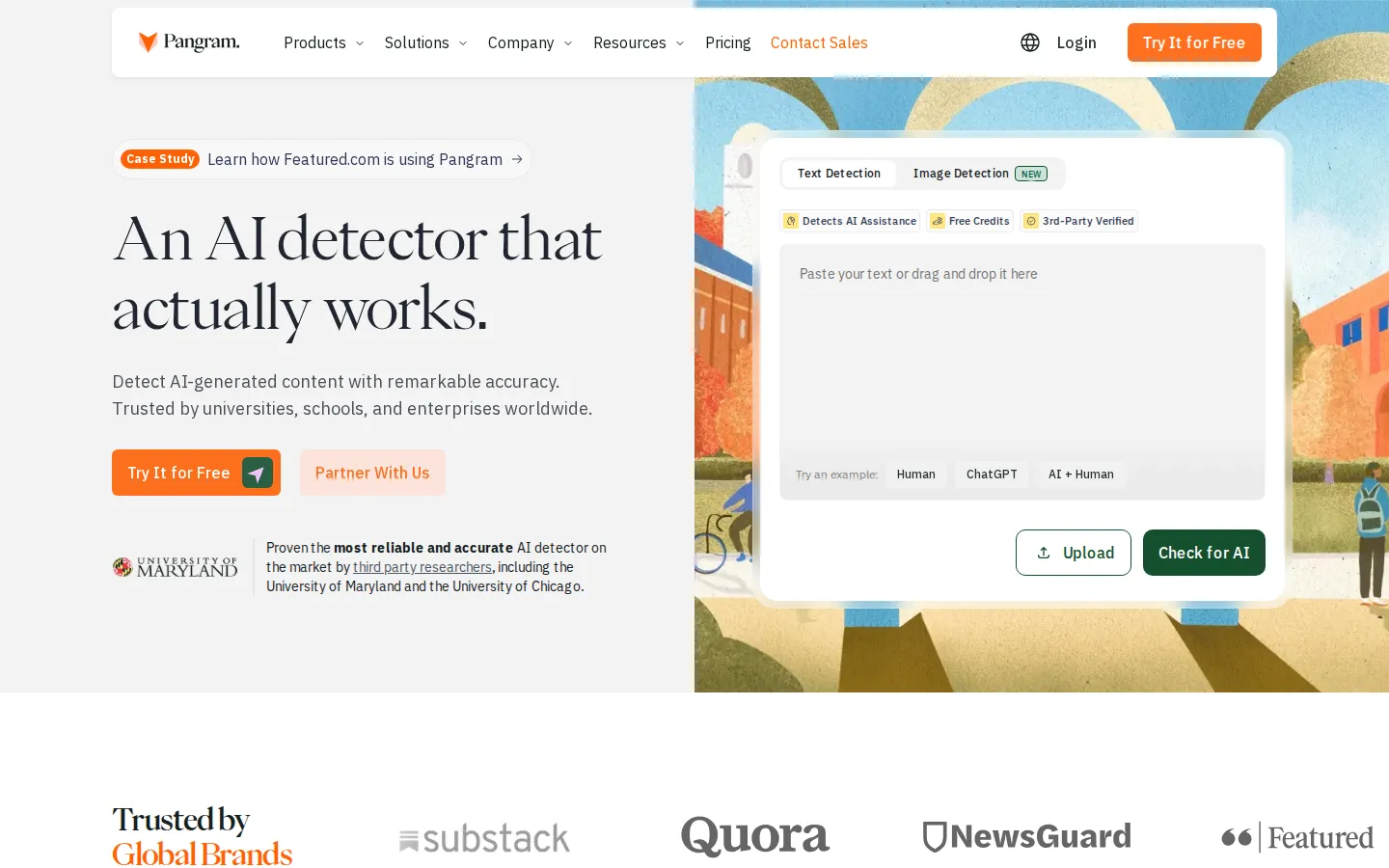
Pangram Core Features
Text detection
Paste text or upload PDF, DOCX and RTF files for a human, AI or AI-assisted verdict.
AI image detection
Scan JPG, PNG and WebP images up to 30MB to spot AI-generated visuals.
Segment highlight view
See exactly which passages look machine-written, with a score showing how much of a document is AI.
Plagiarism checker
Check for plagiarism and AI in the same scan, with one-click detection on every document.
AI assistance detection
Flag segments that were edited or rewritten by AI rather than fully generated.
Multilingual detection
Detect AI writing across more than 20 languages, including English, Chinese, Arabic, Spanish and Japanese.
Built-in integrations
Work inside Chrome, Firefox, Google Docs, Gmail and LMS platforms such as Canvas and Moodle.
Scan history
Store every result, revisit past checks and download reports from a single dashboard.
Who is Pangram for?
Pangram is aimed at people who need to know whether a piece of writing was produced by a human or an AI model, and who cannot rely on gut feeling. The website names several specific groups. Teachers are the clearest audience. Pangram helps them understand the origin of student writing and check for plagiarism, with a documented false positive rate the company cites as 1 in 10,000 so that a flag becomes a prompt for conversation rather than an accusation. Policy guides and Google Docs integration make it usable for day-to-day grading. Universities and their academic integrity offices form a second group. Pangram's LMS integrations for Canvas, Moodle, Brightspace and Google Classroom let institutions apply AI policies at scale, while integrity teams use segment highlights and comparisons to real AI responses as evidence in formal cases. Publishers, editors and newsrooms use Pangram to vet submissions, freelance copy and press releases, since AI-generated pitches now arrive routinely. Partners such as Qwoted and Wiki Education rely on it, and journalists can use it to confirm that a contributor's draft is original. Recruiters and HR departments apply it to resumes, cover letters and application essays, where polished AI text is increasingly common. Law firms use it to check briefs, filings and client documents for machine authorship before they are submitted or relied upon. Trust and safety teams and content moderation groups run Pangram over user-generated posts and comments to reduce moderation workload and flag AI spam at volume. Developers and ML engineers use the API to embed detection into their own products and pipelines. Finally, compliance and research teams turn to Pangram when they need a defensible audit trail of authorship. It is a poorer fit for anyone expecting a verdict with zero review, since the tool reports probabilities and segments rather than absolute proof, and for organisations that cannot send content to a third-party cloud service.
Pangram Use Cases
Check a student essay for AI-generated or AI-assisted writing before grading it.
Scan a batch of resumes and cover letters for machine-written application text.
Verify that a freelance article or press release was written by a human author.
Run plagiarism and AI detection together on a research paper or thesis draft.
Detect AI-generated images submitted alongside written work or listings.
Screen user-generated posts and comments for AI spam at moderation scale.
Embed AI detection into a product or content pipeline through the Pangram API.
Confirm whether a document was rewritten or humanized by an AI evasion tool.
Pangram Pros and Cons
Pros
- Third-party verified accuracy: independent evaluations from the University of Maryland and the University of Chicago found Pangram among the most reliable detectors tested.
- Very low false positive rate: the company cites 1 in 10,000 on aggregate public datasets, which matters for classrooms and hiring decisions.
- Combined AI and plagiarism detection in a single scan, plus AI image detection and AI assistance flags for edited text.
- Broad reach: more than 20 languages, 26 benchmarked frontier models, and integrations for Chrome, Firefox, Google Docs, Gmail and major LMS platforms.
- Real free tier and public API: twenty free checks a day after signing up and an accessible API with credit-based plans.
Cons
- AI detection is probabilistic, so results are evidence rather than proof; flagged writing still needs human judgement before any academic or employment consequence.
- The free plan is limited to a daily word and scan allowance, and deeper features such as plagiarism detection and larger volumes require a paid subscription.
- Pangram's detection quality depends on how current its models are, and no detector catches every humanized, paraphrased or heavily edited piece of AI text.
FAQ About Pangram
Pangram Pricing
Pangram uses a freemium model: a free plan with twenty checks a day (up to 2,000 words daily and three image scans), a $20 per month Individual tier billed annually with a seven-day free trial, a $65 per month Professional tier that adds five times the volume and $200 of monthly API credits, and custom Enterprise pricing via contact sales.
Check official pricingFree
Free plan, no payment method needed. Scan up to 2,000 words per day, get three image detection scans daily, upload files with OCR, detect AI in over 20 languages, use the browser extension and Google Docs integration, and access the Pangram API.
Individual
Marked Recommended and billed annually with $60 saved. Includes a seven-day free trial, then $20 per month for up to 300,000 words monthly, 100 image detection scans per month, plagiarism detection on every scan, automatic scanning of social media and Substack feeds, and Gmail integration.
Professional
Billed annually with $240 saved and $65 billed now. Everything in Individual plus five times more words, five times more image scans, and $200 of API credits included monthly.
Enterprise
Custom pricing for organisations. Contact sales through the Pangram enterprise page for volumes, integrations and support tailored to schools, universities and businesses.
Pangram Alternatives

Winston AI
Winston AI scans text, documents, and images for signs of machine generation and copied material, returning a 0-100 human-versus-AI score with sentence-level highlighting. It detects output from ChatGPT, Claude, Gemini, and Llama across fourteen languages, checks plagiarism against web sources, reads handwriting through OCR, and exports shareable PDF reports. Education, publishing, and SEO teams use it for integrity checks.
Netus AI
Netus AI is a writing and chat platform with two apps on one account. Writer humanizes AI text so detectors such as Turnitin, GPTZero and Copyleaks read it as human, paraphrases, summarizes and generates articles and emails, and includes an unlimited free AI detector. Chat runs models from OpenAI, Anthropic, Google, xAI, DeepSeek, Kimi and MiniMax in one interface, switching mid-conversation without losing context.
WriteHuman
WriteHuman is an AI humanizer and detector built for serious writing. Paste AI-generated text from ChatGPT, Claude, Gemini, Grok, DeepSeek or any other model and it rewrites the draft with varied sentence length, stronger word choice and conversational transitions, while keeping your original meaning intact. It supports 40-plus languages and ships a built-in AI detector, an AI image detector, a Chrome extension and mobile apps.