
Verdent
Verdent is an agentic coding suite that turns plain-language product goals into working software. Its desktop app, browser-based Verdent Cloud, and VS Code and JetBrains extensions coordinate parallel AI agents that plan, build, test, and review work. Powered by Claude, GPT, Gemini, Kimi and GLM models, Verdent keeps full project context, remembers your preferences, and offers free, credits, Eco Mode and BYOK usage.
What is Verdent?
Verdent is an agentic coding suite from Verdent AI, Inc., built around a simple idea: describe the outcome you want in plain language, and a team of AI agents plans the work, executes it in parallel, tests it, and reports back when it is done. Instead of autocompleting the next line of code, Verdent takes a product goal, decomposes it into phases and subtasks, dispatches each subtask to a dedicated worker agent, and tracks progress on a Kanban-style task board with a dedicated review column.
The product ships across three connected surfaces. The Verdent desktop app for macOS and Windows is the multi-agent workspace where projects, tasks, memory, automations, and integrations live. Verdent for VS Code and the JetBrains integration bring the same agentic engine into the editor you already use, with a Plan-Code-Verify workflow, code diffs, isolated git worktrees, and specialized subagents such as a verifier and a fast context agent. Verdent Cloud runs in the browser, so you can build, edit, preview, publish, and manage web apps without installing anything, and free-mode accounts include a limited number of Cloud apps, project storage, and a database.
Verdent is powered by multiple frontier model families, including Claude, GPT, Gemini, Kimi, GLM, and DeepSeek options, so each agent can use the model best suited to its task. Usage is credit-based, with flexible top-ups, Eco Mode for lower-cost models that do not consume credits, BYOK support for plugging in your own provider API keys, and BYOA for running workers on external agent runtimes. Credits are shared across the desktop app and the VS Code extension.
Context and memory sit at the centre of the design. Verdent keeps the whole project in view, so a subscription billing task added this week and an admin dashboard added next month both start from the same understanding of the codebase. It learns your preferences, stack choices, coding style, and standards over time, then applies them across projects. Project rules in an AGENTS.md file, workspace settings, and user rules in a VERDENT.md file are resolved in a defined priority order.
Beyond code, Verdent covers the rest of the build: authentication, data storage, payments and subscription billing, admin tooling, plugin integrations for GitHub, Stripe, Supabase, Notion, and Linear, natural-language scheduled automations, short video generation from chat, and instant messaging so you can assign work from Telegram, Slack, or Feishu. Work keeps moving while you are away, and finished tasks wait in review rather than interrupting you with constant questions.
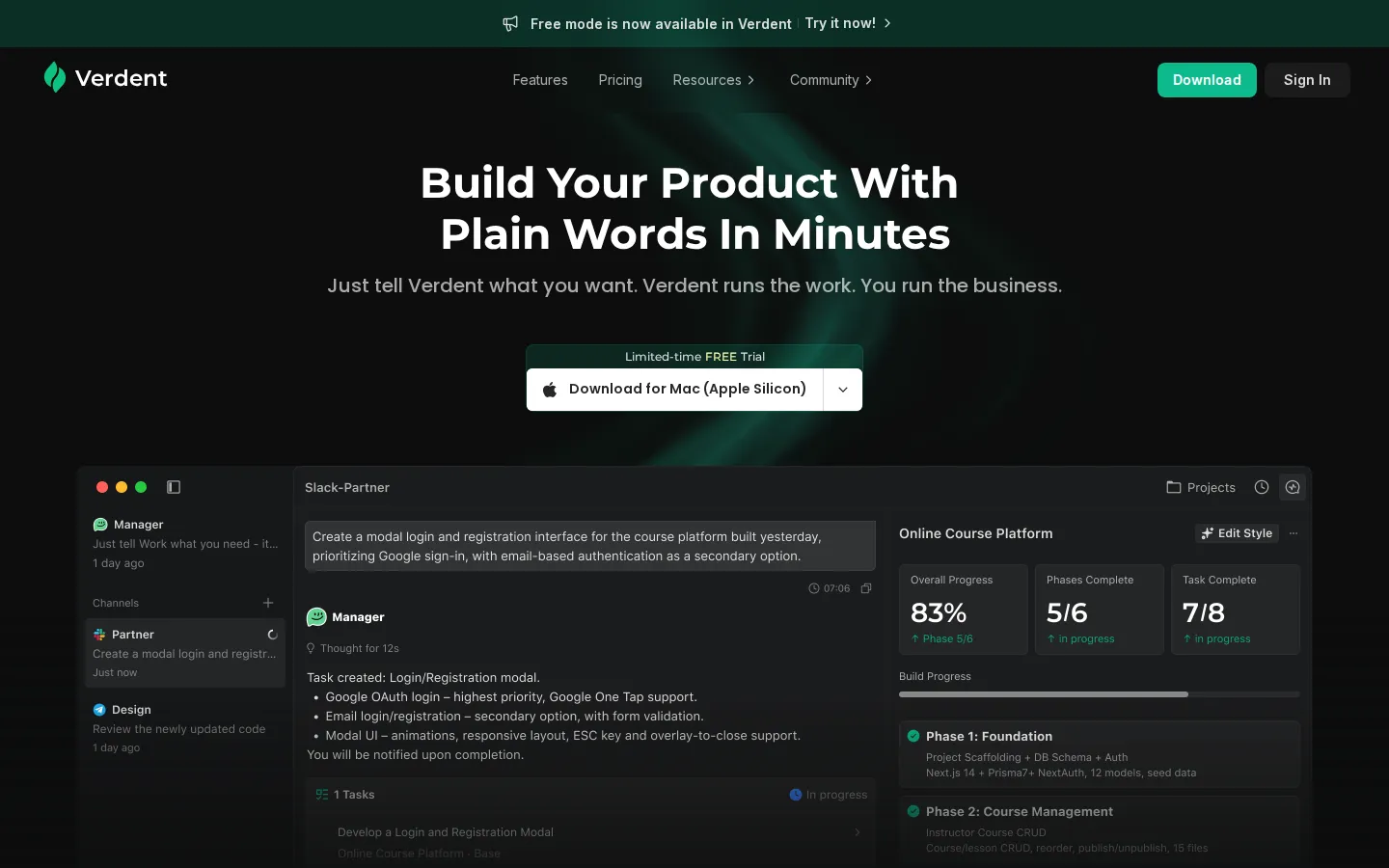
Verdent Core Features
Parallel multi-agent execution with a Kanban board, status tracking, and a dedicated review column
Plan Mode that researches a codebase and produces a reviewable implementation plan before any change
Plan-Code-Verify workflow with verifier subagents and browser tools that test work continuously
Project memory that learns your preferences, stack choices, and coding style across projects
Isolated git worktrees that let multiple agents work on independent tasks without conflicts
Multi-provider model support spanning the Claude, GPT, Gemini, Kimi, GLM, and DeepSeek families
Cloud publishing for building, previewing, and deploying web apps to a live URL from the browser
Integrations and messaging for GitHub, Stripe, Supabase, Notion, Linear, Telegram, Slack, and Feishu
Who is Verdent for?
Verdent targets people who need software built but do not want to assemble a team or hand-code every layer. That starts with founders and solo builders who have a product idea and want to go from concept to a launchable application, something with real login, real data storage, real payments, and an admin dashboard, without hiring a full engineering staff. Verdent positions itself as an AI technical cofounder for exactly this audience, and its free mode plus low-cost entry plans make that promise cheap to test. It also fits working developers who already have codebases and want a faster loop. Engineers use the Verdent VS Code or JetBrains extension for the Plan-Code-Verify cycle, for multi-file refactors, for test generation and debugging, and for parallel work on independent features isolated in git worktrees. Teams that want more than a chat window get a Kanban board with a review column, verifier subagents, and shared credits across products. Freelancers and agencies building client web projects can use Verdent Cloud to build, preview, and publish apps from the browser, then hand off a live URL. Product managers, growth leads, and other non-engineering roles fit too: the site's own case studies include a growth lead who replaced a multi-day data engineering ticket with a working Google Ads analytics pipeline after sending a single message. Indie game developers, hobbyists, and tinkerers are another natural fit. One documented use case has a solo developer describing a dark gothic roguelike to Verdent and getting a playable build, complete with dozens of sprites and bug fixes, in roughly twelve hours. More broadly, anyone who wants an assistant that remembers preferences, accepts instructions over Slack or Telegram, and keeps working while they step away from the desk will find the product relevant. It is a weaker fit for developers who want a strictly terminal-first, scriptable agent, for Linux desktop users, or for teams that must keep all inference on-premises.
Verdent Use Cases
Turning a plain-language product idea into a launchable app with login, storage, and payments
Breaking a large feature into subtasks and running agents on them in parallel
Understanding and safely refactoring an unfamiliar or legacy codebase across many files
Generating test suites and debugging failures with multipass repair until checks pass
Building and publishing client web projects in the browser, then handing off a live URL
Replacing one-off data engineering requests with reusable self-service analytics pipelines
Shipping game prototypes and playable builds from a written concept in a single session
Assigning coding tasks by Telegram, Slack, or Feishu when you are away from the desk
Verdent Pros and Cons
Pros
- One subscription covers a desktop app, a browser cloud builder, and VS Code and JetBrains extensions.
- Genuine parallel execution with isolated git worktrees and a review column, not just a chat interface.
- Plan Mode and verifier subagents add a review gate before production-impacting changes are made.
- Flexible cost control through Eco Mode, top-up credits that never expire, and BYOK with your own keys.
- Free mode and a 100-credit trial make it cheap to evaluate before committing to a subscription.
Cons
- The desktop app is limited to macOS and Windows, with no Linux build offered.
- Heavy usage depends on credits, and the upper plans run from $59 to $179 per month.
- The agent-board workflow and configuration options may feel heavy for simple one-file edits.
FAQ About Verdent
Verdent Pricing
Verdent uses freemium, credit-based pricing. New users get a 7-day trial with 100 free credits, and a Free plan is listed at $0 with limited-time extras. Paid tiers are Lite at $5/month, Starter at $19/month (480 credits), Pro at $59/month (1,500 credits), and Max at $179/month (4,500 credits), each with limited-time bonus credits on the upper plans. Teams costs $20 per user per month and Enterprise is custom. Top-ups range from $20 for 340 credits to $200 for 3,400 credits, priced at roughly $0.059 per credit with no provider markup, and they never expire. Eco Mode and BYOK let you keep working without spending credits.
Check official pricingFree
7-day trial with 100 credits; access to Claude Opus 5, Sonnet 5, GPT-5.6, Gemini 3.1 Pro, GLM-5.2 and Kimi K3; BYOK and BYOA; limited-time 1 Cloud app, 10 GB storage, and a 500 MB database.
Lite
Keep building for less with Eco Mode for light monthly usage, low-cost models such as GPT-5.6 Luna and GLM-5.3-Flash, and optional credits for Claude, GPT, and Gemini. Limited-time 2 Cloud apps, 20 GB storage, 2 GB database.
Starter
480 credits per month (320 base plus a 160 limited-time bonus) for occasional use and small tasks. Includes Eco Mode, frontier Claude, GPT, Gemini, Kimi, and GLM models, and 2 Cloud apps with 20 GB project storage.
Pro
1,500 credits per month (1,000 base plus a 500 limited-time bonus) for regular use and ongoing work. Includes extended Eco Mode and a 10 Cloud app allowance with 30 GB of project storage and an 8 GB database per app.
Max
4,500 credits per month (3,000 base plus a 1,500 limited-time bonus) for advanced and complex work. Includes maximum Eco Mode capacity plus 50 Cloud apps, 80 GB of project storage, and a 32 GB database per app.
Teams
Everything in Starter plus 480 credits per user per month, unified payment for easy reimbursement, simple member addition and removal, clear usage overview, and priority dedicated support.
Enterprise
Everything in Teams plus custom credit allocation, billing structure and invoicing, organization-wide management and permissions, and priority support with hands-on onboarding. Priced by contacting sales.
Verdent Alternatives

T3 Code
T3 Code is an open-source control plane for coding agents. It runs Claude Code, Codex, Antigravity, OpenCode, Cursor and Grok from one desktop app, keeps every agent thread on its own Git branch, and commits, pushes and opens a pull request with one button. iOS and Android apps steer the same work remotely. The app is free and MIT licensed; you bring your own agent subscriptions.

Zread
Zread is an AI-powered GitHub repository reading assistant. Give it a public repository and it produces structured docs — what the project solves, how it works, core design principles, and a file tree — with sources cited. A searchable Discover feed surfaces trending repos, and private repositories, a library, an MCP server, and a CLI extend the workflow.

Factory
Factory is an agent-native platform that automates software delivery using autonomous AI agents called Droids. Droids handle coding, bug fixing, testing, and production incidents across desktop, CLI, and SDK. With cloud background agents, usage dashboards, and enterprise controls such as SSO, audit logging, and data residency, Factory serves individual developers through large engineering organizations.