
Factory
Factory is an agent-native platform that automates software delivery using autonomous AI agents called Droids. Droids handle coding, bug fixing, testing, and production incidents across desktop, CLI, and SDK. With cloud background agents, usage dashboards, and enterprise controls such as SSO, audit logging, and data residency, Factory serves individual developers through large engineering organizations.
What is Factory?
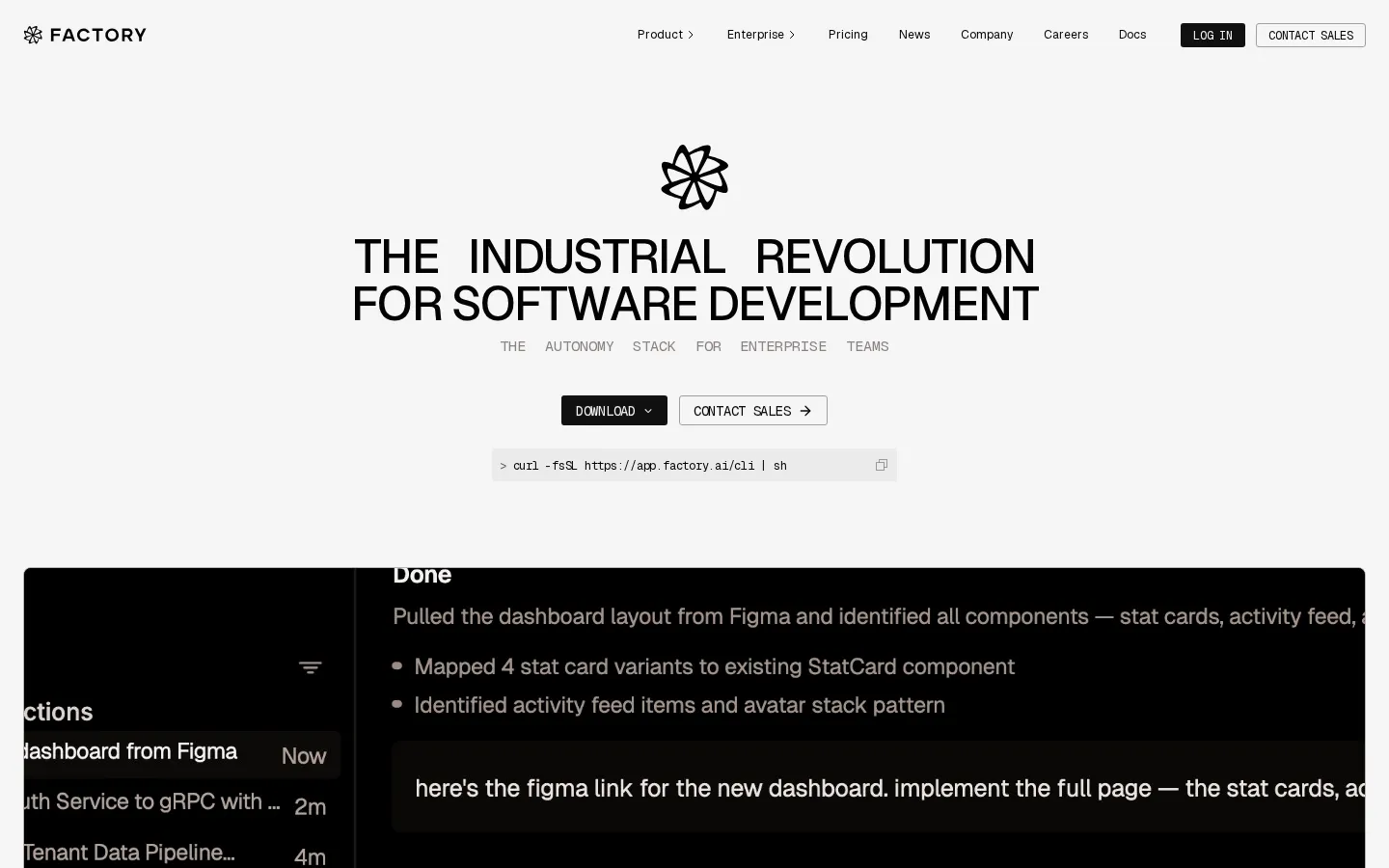
Factory is an agent-native software development platform that uses autonomous AI agents called Droids to automate coding, testing, deployment, and production support. The core idea is that software delivery can be treated as an agent task rather than a human workflow: developers describe the work, and Droids plan, write, test, and ship code while humans review and guide. Factory operates across desktop, CLI, and SDK, and supports both cloud and local background agents, so work can run on the developer's machine or on Factory-managed cloud computers for remote execution. The platform tracks billing and usage statistics and provides an agent-readiness dashboard that shows how much work is being automated and where bottlenecks remain. Individual plans start with complete software development agents, while higher tiers expand rolling rate limits, roughly five times and ten times the usage of the Pro plan, and add Droid Computers for cloud-based remote agents. Team plans bring centralized billing for up to ten seats with shared cloud computer hours, and larger business plans support up to 150 members with custom usage limits, SSO, SAML and SCIM provisioning, audit logging, and admin controls such as model selection, autonomy level, model access controls, and network policy. Enterprise deployments add dedicated compute with a partitioned inference pool, customer-managed encryption keys, data residency, sub-organizations, on-premise options, and premium support with dedicated account managers. The company positions Factory as the future of software engineering where AI handles the heavy lifting and humans guide the vision, and it publishes outcome stories showing daily, weekly, and monthly active usage across customer teams. Factory is used by startups and enterprises to automate everything from bug fixing and incident response to full feature delivery. Droids can also operate at configurable autonomy levels, from suggesting changes to executing and verifying them, and organizations can control which models agents may use. Factory's billing model tracks usage precisely, and the platform provides rate limits that expand predictably with each tier, so teams can estimate spend before scaling. The company publishes case studies and outcome stories with real usage metrics, giving buyers evidence of adoption rather than marketing claims alone.
Factory Core Features
Droids for Software Delivery
Autonomous agents automate coding, testing, bug fixing, and production incident response
Multi-Surface Access
Desktop app, CLI, and SDK support development on any platform
Cloud and Local Background Agents
Run agents locally or on Factory-managed cloud computers for remote work
Usage and Billing Dashboard
Track spend, usage statistics, and rolling rate limits from one place
Agent-Readiness Dashboard
Shows how much of the delivery workflow is automated and where humans are still needed
Droid Computers
Factory-managed cloud computers for remote Droids on higher plans
Enterprise Security Controls
SSO, SAML/SCIM provisioning, audit logs, admin controls, and network policy
Enterprise Scale Features
Dedicated compute, data residency, customer-managed encryption keys, and on-premise options
Who is Factory for?
Factory is built for software engineering teams that want AI agents to take over repetitive development work. Individual developers and freelancers use the Pro plan to automate coding, debugging, and deployment tasks across their personal projects. Small startups use Factory to compress delivery cycles, letting a small team ship features that would otherwise require more engineers, with Droids handling coding, testing, and fixes. Engineering managers use the agent-readiness dashboard and usage statistics to understand what their teams are automating and where bottlenecks remain. Platform and DevOps engineers use the CLI, SDK, cloud background agents, and Droid Computers to run agents in their existing workflows. Enterprises with compliance requirements use SSO, SAML/SCIM provisioning, audit logging, data residency, and zero-data-retention options to adopt agents safely. Organizations running production systems use reliability Droids for bug fixing, troubleshooting, and incident response. The product spans individual developers through organizations of 150 or more members, with enterprise features like partitioned inference pools for large-scale adoption. Technical founders use Factory as an extension of a small team, offloading routine implementation work to agents while they focus on product decisions. QA and test engineers use Droids for automated test writing and regression checks, and security-conscious organizations in regulated industries use the audit logging and admin controls to meet internal governance requirements before rolling out agents.
Factory Use Cases
Automate bug fixing and troubleshooting for a production service with a reliability Droid
Ship a feature end to end, from planning to tests to deployment, with coding agents
Run background agents on cloud computers for long-running development tasks
Track automation coverage across the team with the agent-readiness dashboard
Adopt AI agents in a regulated enterprise with SSO, audit logs, and data residency
Give a small startup the delivery capacity of a larger engineering team
Use the CLI and SDK to integrate agent workflows into existing build pipelines
Factory Pros and Cons
Pros
- Droids cover the full delivery loop, including production incident response, not just code generation
- Desktop, CLI, and SDK surfaces fit into existing developer workflows
- Enterprise tier addresses security and compliance requirements that block agent adoption elsewhere
- Usage-based tiers scale predictably from individuals to 150-seat organizations
Cons
- Pricing starts at $20 per month for individuals, with team plans priced per seat
- Higher usage tiers are required for heavy workloads and cloud computers
- Teams still need human review and guidance for complex or ambiguous work
FAQ About Factory
Factory Pricing
Paid. Pro $20/mo, Plus $100/mo (~5x usage), Max $200/mo (~10x usage), Teams per seat (custom), Business and Enterprise custom.
Check official pricingPro
Complete software development agents for individuals, desktop/CLI/SDK, usage dashboard
Plus
Everything in Pro with ~5x usage and expanded rolling rate limits
Max
~10x usage of Pro, Droid Computers for remote agents, early feature access
Teams
Up to 10 seats, centralized billing, 10 hrs/mo shared Droid Computers, per-seat pricing
Business
Up to 150 seats, SSO, SAML/SCIM, audit logs, custom usage limits
Enterprise
Unlimited members, dedicated compute, data residency, on-premise options
Factory Alternatives
FastRouter
FastRouter is a unified LLM gateway that gives developers one OpenAI-compatible API for 200+ models from providers such as OpenAI, Anthropic, Google, and xAI. It adds automatic model routing, fallbacks, caching, spend caps, role-based access, guardrails, and per-request observability, while passing provider token prices through with no markup on any plan, including the free tier.
Cindy
Cindy is an open-source desktop AI agent from XD Inc. that unifies Claude Code, Codex and Pi harnesses with 20+ tools, persistent memory and reusable skills. Use it free with your own API key or existing Coding Plan, or pay for the optional managed model service that works the moment you sign in. No setup project required.

MyToolster
MyToolster packs 41 free utilities into one browser-based site, sorted into Audio & Video, Text, Data, Web, Color, QR Code and Image. Beyond the usual encoders, formatters and generators it runs OpenAI Whisper transcription, AI text and image detection, background removal and subtitle export locally, with no uploads, account or installation, and every tool page does its work client-side.