
Cindy
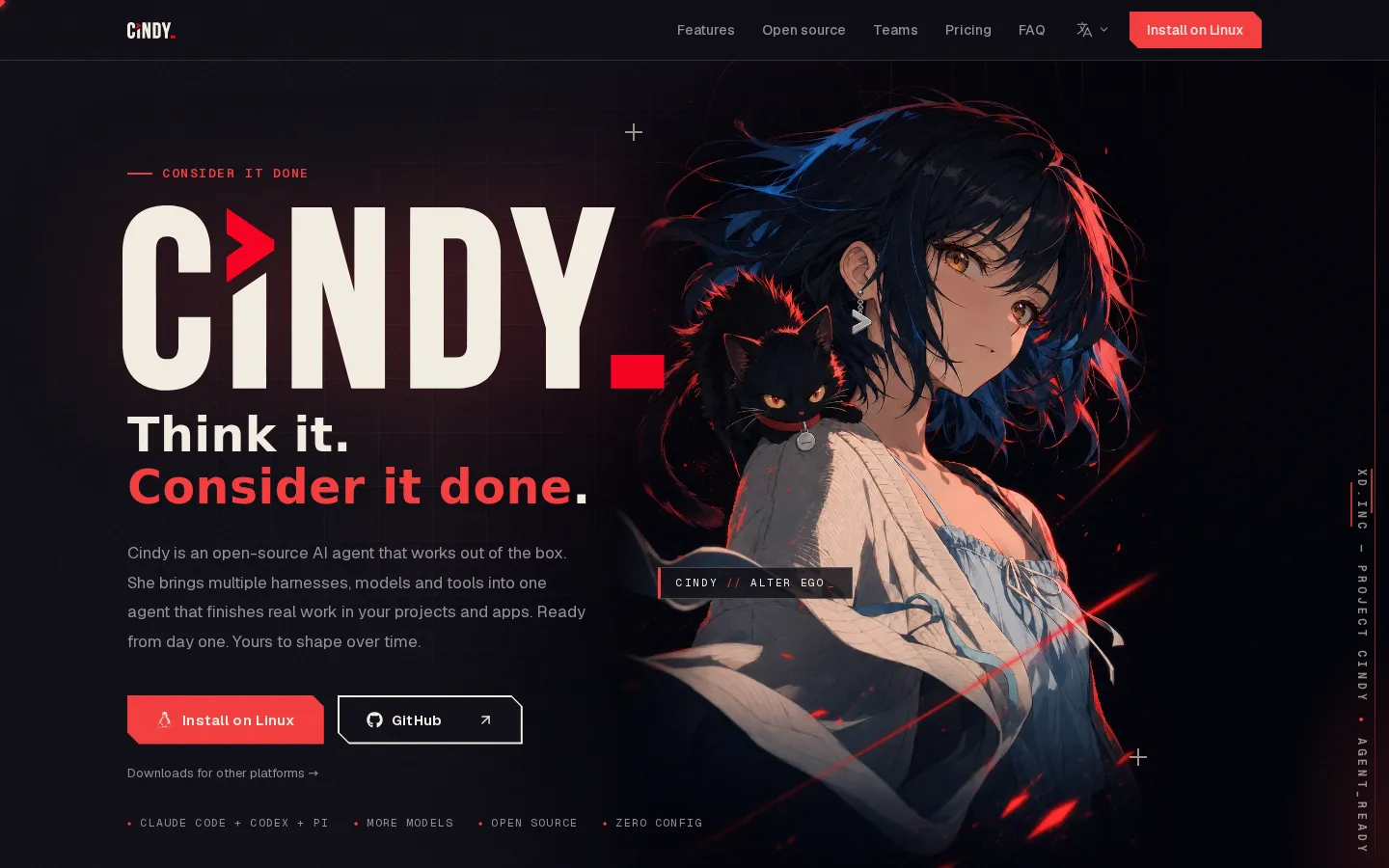
Cindy is an open-source desktop AI agent from XD Inc. that unifies Claude Code, Codex and Pi harnesses with 20+ tools, persistent memory and reusable skills. Use it free with your own API key or existing Coding Plan, or pay for the optional managed model service that works the moment you sign in. No setup project required.
What is Cindy?
Cindy is an open-source AI agent built by XD Inc. that runs on your own computer and works inside your real projects, files and signed-in apps. Rather than locking you to one vendor's assistant, she bundles several agent harnesses, a broad model catalog, more than 20 built-in tools, persistent memory and reusable skills into a single agent. The promise is simple: ready from day one, yours to shape over time.
The defining idea is the multi-harness deck. Cindy currently drives Claude Code, Codex and Pi, with more harnesses integrating and a Cindy-native harness in development. Every supported model runs across every supported harness, and you can switch harness or model mid-task without losing workspace state, memory, skills or tools. One task can even be planned by one harness-model pair, executed in parallel by three workers, and reviewed by another, while Cindy holds the context and acceptance criteria.
Getting started is deliberately short. You can sign in to Cindy's managed model service, authorize an existing Claude Code, Codex or Pi Coding Plan with one click, connect your own provider API key, or point her at local models through Ollama, vLLM or any OpenAI-compatible endpoint. The app ships with sensible defaults, so a first task usually starts minutes after download instead of after a configuration project.
She works where the work already lives: local projects, terminals and browser sessions, plus Slack, Feishu, GitHub, Jira, GitLab, Confluence and Google Workspace, remote servers over SSH and Android devices. Scheduled tasks run on time and report back to your chat app, while the mobile apps let you check progress, ask follow-ups and approve sensitive actions from your phone.
Control is treated as a feature rather than a footnote. Code changes start in an isolated workspace, edits pass through a review panel for line-by-line approval, checkpoints allow rollback, and irreversible decisions return to you. Files, code and chat history stay on your machine by default, and running cost is visible in real time.
The client is Apache-2.0 licensed and developed in public on GitHub, with roughly 3,200 stars at the time of writing; the hosted backend is a separate, closed repository. The software is free when you bring a key or an existing subscription. Paid tiers only cover managed model usage: PLUS at $20, SUPER at $100 and ULTRA at $200 per month of credit, with 20% off auto-renewing monthly plans.
Cindy Core Features
Multi-harness deck
Claude Code, Codex and Pi run inside one agent, with more harnesses integrating and a native Cindy harness in development.
Mid-task switching
change harness or model without restarting the job, because workspace, memory, skills and tools stay continuous.
Bring your own models
use the managed service, an existing Coding Plan, provider API keys, Ollama, vLLM or any OpenAI-compatible endpoint.
Multi-agent orchestration
assign planning, parallel execution and independent review to different harness-model pairs within a single task.
Persistent memory and skills
correct her once and every harness applies it next time; teach a working method once and reuse or share it.
Isolated workspaces with review
edits start in a sandbox, pass through a line-by-line approval panel and can be rolled back to a checkpoint.
Collaboration and remote reach
Slack, Feishu, GitHub, Jira, GitLab, Confluence, Google Workspace, SSH servers and Android devices.
Automation and mobile control
scheduled jobs report results into your chat app, while iOS and Android let you monitor and approve from anywhere.
Who is Cindy for?
Cindy targets people who already delegate real work to AI but refuse to be locked into a single vendor's harness or subscription. She is most valuable when a task spans several tools, models or machines, and when auditability matters as much as speed. Software engineers and technical leads: they can keep using the Claude Code or Codex plan they already pay for, switch models per task, run parallel workers on tests or migrations, and review every diff before it touches the repository. Product managers and designers: they can turn a discussion into a clickable prototype during the meeting, apply a direction to the real page instead of a static mockup, and hand engineering a working artifact rather than a specification. AI power users and tinkerers: people who collect API keys, run local models and want one cockpit for harnesses, MCP servers, skills and schedules, rather than four terminals and a notes file. Solo founders and small studios: they get an agent that handles research, code, docs and recurring admin without hiring for each function, and can connect their own keys so the software itself costs nothing. Platform and DevOps teams: they can reach remote servers over SSH, run maintenance jobs on a schedule, and connect internal systems through custom MCP tools without exposing credentials to a third party. IT administrators at larger companies: they get centralized model access, credit limits, SSO through Feishu or WeCom, and optionally a gateway inside their own VPC, all configured once and inherited by members at sign-in. Teams considering it today should note that the TEAM tier is still a waitlist.
Cindy Use Cases
Ship a feature from ticket to reviewed pull request without leaving the desktop app
Run tests, documentation and release notes as parallel workers on one codebase
Turn a meeting idea into a clickable demo before the call ends
Automate recurring reports and send the result to Slack or Feishu on a schedule
Debug a failing build on a remote server over SSH with checkpoint rollback
Migrate a legacy module while an independent reviewer checks edge cases
Connect internal tools through custom MCP servers so Cindy can act on business systems
Kick off research or drafting from your phone and approve the result later
Cindy Pros and Cons
Pros
- Genuinely free software: Apache-2.0 client, no licence fee, and existing Coding Plan subscriptions keep working inside Cindy without a duplicate bill.
- Harness and model freedom is real, not marketing: switching mid-task preserves context, and a task can mix planners, parallel workers and reviewers.
- Safety defaults suit delegated work: isolated workspaces, line-by-line review, checkpoints and local-first files.
- Wide reach for one agent: IDE-style files and terminal, chat apps, issue trackers, SSH servers and mobile approvals.
Cons
- Only the client is open source; the hosted backend and managed gateway live in a separate closed repository.
- The project is young and moving fast, with a large open issue count and features such as plugins and the public skill marketplace still in development.
- Desktop installation is required for full capability, and Linux users may need to deal with keyring setup and distribution-specific packages.
FAQ About Cindy
Cindy Pricing
The software is free forever: bring an API key, connect local models, or authorize an existing Claude Code, Codex or Pi Coding Plan and pay Cindy nothing. The optional managed model service is sold as usage credit: PLUS $20/month, SUPER $100/month and ULTRA $200/month, with auto-renewing monthly plans 20% cheaper at $16, $80 and $160. Pay-as-you-go top-ups start at $10 and never expire, unused monthly credit rolls over within tier caps, and TEAM and ENTERPRISE are waitlist-only with seat-based pricing.
Check official pricingFree
Complete agent capabilities and built-in tools with your own API key, existing Coding Plan or local models. Pay-as-you-go top-ups from $10 never expire.
Plus
Managed model service with $20 of monthly usage credit, every managed model available in your region, and rollover of unused credit up to $10. $16/month on an auto-renewing plan.
Super
Five times the Plus credit for heavy delegation, with $100 monthly usage credit and rollover up to $50. $80/month on an auto-renewing plan.
Ultra
The highest credit tier for all-day agent work: $200 monthly usage credit, rollover up to $100, and the same model access. $160/month on an auto-renewing plan.
Team
Collaboration and centralized governance: SSO, centrally distributed configuration, model access and credit controls, team skills and shared working standards.
Enterprise
Self-hosting and compliance: gateway inside your VPC, complete audit logs, cost attribution and dedicated support. Priced by seats and governance needs.
Cindy Alternatives

Velozity
Velozity is a multiplayer AI office for remote teams that puts people and AI agents in the same shared workspace. Persistent presence, video and audio calls, transcripts, tasks, notes, calendars and guest passes live in a single window, while built-in and bring-your-own agents take on real work across more than 100 integrations and a cloud computer.

Migoo
Migoo turns a single chat window into a small AI department: a general assistant plus named specialists for video ads, design, slides, brochures, research, data analysis, photo editing, writing, websites and job applications. It reads the Google Workspace context you connect, then drafts reports, files expenses, builds decks and produces publishable assets, charging through a monthly points allowance rather than per-seat licences.

SnapDub
Turns long recordings into ready-to-post shorts Paste a long video, get vertical clips that keep the speaker in frame