
Venice AI
Venice is a privacy-first AI platform giving unrestricted access to leading AI models across text, image, video, code, and audio generation. Prompts and responses stay in your browser rather than on Venice servers, with anonymized, private, TEE, and end-to-end encrypted modes. A free tier is available, and paid plans add unlimited text prompts, more credits, and higher API limits.
What is Venice AI?
Venice AI is a privacy-first generative AI platform that provides unrestricted access to the world's leading AI models across text, image, video, code, and audio generation. Trusted by over three million users, Venice was founded by Erik Voorhees in 2024 on the principle that machine intelligence must respect the sovereignty of the people who use it: private by default, open to free thought, and built on leading open-source technologies. The platform bundles several studios behind one sign-in. Text generation covers chat, reasoning, writing, and code across more than one hundred models, from fast open-weight systems to frontier reasoning models, and its catalogue spans OpenAI, Anthropic, Google, the Grok suite by xAI, DeepSeek, Mistral, Meta, Qwen, Kimi, NVIDIA, and Black Forest Labs. An image studio generates, edits, upscales, creates variants, and removes backgrounds, with control over negative prompts, aspect ratio, steps, adherence, seed, and watermark hiding. Video generation runs text-to-video and image-to-video models including Sora, Kling, Runway, Veo, Seedance, and Grok Imagine. An audio studio adds text-to-speech voices, music generation, sound effects, speech-to-text, and voice cloning. Venice also supports custom AI characters with rich backstories, document uploads, vision, web search and scraping, embeddings, and agent workflows. Privacy is the differentiator, and Venice documents four tiers. Anonymized access strips identifying metadata before requests reach third-party models. Private mode adds zero data retention on self-hosted open-source models. Trusted Execution Environment mode runs inference inside hardware-secured enclaves so Venice itself cannot access the computation. End-to-end encryption encrypts prompts in the browser so only the TEE decrypts them. Conversation history is stored locally in the browser rather than in a central database. Venice is free to start: the Free tier includes base models, ten text prompts and fifteen image prompts per day, and API access paid with credits. Paid plans are Pro at eighteen dollars per month, Pro Plus at sixty-eight, and Max at two hundred, adding unlimited text prompts, one thousand images per day, encrypted chat backup, extended context windows, priority support, and monthly credit allotments of one hundred, seven thousand five hundred, and twenty-two thousand five hundred credits. Credits are the universal currency for video, music, frontier models, and API usage, and one hundred credits equal one dollar. Developers reach everything through one OpenAI-compatible API with zero data retention, plus an MCP server, a CLI, and skills. Venice also offers mobile apps for iPhone, iPad, and Android, and is accessible through its VVV token and DIEM compute credits.
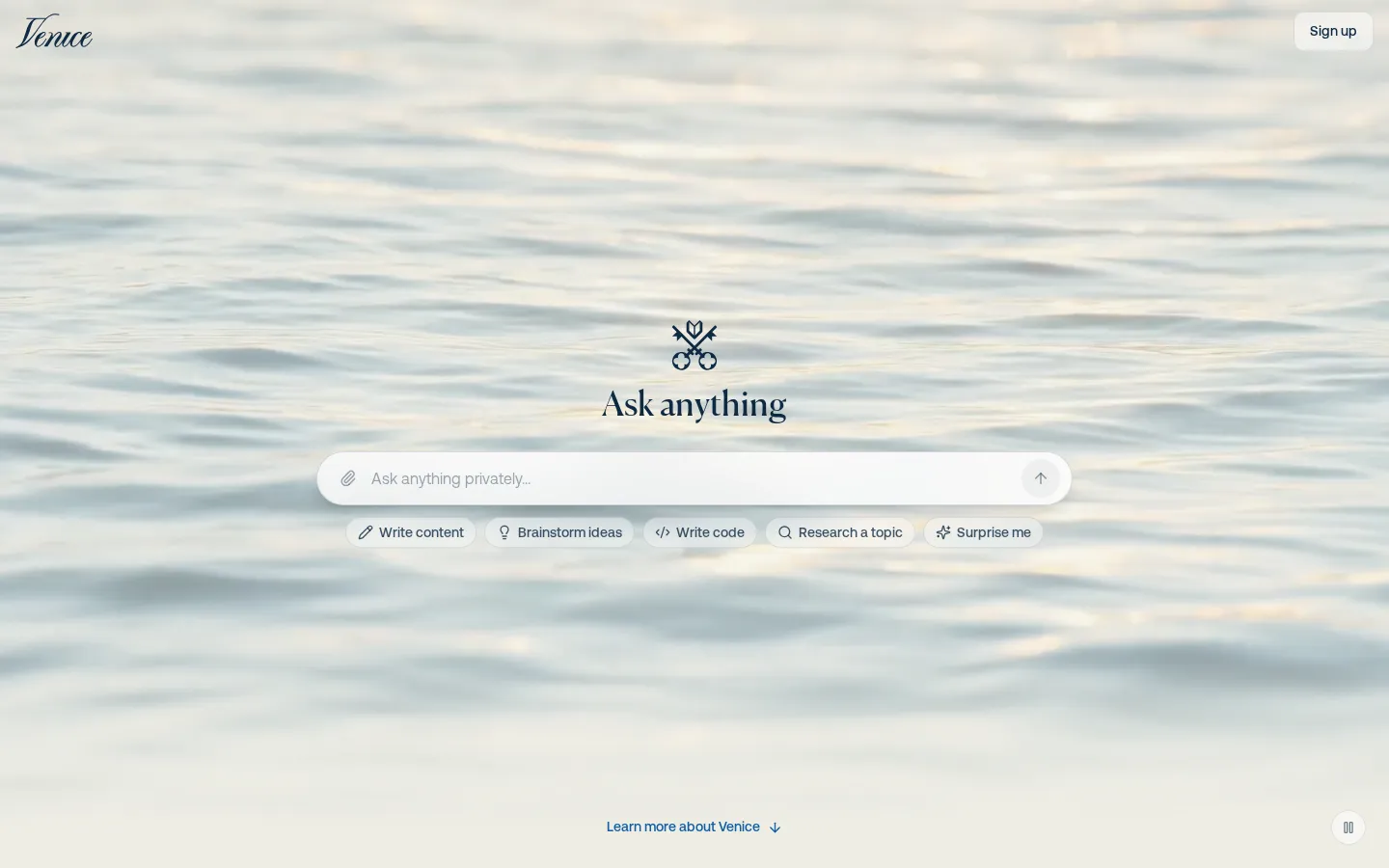
Venice AI Core Features
Private by default
prompts and conversation history stay in your local browser, never on Venice servers
Uncensored open-source models
chat, reason, and write with unrestricted open-weight models, including Venice Pro models
Image generation studio
generate, edit, upscale, create variants, and remove backgrounds, with optional watermark removal
Video generation
create clips from text or images with leading models such as Sora, Kling, Runway, and Veo
Audio and music
text-to-speech voices, music generation, and sound effects, plus speech-to-text and voice cloning
Custom characters
build and share AI characters with rich backstories, no filters, and duplicate-and-evolve editing
OpenAI-compatible API
one key for text, image, video, music, speech, and embeddings, with zero data retention
Four privacy tiers
anonymized third-party models, private zero-retention models, TEE enclaves, and end-to-end encryption
Who is Venice AI for?
Venice is aimed at people who want powerful AI without surveillance. Privacy-conscious professionals can ask sensitive questions about contracts, health, or strategy knowing prompts are encrypted in the browser and never stored on Venice servers. Creators get a single studio for images, video, audio, and music, with uncensored open-source models that do not refuse ordinary requests. Developers are a core audience: the OpenAI-compatible API at api.venice.ai lets teams swap a base URL and keep existing tooling, so Cursor, Claude Code, Codex CLI, LangChain, and CrewAI all work with a Venice key. Credits let teams budget text, image, video, and embeddings spend together, while rate limits rise across Pro, Pro Plus, and Max. Writers and researchers use Venice for drafting, brainstorming, document analysis, and cited web search inside a private workspace. Marketers and small studios produce photorealistic images, short videos, narration, and background music without stacking per-tool subscriptions. Crypto-native users are explicitly served, because Venice is accessible through its app, its API, and permissionlessly by staking the VVV token, and through DIEM, where one Diem equals one dollar per day of compute. Students and hobbyists start on the free tier, which includes base models, ten text prompts and fifteen image prompts per day, and API access paid with credits, with no credit card required. Teams and enterprises move to higher tiers for larger credit allotments, two- or three-month credit banking, higher API limits, priority support, encrypted chat backup, and extended context windows for long-running work. Builders of companion and roleplay apps are a strong fit too, since custom characters can be created, shared, and evolved, and mature-content filters can be disabled on eligible models. Anyone who values free expression online, from journalists to independent artists, belongs here, while organisations that need published enterprise certifications or on-premises deployment should look elsewhere.
Venice AI Use Cases
Chat privately with frontier and open-source models about sensitive work topics without logging prompts
Generate photorealistic or stylized images and upscale them without watermarks for client projects
Create short AI videos from text prompts or reference images using credit-based video models
Build private AI agents and coding assistants on the OpenAI-compatible API with your own key
Produce voiceovers, narration, and background music for podcasts, videos, and presentations
Research topics with web search, document uploads, and cited answers inside a private workspace
Design uncensored AI characters with backstories for roleplay, storytelling, and companion apps
Draft, refactor, and debug code by pointing Cursor, Claude Code, or Codex CLI at Venice
Venice AI Pros and Cons
Pros
- Free tier with private, uncensored base models and no credit card required to start
- Four documented privacy tiers, including hardware-secured TEE enclaves and browser-side end-to-end encryption
- One subscription covers text, image, video, audio, code, and custom characters across more than one hundred models
- OpenAI-compatible API with a single key, zero data retention, MCP server, CLI, and popular framework integrations
- Credits priced transparently at 100 credits per dollar, with unused credits rolling forward on Pro Plus and Max
Cons
- The free tier caps usage at 10 text prompts and 15 image prompts per day, so regular users hit limits quickly
- Frontier third-party models, video generation, and API usage are metered through credits, so heavy workflows cost more than the subscription alone
- Crypto and token features such as VVV staking and DIEM add complexity for users who want a conventional, non-web3 AI subscription
FAQ About Venice AI
Venice AI Pricing
Venice AI is free to start on a $0 Free tier, then $18/month Pro, $68/month Pro Plus, and $200/month Max, with annual billing saving 10% (up to 16.7%) and credits valued at 100 credits per dollar for video, music, frontier models, and API usage.
Check official pricingFree
Explore Venice with base AI models: 10 text prompts and 15 image prompts per day, API access paid with credits, private and uncensored.
Pro
All Pro models, unlimited text prompts, 1,000 images per day, extended context windows, encrypted chat backup, 500 welcome credits, and 100 credits per month for video, music, premium models, and API.
Pro Plus
Everything in Pro plus higher image generation limits on Venice Pro models, 7,500 credits per month with a 10% bonus versus retail, 2-month credit banking, and higher API limits.
Max
Everything in Pro Plus plus the highest image generation limits, 22,500 credits per month with a 12.5% bonus versus retail, 3-month credit banking, the highest API limits, and priority support.
Venice AI Alternatives

Mistral AI
Mistral AI is a French frontier AI company that helps organizations build tailored AI systems. Its platform spans Vibe, an AI agent for long-horizon work; Vibe for code; Studio for building and running agents and apps; Forge for training custom models; and Compute, frontier-scale infrastructure for training and inference. Models can be self-hosted, run on Mistral's EU cloud, or accessed through cloud partners.

LM Studio
LM Studio downloads and runs open-weight language models on your own machine using llama.cpp and MLX. Its Bionic agent creates and edits documents, writes code, automates tasks, and transcribes speech locally. Free users run offline models; paid plans add US-hosted open models such as Kimi K3, GLM 5.3, and DeepSeek V4 Flash with zero data retention.

BlueSearch
BlueSearch is an AI-powered website search component that delivers intelligent, conversational answers to user queries with source references.