
Undermind
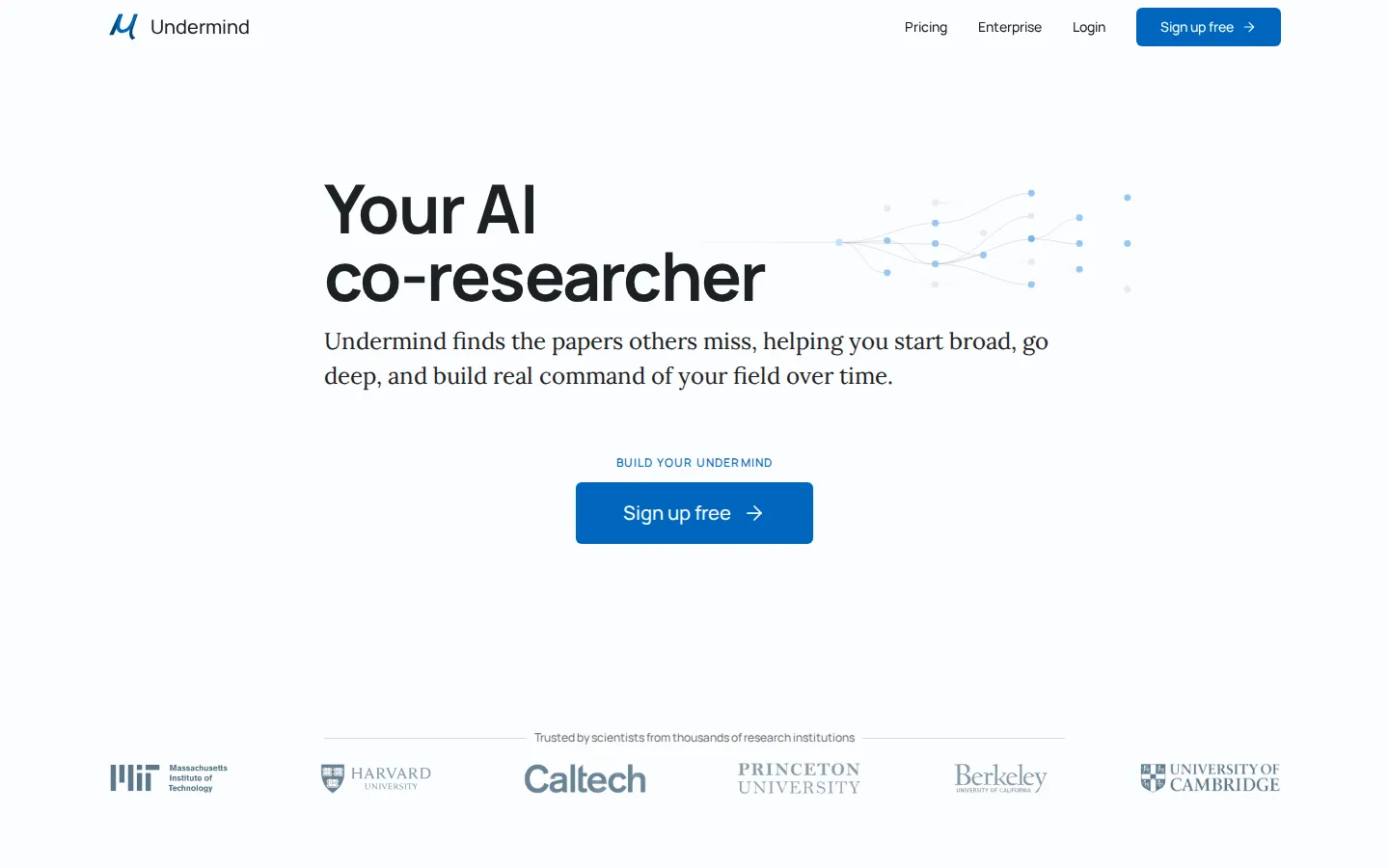
Undermind is an AI co-researcher for scientific literature. Users describe their research in plain language, Undermind asks clarifying questions, then reads and evaluates hundreds of papers, follows citation trails, and returns findings with in-line citations traceable to sources. It supports full-text deep dives, report iteration, shared workspaces, and alerts. Built by MIT quantum physics PhDs and backed by Y Combinator, it offers a free tier, Pro at $16 monthly, and Team and Enterprise plans.
What is Undermind?
Undermind is an AI co-researcher for the scientific literature that helps researchers find papers they would otherwise miss and build real command of their field over time. The workflow starts when a user describes what they are working on in plain language. Undermind asks follow-up questions to understand exactly what is needed, then searches the literature by reading and evaluating hundreds of papers, following citation trails until it has found everything relevant. Users can then go deeper together, iterating on reports, diving into full texts, extracting details, and refining their understanding. Undermind keeps tabs on areas of interest and notifies users with important updates through alerts. Every statement can be verified by following in-line citations back to the source paper. The platform supports shared workspaces for collaboration, file and paper libraries, and connections to AI agents like Claude and ChatGPT. Founded by two quantum physics PhDs from MIT with decades of experience in deep research, Undermind is backed by Y Combinator and trusted by research teams at institutions such as MIT, the Koch Institute for Integrative Cancer Research, Northeastern University, and companies including Actipulse Neuroscience and Engage Bio. Pricing starts with a free tier for exploratory research, a Pro plan at $16 per month billed annually with 10x higher usage limits and the latest AI models, a Team plan at $15 per person per month, and enterprise agreements with custom terms, security reviews, and dedicated support. The search experience is designed around the way researchers actually work: the system asks follow-up questions to disambiguate intent, then searches broadly across the literature, evaluating papers for relevance rather than simply matching keywords, and follows citation trails forward and backward until coverage is complete. Results are presented with in-line citations, so any statement can be traced back to its source paper, which is critical for academic credibility. The collaboration layer supports shared workspaces where teams can build paper libraries together, and the agent connection feature lets users link Claude, ChatGPT, and other assistants into the research flow. Alerts monitor user-defined areas of interest and surface important new publications automatically. On the security side, Undermind provides encryption in transit and at rest, independent penetration testing, and guarantees that proprietary R&D data is never used to train models or retained by model providers.
Undermind Core Features
AI literature search
Describe your research and Undermind reads and evaluates hundreds of papers, following citation trails until it finds everything.
Clarifying questions
The system asks follow-up questions to understand exactly what you need before searching.
In-line citation verification
Trace any statement by following in-line citations back to the source paper.
Full-text deep dives
Dive into full texts, extract details, and refine your understanding iteratively.
Alerts and monitoring
Undermind keeps tabs on your areas of interest and notifies you with important updates.
Shared workspaces
Collaborate on shared workspaces, files, and paper libraries with your team.
Agent connections
Connect your agents including Claude, ChatGPT, and others to the research workflow.
Report generation
Iterate on reports that synthesize findings from across the literature.
Who is Undermind for?
Undermind is designed for researchers, scientists, and R&D teams who need to search and understand the scientific literature. PhD students and graduate researchers use it for literature reviews, finding obscure papers, and staying current in their field. Principal investigators and professors use it to survey research before starting new projects and to keep labs informed of new developments. Medical and clinical researchers use it for extensive literature review on nuanced topics like drug delivery and clinical trial data. Biotech and deep-tech companies use it for competitive intelligence and R&D team research, with teams subscribing to Pro for shared workspaces. Startup founders and entrepreneurs in hard-tech fields use it to quickly assess the technical literature around new product ideas. Industry analysts and consultants use it to build command of scientific domains relevant to their clients. Any researcher who relies on PubMed, arXiv, or academic databases will find the citation-backed answers and paper discovery useful. Postdoctoral researchers and academic labs use the platform to monitor their field continuously without manual database searching. Librarians and research support staff use it to help patrons find hard-to-locate literature. Science journalists and technical writers use it to verify claims against primary sources before publication. R&D teams in pharmaceuticals, materials science, and engineering use the enterprise tier for isolated data handling and compliance with security reviews.
Undermind Use Cases
Conduct a comprehensive literature review on a nuanced drug delivery topic for clinical research
Find obscure papers that standard search engines miss for a new research project
Verify claims by tracing in-line citations back to source papers before citing them
Keep an R&D team updated with alerts on new publications in their research areas
Survey the technical literature quickly before starting a hard-tech startup
Build shared research workspaces for a lab group collaborating on one topic
Extract specific experimental details from full texts without reading entire papers
Connect Claude or ChatGPT agents to run deep literature searches autonomously
Undermind Pros and Cons
Pros
- Finds obscure and hard-to-discover papers that standard literature search tools miss
- In-line citations let you verify every statement back to its source paper
- Built by MIT quantum physics PhDs and backed by Y Combinator, trusted by research institutions
- Free tier available, with Pro at $16 per month billed annually for serious research
Cons
- Free tier has standard rate limits on chats and searches that constrain heavy use
- Best suited to scientific and technical literature, less useful for general web research
- Team and enterprise features require annual billing for the advertised per-month pricing
FAQ About Undermind
Undermind Pricing
Freemium: free tier for exploratory research; Pro $16/month billed annually, Team $15/person/month billed annually, Enterprise custom.
Check official pricingFree
Strong AI models for chat, deep searches and reports, shared workspaces, agent connections, standard rate limits.
Pro
Latest AI models, deepest full-text analysis, 10x higher usage limits, unlimited workspaces and paper libraries. Billed annually.
Team
All Pro features plus team member management, priority support, centralized billing. Billed annually.
Enterprise
Increased compute, organizational login, onboarding seminars, admin dashboard, custom terms and SLA.
Undermind Alternatives

Metaso
Metaso (秘塔AI搜索) is an AI search engine built for research-grade answers rather than link lists. It searches the open web, document libraries, and academic indexes such as PubMed, SCIE, EI, and JCR, then writes a structured, cited answer. Extra modes produce mind maps, slides, interactive web pages, and deep-research reports, and a paid Search API exposes the same index to developers.

Trooly
Trooly is an AI-native qualitative research platform. It writes the research plan, screens and recruits participants, moderates one-on-one multimodal voice interviews, and synthesizes transcripts into themed reports. Product and research teams can bring their own users at $10 per interview, or let Trooly recruit from a network of 180M+ respondents, with every interview quality-checked before delivery.
QwQ AI
Search the live web, research complex topics, and make sense of financial data with traceable sources.