
Metaso
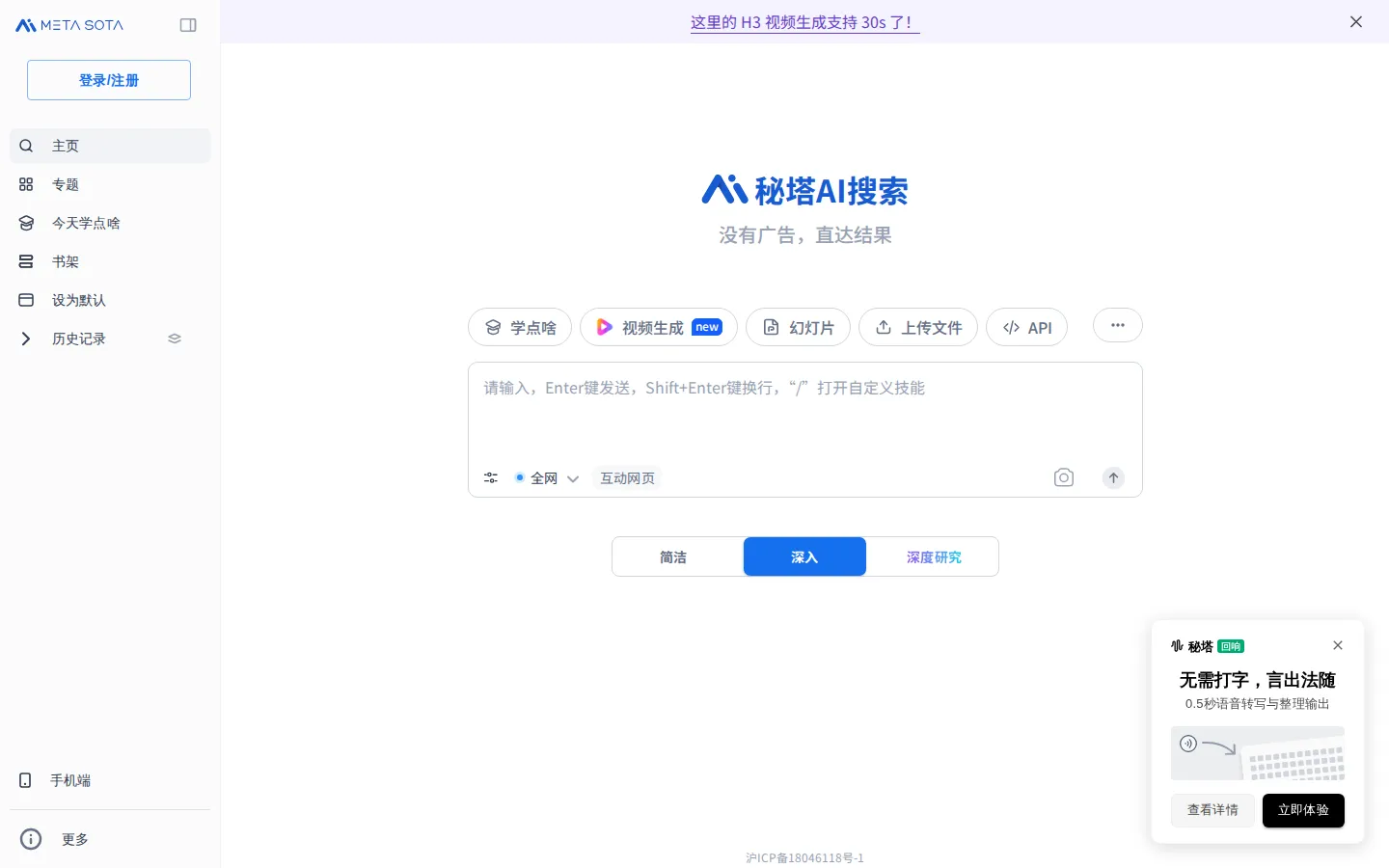
Metaso (秘塔AI搜索) is an AI search engine built for research-grade answers rather than link lists. It searches the open web, document libraries, and academic indexes such as PubMed, SCIE, EI, and JCR, then writes a structured, cited answer. Extra modes produce mind maps, slides, interactive web pages, and deep-research reports, and a paid Search API exposes the same index to developers.
What is Metaso?
Metaso (秘塔AI搜索) is an AI search engine from Shanghai Metaso Network Technology Co., Ltd. that replaces the familiar column of blue links with a single structured answer. Type a question and Metaso runs an automated, non-human retrieval pass over public web pages, then composes a readable report: a short conclusion, organized sections, inline citations pointing at the exact sources, and a mind map or outline you can follow. The company states plainly that it does not control or edit the pages it retrieves; the answer is generated from linked material, and claims are meant to be checked at their source.
The positioning is deliberately narrow: no advertising, no sponsored slots, results straight ahead. That matters in research, where a paid placement wastes time and quietly biases what the model reads.
Scope is where Metaso separates itself from a general chatbot. A search-scope selector switches between the open web, a document library, and academic sources, and the academic branch is unusually granular: all literature, Chinese and English collections, PubMed, 北大核心 (Peking University core journals), 中科院分区 (Chinese Academy of Sciences journal tiers), JCR quartiles, SCIE, and EI. A researcher can restrict a query to Q1 journals or CAS tier 1 before a single token of the answer is generated, instead of filtering afterwards.
Three answer modes sit above that: a concise mode, a deeper mode, and 深度研究 (deep research), described as multi-thread iterative searching until the logic closes. It thinks first, builds a framework, then searches and consolidates, rather than searching first and extending afterwards.
Beyond answering, Metaso has accumulated a small suite of study and output tools. 今天学点啥 turns material into audio explanations with slides, 幻灯片 generates a deck from a topic, 互动网页 produces an interactive page, file upload lets you search inside your own PDFs, and voice input transcribes speech in roughly half a second. Work can be saved into 专题 (topics) or 知识岛 (knowledge islands that can be shared or sold by subscription).
For developers, a public Search API exposes the retrieval layer directly and is billed per query. Everything runs in the browser or on mobile, and the interface is Chinese-first, with English-language sources reachable through the academic filters.
Metaso Core Features
Ad-free answer search
Every query returns a structured, cited report instead of a page of sponsored links, so nothing appears because someone paid for placement.
Academic scope filters
Restrict a search to PubMed, SCIE, EI, JCR quartiles, Chinese Academy of Sciences tiers, or Peking University core journals before the answer is generated.
Deep research mode
Multi-thread iterative retrieval that builds a framework first, then searches and consolidates until the reasoning closes.
Document library search
Search inside uploaded PDFs and files alongside the public web, with per-megabyte credit costs disclosed in the user agreement.
Slide and interactive page generation
Turn a topic or a finished answer into a presentation deck or a shareable interactive web page without leaving the session.
Study mode (今天学点啥)
Generates an audio explanation paired with slides, aimed at learning a subject rather than answering one question.
Public Search API
Per-query access to the same retrieval index for developers building RAG pipelines, agents, or their own search products.
Who is Metaso for?
Metaso fits people who need an answer they can defend, not a faster way to skim. The core audience is Chinese-reading researchers, graduate students, and analysts who want to search academic literature without juggling PubMed, a journal-ranking list, and a general search engine across separate tabs. The academic scope selector is the draw: you can constrain a query to SCIE, EI, JCR Q1, CAS tier 1, or Peking University core journals before the answer is written, which is close to how a literature review actually starts. Second are knowledge workers who write reports and need a first draft with traceable sources: consultants, policy researchers, product marketers sizing a market, journalists checking a claim. The cited answer and mind map remove the blank-page phase, and the slide and interactive-page exporters remove a formatting step. Third are students and self-learners. 今天学点啥 converts a document or topic into an audio walkthrough with matching slides, which suits revision on a commute, while topics and the document library reward people who return to the same subject repeatedly. Developers and small teams embedding retrieval in their own products are a fourth group. The Search API sells the index per query, so a RAG pipeline or agent can call Metaso instead of assembling crawlers and rankers from scratch. It is a weaker fit for anyone who needs an English-first interface, minute-level market data, or full control over model choice and prompting. Teams requiring SSO, audit logs, and data-residency guarantees should assume consumer-grade tooling until they confirm otherwise. And because answers are assembled from third-party pages, users in regulated fields still need to verify every figure at the cited source.
Metaso Use Cases
Screen recent literature by restricting a query to JCR Q1 or CAS tier 1 journals before reading.
Draft a sourced market overview and export it as a slide deck for a Monday meeting.
Check a factual claim from a report against the exact pages Metaso cites.
Search your own uploaded PDFs for a definition without leaving the browser tab.
Build a retrieval-augmented prototype by calling the Search API per query instead of running crawlers.
Learn an unfamiliar subject through generated audio explanations paired with slides.
Turn a research question into an interactive web page colleagues can browse.
Metaso Pros and Cons
Pros
- Answers arrive structured and cited, so verification is a click rather than a hunt through tab after tab.
- Academic filtering happens before the answer is written, which matches how a literature review actually begins.
- The consumer product is free and genuinely ad-free, with no sponsored results to mentally filter out.
- Slide, page, and audio outputs remove a separate formatting pass for people who have to present their research.
Cons
- The interface is Chinese-first, which adds real friction for English-only users despite English source coverage.
- Free usage runs on credits: slides cost one per page, uploads two per megabyte, and DeepSeek-backed answers cost more.
- No transparency about which base models answer, and no enterprise controls such as SSO, audit logs, or residency options.
FAQ About Metaso
Metaso Pricing
Search is free with no ads. Extra actions (slides, uploads, deep answers) consume credits, with daily free credits plus purchasable long-term credits; the Search API is billed per query. Check metaso.cn/search-api for current rates.
Check official pricingFree
Ad-free web search with cited answers, academic scope filters, mind maps, and a daily allowance of refresh credits.
Credits / Membership
Top-up and membership tiers that fund slides, file uploads, and deep-research answers; prices are shown on the in-app purchase page.
Search API
Programmatic access to the same retrieval index, billed per query; current rates and limits are published on the API page.