
Two Tensors
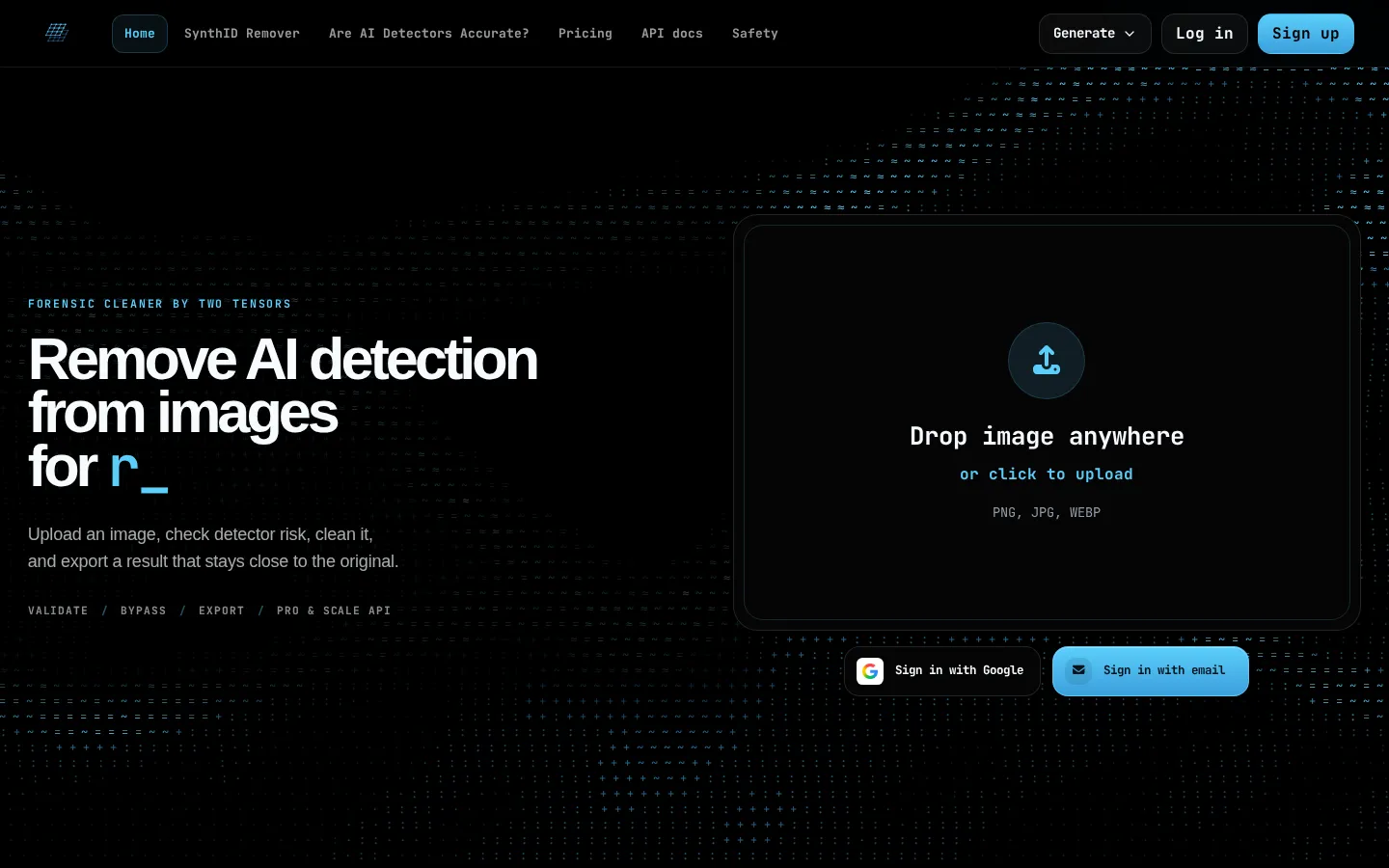
Two Tensors (twotensors.ai) is a browser-based image cleaning tool built around Forensic Cleaner. Upload a PNG, JPG, or WEBP you own, let validation run safety and dimension checks with an AI slop score, then clean the file to reduce detector-facing signals, strip SynthID watermarks, and drop EXIF, XMP, C2PA, and Content Credentials on export. Free accounts get 10 credits; Pro and Scale add API access.
What is Two Tensors?
Two Tensors is the company behind Forensic Cleaner, a web app at twotensors.ai that removes AI-detection signals from images you own. The product is narrower than a general photo editor: it is a staged cleanup pipeline for PNG, JPG, and WEBP files that platforms and third-party detectors score as AI-generated. You upload a file, the service validates it, estimates how hard it will be to clean, runs a bypass pass, and exports a result designed to stay close to the source.
The workflow has four stages. Upload accepts PNG, JPG, or WEBP and carries the file into the app after sign-in. Validate runs dimension and safety checks, removes a visible Gemini logo if one is found, and produces an AI slop score that estimates cleaning difficulty. Clean offers two strengths: Strong reduces detector signals aggressively, while Quality mode is a gentler process reserved for paid plans and chosen when Strong visibly changes the image. Export returns the file without EXIF, IPTC, XMP, C2PA manifests, Content Credentials, or other AI provenance metadata. Nothing is installed locally, and the export arrives in the same format you uploaded.
A dedicated SynthID stage handles Google's invisible pixel watermark for Gemini and Imagen output, with its own adjustable strength. The site recommends Medium as a starting point and warns that small or distant faces distort at higher settings. A 1024px downscale option improves both SynthID removal reliability and detection results on stubborn files. Published before-and-after examples show one photograph moving from a detected SynthID and a 99% AI score to no SynthID and a 1% score after a Quality mode clean.
Two Tensors publishes its limits plainly. Internal testing puts the clean rate near 90% across three popular AI image detectors, and the FAQ states outright that no tool can promise universal undetectability; results move with image type, detector, and detector updates. Maximum output is roughly 2 megapixels. Video and audio SynthID removal are not available. Use is restricted too: fraud, impersonation, non-consensual imagery, and illegal activity are prohibited, and the copy leans hard on ownership — clean images whose rights you hold.
Accounts are credit-based. Free gives 10 credits a month and three 768px exports. Paid tiers raise output to 1024px, add Quality mode, allow more concurrent jobs, and unlock API access from Pro upward. Checkout takes cards plus Bitcoin Lightning, ETH, SOL, USDT, and USDC directly in the app. The documented API covers upload, job polling, and download, which is the main difference between this and the many one-off watermark removers.
The site doubles as a small knowledge base. Separate guides cover Gemini visible-logo removal, metadata and C2PA stripping, detector accuracy and false positives, and a step-by-step remove-AI-detection walkthrough, with translated pages in Spanish, Portuguese, Indonesian, and Russian for non-English users. That material is worth reading before assuming a failed clean was the tool's fault.
Two Tensors Core Features
Staged forensic cleanup
Upload, validate, clean, and export run as separate steps, with dimension and safety checks and an AI slop score before any credits are spent.
Detector bypass strengths
Strong mode reduces detector-facing pixel signals aggressively, while Quality mode on paid plans applies a gentler pass that keeps the image closer to the original.
Dedicated SynthID removal
A separate stage targets Google's invisible pixel watermark in Gemini and Imagen files, with adjustable strength from low to high and a recommended Medium starting point.
Visible Gemini logo removal
Validation detects and removes the visible Gemini watermark automatically, complementing the invisible SynthID stage.
Metadata and C2PA stripping
Exports drop EXIF, IPTC, XMP, C2PA manifests, Content Credentials, and other AI provenance metadata without a separate tool.
1024px downscale option
An optional resize improves SynthID removal reliability and detection results on images that survive a normal clean.
Credit-based plans with API
Free, Starter, Pro, and Scale tiers meter cleaning in credits, and Pro and Scale include documented API access for upload, job polling, and download.
Account history and crypto checkout
Downloads, copies, favorites, reruns, and deletions live in account history, and checkout accepts cards plus Bitcoin Lightning, ETH, SOL, USDT, and USDC.
Who is Two Tensors for?
Two Tensors is aimed at people who hold the rights to an image and need it to stop scoring as machine-made. The homepage names the audience directly: creators, founders, researchers, marketers, freelancers, entrepreneurs, editors, designers, and curators. In practice that means a designer whose AI-assisted mockup gets rejected by a stock platform, a marketer whose product visuals trigger a client's detector, or a researcher who needs a provenance-free copy of their own generated figure. A second group is small teams with a pipeline. Pro and Scale include API access with upload, polling, and download endpoints, so an agency or marketplace can screen and clean images inside its own tooling instead of sending staff to a web form. Scale adds four concurrent jobs for that kind of throughput. The third group is individual sellers and publishers: print-on-demand shops, Etsy and marketplace sellers, newsletter writers, and social creators who generate images and then hit upload filters that flag synthetic origin. The free tier's three 768px exports a month are enough to test whether the clean survives the detector they actually care about. It fits poorly elsewhere. Anyone wanting a full editor, layer control, or upscaling past roughly 2 megapixels will be frustrated, as will video or audio creators, since only still images are supported. People looking to pass off someone else's work are explicitly excluded by the safety rules. Curators and archivists round out the list the homepage names, and for them the metadata stage may matter more than the bypass stage: an export can ship without embedded provenance fields that clash with an institution's own cataloguing. Reviewers and newsletter operators get a second reason to look, since the affiliate program advertises no minimum payout and manual processing. What nobody gets is print-scale output or unattended bulk uploads in the browser.
Two Tensors Use Cases
Clean your own AI-generated product renders before uploading them to a marketplace that screens for synthetic origin.
Remove the visible Gemini logo and invisible SynthID watermark from an Imagen image you commissioned.
Strip C2PA manifests and EXIF metadata from client images before publishing them on a site.
Test whether a cleaned export still trips Hive, TruthScan, or AI or Not before a campaign goes live.
Run the API inside a design pipeline so dozens of owned images are processed without manual uploads.
Rescue archive images that unreliable detectors mislabel as AI because of resolution or JPEG compression.
Prepare founder headshots or mockups generated with Nano Banana or Seedream for stock and ad platforms.
Two Tensors Pros and Cons
Pros
- The pipeline is honest about its limits: the site publishes a ~90% internal clean rate and states plainly that no tool guarantees universal undetectability.
- Validation is free and credits are only spent on an actual clean, so you can screen an image and read its slop score before paying anything.
- Metadata handling is thorough — EXIF, IPTC, XMP, C2PA, and Content Credentials all come off in one pass, alongside the SynthID stage.
- Pro and Scale ship a real documented API with upload, polling, and download, plus card and direct crypto checkout including Bitcoin Lightning.
Cons
- Output caps at roughly 2 megapixels, which rules out print-resolution work and high-DPI marketing assets.
- Only still images are supported; SynthID removal for video and audio is not available.
- The web app has no batch upload, and Quality mode, 1024px export, and API access all require an active paid subscription.
FAQ About Two Tensors
Two Tensors Pricing
Freemium: a free account gives 10 credits a month and three 768px exports. Paid plans are Starter at $29/mo (350 credits, 116 1024px images, one concurrent job), Pro at $49/mo (1,500 credits, 500 images, two jobs, API), and Scale at $149/mo (5,000 credits, 1,666 images, four jobs, API), with yearly options at $290, $490, and $1,490. One-time credit packs run from $29 for 200 credits to $1,499 for 50,000. Cards and crypto accepted.
Check official pricingTwo Tensors Alternatives

EvadeGPT
EvadeGPT is a writing workspace built around an AI humanizer that restructures sentence rhythm, phrasing and paragraph flow so machine-written drafts read more naturally. It adds a built-in AI detector, a multi-model chat, a rubric-aware essay drafter, slide generation and citation lookup on one shared points balance, aimed at marketers, editors and multilingual writers polishing their own drafts.

Liberty AI
Liberty AI is a free-tier chat assistant built on decentralized compute and zero-data-retention providers. It runs open-source models, keeps conversations out of Big Tech training pipelines, offers Ghost Mode and hardware TEE processing for sensitive queries, and bundles real-time search plus image and video generation for individuals and small teams, priced from $0 to $99.99 a month.

Winston AI
Winston AI scans text, documents, and images for signs of machine generation and copied material, returning a 0-100 human-versus-AI score with sentence-level highlighting. It detects output from ChatGPT, Claude, Gemini, and Llama across fourteen languages, checks plagiarism against web sources, reads handwriting through OCR, and exports shareable PDF reports. Education, publishing, and SEO teams use it for integrity checks.