
SupaVoxel
SupaVoxel is a free AI 3D model generator that turns any 2D image into a detailed, textured voxel model in seconds. Simply upload a photo, sketch, or artwork and the AI produces a ready-to-use 3D mesh with automatic PBR textures. Export to GLB, FBX, OBJ, STL, PLY, and USDZ for games, 3D printing, VFX, and AR. No modeling skills required.
What is SupaVoxel?
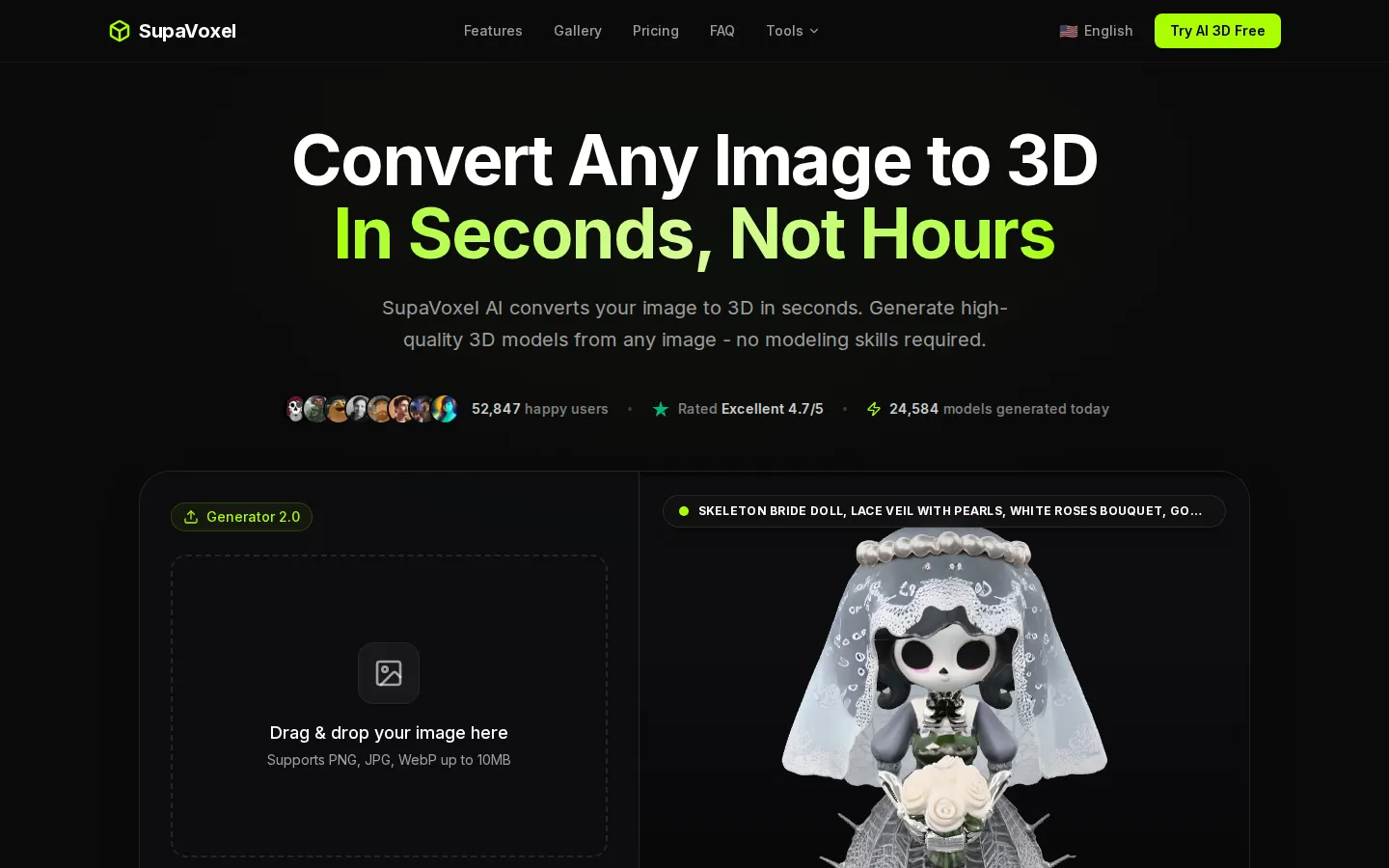
SupaVoxel is a web-based AI 3D model generator that converts any two-dimensional image into a fully formed 3D voxel model in seconds. Rather than spending hours sculpting in Blender, Maya, or ZBrush, you simply drag and drop a photo, sketch, piece of AI art, or logo, and the SupaVoxel engine analyzes the image and generates a detailed mesh with automatic PBR textures. The homepage describes the process as converting any image to 3D in seconds, not hours, and the platform positions itself as a fast, beginner-friendly alternative to traditional modeling software. The tool runs entirely in the browser with no downloads or installs required, and it is built around a generous free tier that lets anyone generate three free models per day without a credit card. Models can be exported in a wide range of industry-standard formats, including GLB, GLTF, FBX, OBJ, STL, PLY, and USDZ, so the output is ready for game engines, 3D printing, film and VFX pipelines, and AR experiences. SupaVoxel highlights several technical strengths: generation in roughly twelve seconds versus five or more minutes for competing tools, clean quad-dominant topology with optimized polygon counts, and automatic texturing that turns the source image into PBR materials. Paid plans add higher monthly credit quotas, concurrent task generation, AI image editing through models such as Nano Banana Pro and GPT Image 2, background removal, mesh editing, and queue priority. The Ultra tier removes generation limits entirely and, according to the FAQ, unlocks API access for integrating SupaVoxel into custom applications and bulk workflows. The gallery showcases the range of subjects the engine handles, including creatures, characters, vehicles, objects, and architecture, rendered in a stylized voxel aesthetic. SupaVoxel markets itself to game developers, studios, 3D artists, and teams, and states it is used by professionals working with tools like Unreal Engine, Blender, Houdini, Maya, ZBrush, and 3ds Max. A Trustpilot badge on the homepage shows a 4.7 out of 5 Excellent rating, and the site reports more than 52,000 happy users and roughly 24,000 models generated per day. The brand is described as made with AI in San Francisco. In short, SupaVoxel is a fast, accessible image-to-3D converter that lowers the barrier to creating usable 3D assets.
SupaVoxel Core Features
Instant AI image-to-3D conversion completes in roughly 12 seconds, far faster than typical tools
Multiple export formats including GLB, GLTF, FBX, OBJ, STL, PLY, and USDZ
Automatic PBR texturing generated from your source image with no manual work
Clean, quad-dominant topology with optimized polygon counts for real-time use
One-click export downloads models instantly with textures and materials included
AI image editing powered by Nano Banana Pro, GPT Image 2, Z-Image-Turbo, and Qwen Image Edit
Concurrent generation of up to four models at once on Pro and higher plans
API access on the Ultra plan for integrating SupaVoxel into custom workflows
Who is SupaVoxel for?
SupaVoxel is aimed at anyone who needs 3D assets but does not want to spend hours learning or operating complex modeling software. Its core audience is game developers and indie studios who need to quickly produce props, characters, creatures, and vehicles for their projects. Because SupaVoxel exports to standard formats such as GLB, FBX, and OBJ, the resulting models drop straight into engines and pipelines that already use tools like Unreal Engine, Blender, Houdini, Maya, ZBrush, and 3ds Max. Beyond game development, the platform targets 3D artists and designers who want a fast starting point or a way to prototype ideas before investing heavy manual effort. It also suits 3D printing hobbyists, since clean meshes and STL export make printing straightforward, and film and VFX teams that need rapid concept assets. AR and VR creators benefit from USDZ export for mobile augmented reality, while educators and students are drawn to the free tier and the promise of no modeling skills required. Product designers and interior designers are listed among the industries SupaVoxel serves. On the business side, freelancers and small studios watching costs are attracted by the low per-model pricing, which the site claims works out to about $0.048 per model and a 76% saving versus competitors. Hobbyists can start and stay free by generating up to three models per day, while power users and professional teams upgrade to paid plans for higher quotas, concurrent generation, AI image editing, and unlimited output. Overall, SupaVoxel fits creators who value speed and simplicity over granular manual control.
SupaVoxel Use Cases
Generate game-ready props, characters, and creatures for indie game projects
Prototype 3D concepts quickly from sketches or reference photos
Create printable STL models for 3D printing at home or in a studio
Build AR-ready assets using USDZ export for mobile augmented reality
Produce concept assets for film and VFX pipelines without manual modeling
Convert logos, artwork, or AI images into shareable voxel models
Teach 3D design fundamentals in classrooms with free daily generations
Integrate bulk image-to-3D conversion into custom apps via the API
SupaVoxel Pros and Cons
Pros
- Extremely fast generation, around 12 seconds versus 5+ minutes for many competitors
- Generous free tier with three models per day and no credit card required
- Broad export support (GLB, FBX, OBJ, STL, PLY, USDZ) suits games, printing, and AR
- Low per-model pricing claimed at $0.048 with a 30-day money-back guarantee
- No modeling experience needed, thanks to a drag-and-drop browser workflow
Cons
- Voxel-styled output may not suit projects needing highly realistic, detailed meshes
- Free tier is limited to three models per day and lacks the paid editing features
- API access is restricted to the top Ultra plan, so cheaper tiers cannot automate bulk jobs
FAQ About SupaVoxel
SupaVoxel Pricing
SupaVoxel is free to start with three models per day and no credit card required, while paid subscriptions run $19 per month for Starter, $29 per month for Pro, and $99 per month for Ultra.
Check official pricingFree
Three free models per day with no credit card required to start
Starter
400 credits per month, first month $9, all export formats, and a private commercial license
Pro
600 credits per month plus AI image editing, unlimited background removal, and four concurrent tasks
Ultra
Unlimited 3D generations and image editing, top queue priority, and API access
SupaVoxel Alternatives

Stability AI
Stability AI is the generative AI company behind Stable Diffusion, Stable Audio, Stable Video and Stable 3D, which generate and edit images, video, audio and 3D assets. Teams can call those models through the developer Platform API, download open weights from Hugging Face, or license them for self-hosted deployment. A free Community License covers organisations under $1M revenue, while enterprise licensing is quoted on request.

Fomrix
Turn images or text into GLB assets, then inspect models with browser-based STL, GLB and OBJ viewers and use STL conversion and mesh tools.
NormalMap AI
NormalMap AI is a free browser-based generator that converts a single photo or albedo texture into a complete set of PBR maps—normal, height, roughness, metallic and ambient occlusion—using real-time WebGL, so nothing is uploaded. Its AI section turns text prompts into seamless, tileable textures, and the built-in 3D viewer previews results on spheres, cubes and planes before you download transparent PNGs.