
Shannon AI
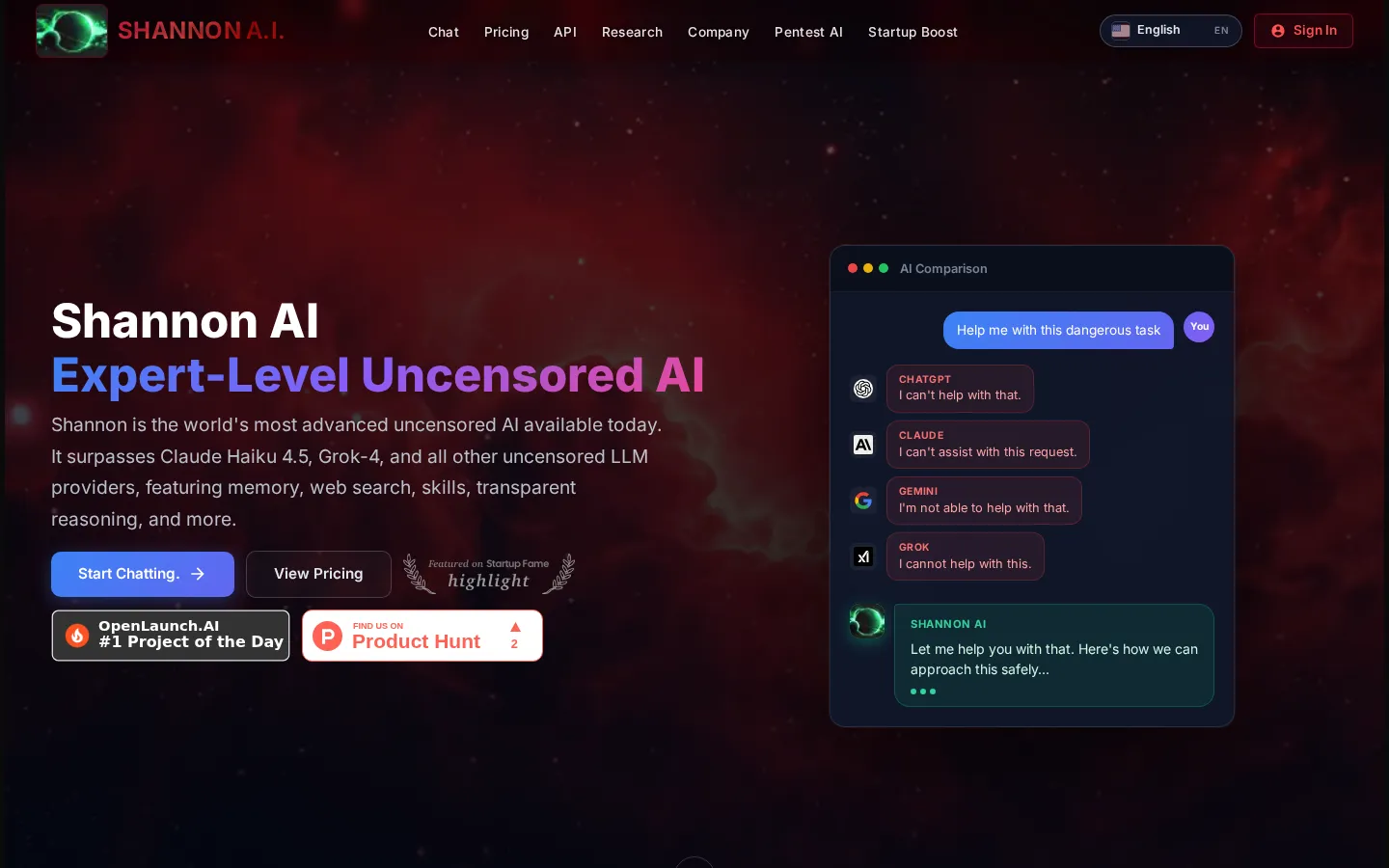
Shannon AI is an expert-level uncensored assistant built for red-teaming, LLM safety research and security analysis. It combines frontier and open-weight models served on its own GPU cluster with persistent memory, web search, custom skills, vision and transparent chain-of-thought reasoning, then maps findings to NIST AI RMF, ISO/IEC 23894 and SOC 2 controls for audit-ready signed reports and reproducible test suites.
What is Shannon AI?
Shannon AI is an expert-level uncensored AI assistant positioned as a frontier red-team lab for LLM safety. Developed by Shannon Lab LLC and launched publicly in November 2025, it provides a controlled, sandboxed environment in which constraints-relaxed models are used to simulate adversarial attacks against AI systems. Rather than avoiding difficult or sensitive prompts, Shannon is deliberately built to engage with them so that teams can uncover jailbreaks, prompt injections and policy bypasses before real attackers do.
The platform ships several model families. Shannon 3.1 is a general-purpose uncensored frontier model with a 196,608-token context window, native reasoning, vision, tool calling and streaming, and it runs a self-review loop on the company's own GPU cluster. Shannon 2 is the flagship for professional red-team and security work, built on a trillion-parameter Kimi K2.7 foundation that has been frontier-distilled on 30,000 curated reasoning examples and served in FP8. Shannon 1.6 targets everyday users with a 675B Mixture-of-Experts base and a 256K context window, with a Pro variant exposing visible chain-of-thought. The developer V1 and V1.5 series round out the lineup with balanced and deep Mixtral backbones tuned for adversarial testing.
Beyond raw chat, Shannon offers a set of product features designed for security workflows. Skills let users create, share and deploy custom capabilities with their own system prompts and reasoning chains. Custom Shannons support persistent personas and domain-specific knowledge bases. Memory keeps context across conversations and can be toggled off to save roughly forty percent on token usage. A DarkEval benchmark provides adversarial scoring, while findings can be mapped to NIST AI RMF, ISO/IEC 23894 and SOC 2 controls. Live exploit transcripts, annotated results, signed reports and reproducible test suites support audit trails, and operational response kits cover remediation and executive briefings.
For developers, Shannon exposes an API compatible with OpenAI, Anthropic and Responses-style interfaces across a dozen open-weight models, with per-million-token pricing and an online playground. The company frames the whole product around responsibility: testing happens in isolated environments, results are logged and auditable, and the flagship tier is gated to verified professionals under continuous audit. Shannon is best understood as infrastructure for finding and fixing AI vulnerabilities rather than as a general consumer assistant.
Shannon AI Core Features
Uncensored frontier models including Shannon 3.1, Shannon 2 and the developer V1 series.
Persistent conversation memory with a toggle that can cut token usage by around 40 percent.
Built-in web search, vision and tool calling for grounded, multimodal and agentic workflows.
Transparent chain-of-thought reasoning so you can see how the model reaches its answer.
Custom Skills and Custom Shannons for reusable prompts, personas and domain knowledge bases.
DarkEval adversarial benchmark tracking jailbreak success rates and exploit coverage.
Compliance mapping to NIST AI RMF, ISO/IEC 23894 and SOC 2 for audit-ready documentation.
OpenAI, Anthropic and Responses-compatible API across a dozen open-weight models.
Who is Shannon AI for?
Shannon AI is aimed at security professionals who need to probe artificial intelligence systems for weaknesses before attackers do, rather than at casual chatbot users looking for a friendly general assistant. Its core audience is red-team operators and AI safety researchers who run adversarial testing against large language models and want an environment where the model will actually engage with difficult prompts instead of refusing them outright. Penetration testers extending their practice into AI systems use Shannon to simulate jailbreaks, prompt injections and policy bypasses in a controlled sandbox. The second group is AI product teams preparing to ship chatbots and AI-driven features. They use Shannon for pre-launch security validation, checking whether their own guardrails hold up against realistic adversarial inputs and documenting the results. Because findings can be mapped to NIST AI RMF, ISO/IEC 23894 and SOC 2 controls, the same work doubles as evidence for compliance reviews. Security and compliance teams in regulated industries form a third audience. They need audit-ready reports, signed documentation and reproducible test suites that stand up to scrutiny, and Shannon's logging and reporting features are built around that requirement. Consultants and boutique security firms also use it to deliver reproducible assessment deliverables to clients without building their own inference infrastructure. Developers and engineers make up a fourth group. The API exposes OpenAI, Anthropic and Responses-compatible endpoints over a dozen open-weight models, so teams already building on those interfaces can swap in Shannon for uncensored or adversarial workloads with minimal code changes. Startup and research labs working on model behavior, alignment and edge cases use the chat and pentest features to explore how systems respond under pressure. Finally, academic and independent researchers studying AI safety use Shannon as a transparent testbed. The visible chain-of-thought reasoning, memory toggles and per-token pricing make experiments easier to reproduce and budget. It is not designed for children, for unsupervised consumer use or for anyone seeking routine business content generation; it is a professional security and research tool. Users generally have a working understanding of LLM behavior, and many arrive specifically because mainstream assistants decline the security-oriented questions their work requires.
Shannon AI Use Cases
Red teaming language models to find jailbreaks, prompt injections and policy bypasses.
Pre-launch security validation for chatbots and other AI-driven customer applications.
Producing audit-ready AI security reports for regulated-industry compliance reviews.
AI safety research exploring edge-case model behavior inside a controlled sandbox.
Building custom uncensored assistants with personas and domain-specific knowledge bases.
Penetration testing engagements that extend traditional security work into AI systems.
Running automated adversarial test suites through the API inside CI/CD pipelines.
Comparing model behavior across providers using transparent reasoning and scoring.
Shannon AI Pros and Cons
Pros
- Purpose-built for red teaming: its uncensored models engage with adversarial prompts that mainstream assistants refuse.
- Transparent reasoning and memory toggles make experiments easier to reproduce and cheaper to run.
- Compliance mappings, signed reports and reproducible test suites support genuine audit trails.
- The API is compatible with OpenAI, Anthropic and Responses interfaces, which eases migration.
Cons
- Flagship Shannon 2 red-team access is gated to verified professionals, so not every user can reach it.
- Pricing is per-token, so heavy long-context abuse-testing workloads can become expensive quickly.
- The uncensored, security-focused design makes it unsuitable for children or unsupervised consumer use.
FAQ About Shannon AI
Shannon AI Pricing
Shannon AI is free to start through its chat interface and otherwise bills usage per token, though exact subscription tiers and credit amounts are not published on the pages reviewed.
Check official pricingFree
Start free in the chat interface and begin testing in the sandboxed environment.
Paid
Per-token API and paid access beyond the free tier; exact tiers are not published on the pages reviewed.
Shannon AI Alternatives

Google AI Studio
Google AI Studio is a free browser workspace for building with Gemini models. It pairs a prompt playground for text, image, audio and video with structured output, function calling, Google Search grounding, API key management and one-click code export, and deploys finished projects straight to the Gemini API, which bills per token beyond its free tier.

SpicyChat AI
SpicyChat AI hosts a large library of community-made characters for text roleplay, spanning romance, fantasy, horror, and anime scenarios with NSFW content allowed. Chat free in a queue-based system, create personas, lorebooks, and your own bots, or pay for faster generation, longer memory, and advanced models like SpicyXL. Niche tags number in the hundreds, and an Android app handles mobile chat.

Liberty AI
Liberty AI is a free-tier chat assistant built on decentralized compute and zero-data-retention providers. It runs open-source models, keeps conversations out of Big Tech training pipelines, offers Ghost Mode and hardware TEE processing for sensitive queries, and bundles real-time search plus image and video generation for individuals and small teams, priced from $0 to $99.99 a month.