
Quilter
Quilter is a physics-driven AI platform that automates PCB placement and routing for electronics design teams. It generates dozens or hundreds of candidate board layouts, validates each trace against physics and fabrication rules, and returns files in native ECAD formats. Teams use it to compress board bring-up from weeks to days without training on their proprietary data.
What is Quilter?
Quilter is a physics-driven AI platform for electronics design that automates PCB placement and routing. Its engine uses reinforcement learning trained entirely on synthetic data generated by simulation — the site compares it to AlphaGo learning Go — rather than on human-designed boards, so it does not imitate human layouts or train on customer IP. For each job, Quilter generates dozens or hundreds of candidate board layouts in parallel and ranks them against a five-part scoring system: routing completion percentage, manufacturability (no DRC violations, trace/spacing/drill compliance), physics rule checks (ground plane overlap, overheated trace length, differential length mismatch, thermal and signal performance), fabrication fit against real fabricator stack-ups, and resource efficiency (layer count, via count, trace length, component density). Engineers can filter candidates by layer count, trace width, and vendor rules. The product works with native ECAD files: users upload Altium, Cadence Allegro, Siemens Xpedition, or KiCad projects, define the board outline, pre-place connectors, and set the floorplan, and Quilter returns files in the same format for DRC, polishing, and fab file generation — no proprietary formats or lock-in. It surfaces physics-aware considerations for review, such as bypass capacitors, impedance-controlled nets, and differential pairs, and gives transparent feedback on which design aspects are done and which need more work. Current capability scope: 100 to 1,000 components per board, roughly 2,000–5,000 pins, pin density under 20%, and through-hole vias, with blind/buried vias, length matching, and RF support in development and BGA fanout generation in beta. In a published comparison, layout work that professionals quoted at 428 hours took 38.5 hours of human cleanup with Quilter. Deployment options include Quilter Cloud on AWS (SOC 2 Type II) and self-hosted Kubernetes deployments via Helm chart with NVIDIA GPU resources, including fully air-gapped operation. A free tier covers academic, personal, and eligible professional use, while paid access is priced per project by unrouted pin count rather than per seat.
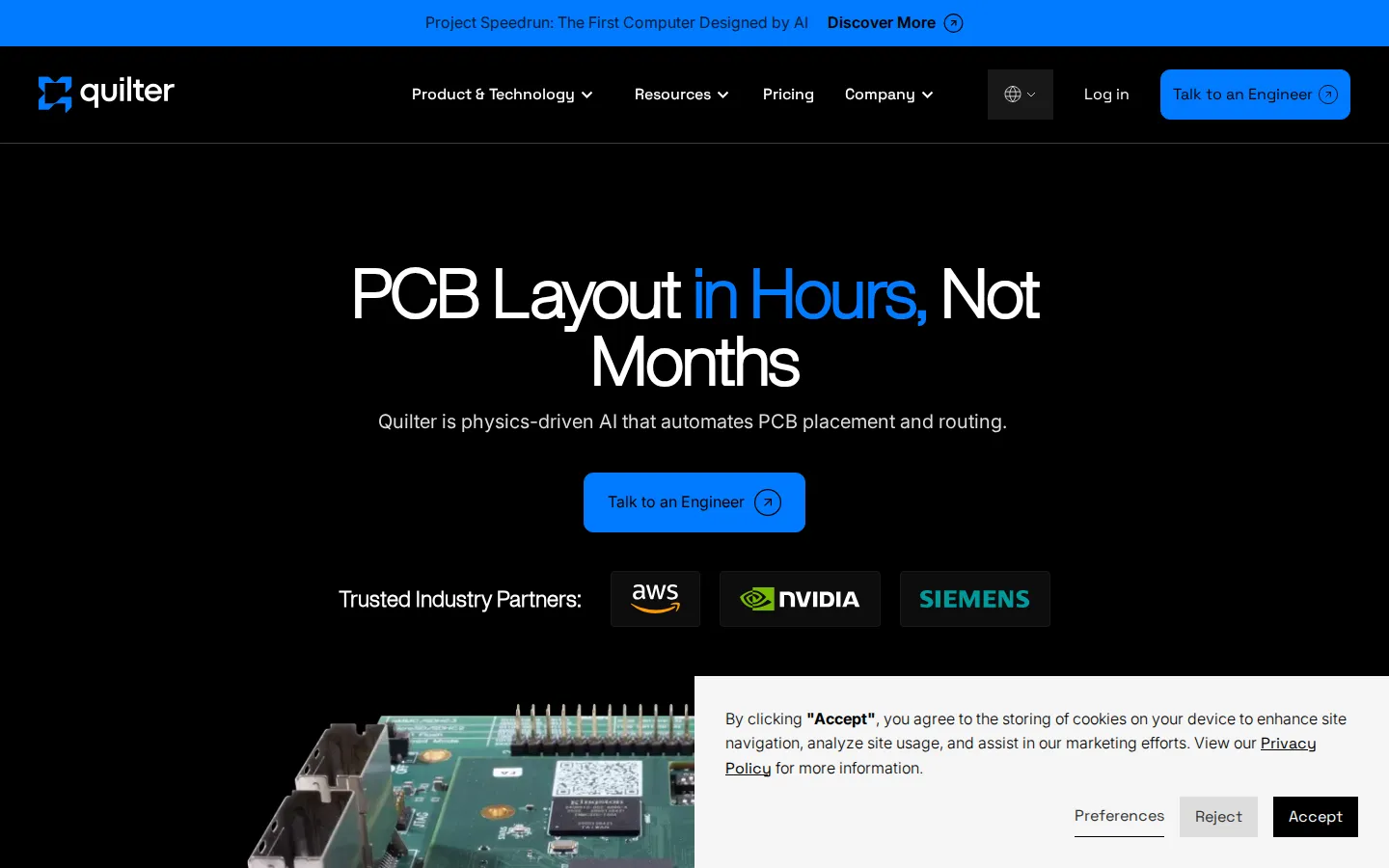
Quilter Core Features
Physics-driven reinforcement learning engine automates PCB placement and routing, validating every trace against physics rules
Native ECAD workflow
uploads and downloads Altium, Cadence Allegro, Siemens Xpedition, and KiCad files with no lock-in
Generates dozens or hundreds of candidate board layouts per job, running multiple versions in parallel
Ranks candidates by routing completion, DRC violations, physics rule checks, fabrication fit, and resource efficiency
Transparent design review gives clear feedback on which design aspects are done and which need more work
Trained on synthetic physics simulations, never on customer designs — protects your IP from day one
Unlimited iterations within a project
change floorplans, stack-ups, and component positions at no extra cost
Enterprise-grade security
SOC 2 Type II compliance, encrypted data, and self-hosted Kubernetes deployment options
Who is Quilter for?
Quilter is built for engineers and teams whose progress is gated by PCB layout work. The primary users are PCB designers and electrical engineers who currently route boards by hand in Altium, Cadence Allegro, Siemens Xpedition, or KiCad — Quilter takes their native project files and automates placement and routing so they can review and polish instead of drafting traces. R&D managers and engineering leaders use it to scale output without hiring: layout talent is scarce, boards sit on hold waiting for it, and Quilter runs multiple boards in parallel overnight to clear the backlog. It targets industries with demanding boards and strict review cycles — semiconductors, robotics, consumer electronics, and aerospace and defense — where teams need bring-up-ready boards in days, not weeks, and where IP protection matters. The site highlights concrete scenarios: test fixtures and harnesses (shaving 4–6 weeks off bring-up), IC evaluation boards, design validation boards, and backplane or interconnect boards, where lead times drop from 30+ days to under 24 hours. The free tier extends access to students, researchers, and fledgling businesses (fewer than 10 employees and under $50K/year revenue), making it usable for personal projects, academic work, and professional development. Quilter is honest about who it is not for: it is not an AI schematic generator and offers limited simulation or circuit analysis functionality.
Quilter Use Cases
Test fixtures and harnesses: shave 4–6 weeks off board bring-up
IC evaluation boards: cut layout cycles from weeks to hours for rapid iteration
Design validation boards: shrink validation cycles from months to days
Backplane and interconnect boards: go from 30+ days to under 24 hours
Semiconductor boards: bring-up ready in a single workday
Robotics hardware: compress board bring-up from 4 weeks to under 1 day
Consumer electronics: fabrication-ready boards in a single workday
Aerospace and defense: faster board bring-up for validation and TRR reviews
Quilter Pros and Cons
Pros
- Free tier with unlimited iterations for personal, academic, and eligible professional use
- Pay-per-project pricing by unrouted pin count — no per-seat licenses or annual contracts
- Never trained on customer data, with SOC 2 Type II and self-hosted options for sensitive IP
- Native ECAD round-trip with no proprietary formats, plus unlimited iterations per project
- Honest published capability roadmap so teams know exactly what Quilter handles today
Cons
- No public API or programmatic integration is documented for embedding Quilter in custom toolchains
- Not a schematic generator, and limited in advanced simulation or circuit analysis functionality
- Sweet spot is 100–1,000 components under 20% pin density with through-hole vias; blind/buried vias and RF are still in development
FAQ About Quilter
Quilter Pricing
Quilter offers a free tier for personal, academic, and eligible professional use, while commercial access is priced per project by unrouted pin count with no per-seat licenses, and full plan pricing is available through a sales consultation.
Check official pricingFree
Free tier for academic, personal, and eligible professional use (under 10 employees, under $50K revenue) with unlimited iterations and all product features; data hosted on public cloud with community support.
Enterprise
Pay-per-project pricing based on unrouted pin count with unlimited iterations, parallel jobs, guided onboarding, and public cloud, private cloud, or on-premises deployment options.
Quilter Alternatives

Google AI Studio
Google AI Studio is a free browser workspace for building with Gemini models. It pairs a prompt playground for text, image, audio and video with structured output, function calling, Google Search grounding, API key management and one-click code export, and deploys finished projects straight to the Gemini API, which bills per token beyond its free tier.

FastRouter
FastRouter is a unified LLM gateway that gives developers one OpenAI-compatible API for 200+ models from providers such as OpenAI, Anthropic, Google, and xAI. It adds automatic model routing, fallbacks, caching, spend caps, role-based access, guardrails, and per-request observability, while passing provider token prices through with no markup on any plan, including the free tier.

Cindy
Cindy is an open-source desktop AI agent from XD Inc. that unifies Claude Code, Codex and Pi harnesses with 20+ tools, persistent memory and reusable skills. Use it free with your own API key or existing Coding Plan, or pay for the optional managed model service that works the moment you sign in. No setup project required.