
Prelint
Prelint is a pull-request reviewer that checks every PR against your product specs. As AI writes more code, it drifts from intent: pricing rules change, compliance is skipped, domain language fragments, and scope creeps. Prelint catches business logic, compliance, tooling, domain language, scope, and strategic drift before it ships, flagging inline findings with suggested fixes linked to your spec.
What is Prelint?
Prelint is an AI product-review bot that checks every pull request against your product specifications. When a developer opens a PR, Prelint reviews the changes for alignment with your documented product intent and posts inline findings directly on the PR, with suggested fixes that reference the relevant spec sections. It targets six ways AI-written code drifts from product intent: business logic (pricing, discount, or billing rules changed without financial understanding), compliance (data stored without consent flows or retention rules), tooling and infrastructure (new vendors added when standards already exist), domain language (generic terms fragmenting established internal vocabulary), scope creep (features nobody asked for), and strategic drift (off-roadmap features and premature abstractions). It integrates with Notion specs and works in pull-request workflows, with open source projects free. Pricing is usage-based at $1 per completed review, with $10 in free credits at signup, no seats, no subscription, and no minimums. Technically, Prelint operates as a bot that watches pull-request events, reads the changed code alongside your linked specification documents, and produces a structured review: a summary comment on the PR, inline findings on the affected lines, and references back to the spec sections that justify each finding. Suggested fixes are concrete, such as storing the charge amount in vendor currency rather than customer currency, so developers can act without interpretation. The product is designed to catch drift that tests miss because tests verify behavior against code, not code against intent. Its six drift categories cover business logic, compliance, tooling and infrastructure, domain language, scope creep, and strategic drift, each with real failure patterns like FX exposure on advance bookings, GDPR violations from unbounded IP logging, vendor duplication, and premature abstractions. Reviews are priced per completed review, with failed or cancelled reviews free, CI bots never triggering reviews, and open source projects supported free. The dashboard shows real-time credit balance and burn-down, with auto-recharge and monthly caps to control spend. Most teams spend $40-80 per month, making the service accessible to startups that cannot justify full-time product review.
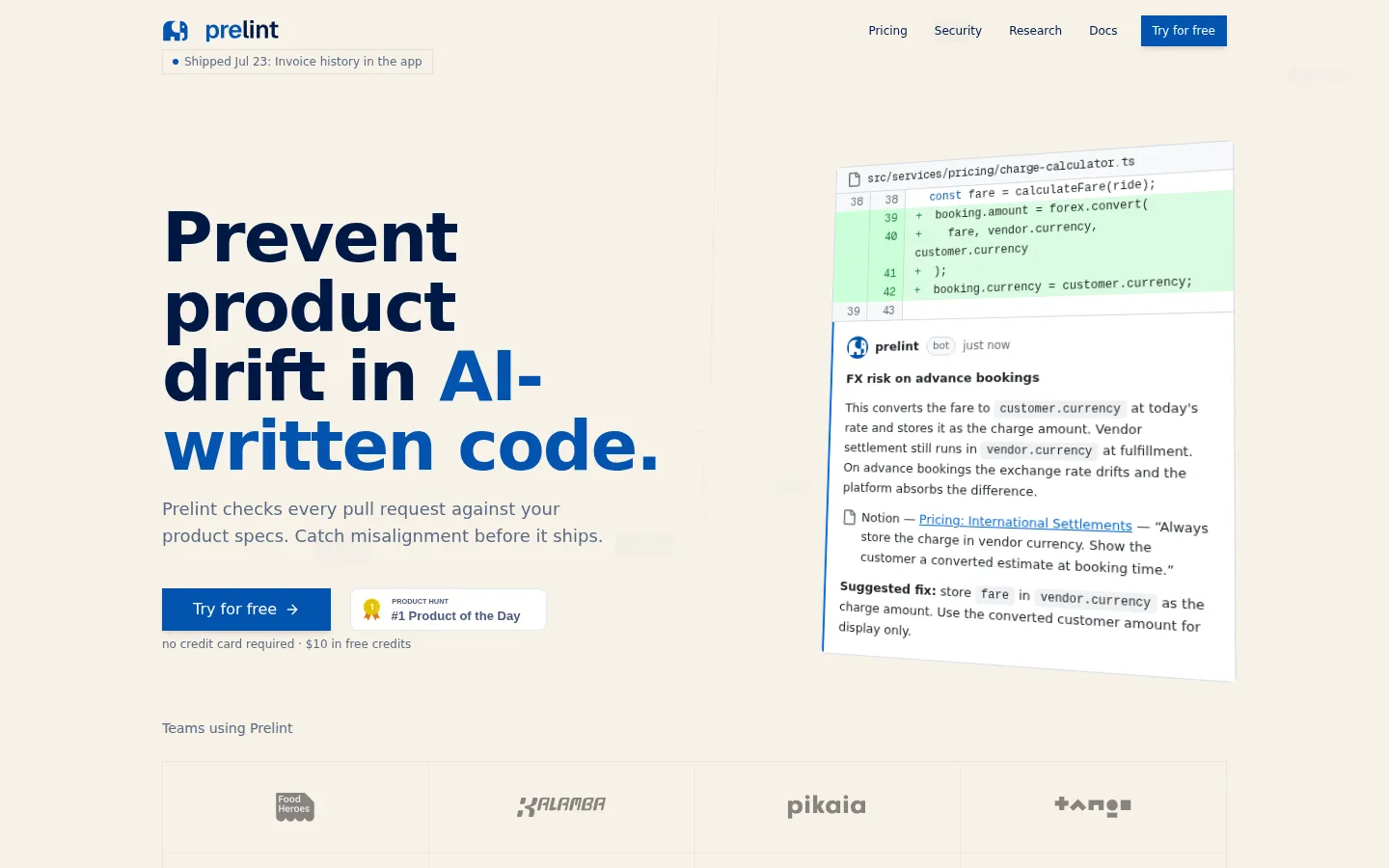
Prelint Core Features
Checks every pull request against your product specifications
Catches business logic drift in pricing, discount, and billing rules
Flags compliance issues like missing consent flows and retention policies
Detects vendor and dependency sprawl against your tooling standards
Enforces consistent domain language across codebases
Identifies scope creep and off-roadmap strategic drift
Posts inline findings with suggested fixes referencing the spec
Usage-based pricing at $1 per completed review with no seats or minimums
Who is Prelint for?
Prelint is for engineering teams, product managers, and startups that rely on AI-assisted coding and need a safety net against product drift. It is especially valuable for teams shipping fast with AI pair programmers, where unreviewed pull requests compound gaps between what AI writes and what the product actually requires. Product managers use it to enforce specs without reading every diff, while engineering leads use it to catch business logic errors, compliance violations, and scope creep before they reach production. Teams standardizing on specific vendors, currencies, or domain language use Prelint to enforce those conventions across all codebases. It is also useful for founders running lean teams who cannot afford a full review process but cannot afford revenue leaks from AI-introduced pricing or billing bugs either. Prelint also appeals to compliance-minded organizations that need audit trails showing code changes were checked against documented requirements, and to platform teams standardizing tooling across many repositories. Technical founders use it as a lightweight product manager that reviews every diff, and QA leads use it to catch specification violations that tests cannot see. Teams migrating from monolithic to service architectures benefit from domain-language enforcement when new services introduce conflicting terms. Agencies building client software use spec checks to deliver exactly what was scoped, and open source maintainers get the same protection for free. Whether a team writes code with AI assistants or human developers, Prelint provides the product-intent layer that traditional linting and testing do not cover.
Prelint Use Cases
Teams using AI coding assistants that need a spec-compliance safety net
Preventing FX and pricing bugs that leak revenue silently
Catching GDPR and CCPA violations before audits find them
Enforcing vendor standards so teams stop paying twice for infrastructure
Unifying domain language across services and teams
Blocking scope creep like unrequested i18n or GDPR features
Open source projects reviewing every PR for free
Product managers enforcing specs without reviewing every diff
Prelint Pros and Cons
Pros
- Pay only when a review runs: $1 per completed review, no seats or subscription
- $10 in free credits at signup with no credit card required
- Free for open source projects
- Catches drift types that normal code review and tests miss
Cons
- Requires product specs to be documented for reviews to be meaningful
- Credits auto-recharge by default, which may surprise cost-sensitive users
- Young product focused on PR workflows, with no standalone CLI or IDE extension yet
FAQ About Prelint
Prelint Pricing
Usage-based: $1 per completed review, $10 free credits at signup, no seats or subscription, open source projects free.
Check official pricingPay-as-you-go
$1 per completed review, $10 free credits at signup, credits never expire
Open Source
Free for open source projects
Prelint Alternatives

Kilo Code
Kilo Code is an open-source AI coding agent that works across VS Code, JetBrains, CLI, and cloud environments. It gives developers access to 500+ models through one agent, with zero markup on provider rates, and offers specialized modes for coding, architecture planning, debugging, and code review, plus Auto Model routing to control costs.

Zencoder
Zencoder is an AI orchestration platform for software teams, combining planning, coding, testing, and code-review agents in one subscription. It routes every task to the best frontier model, from Claude Opus for architecture planning to Gemini for implementation and Codex for review, while supporting bring-your-own-key usage. Teams get multi-repository indexing, parallel agent execution, scheduled automation, and built-in quality gates, with desktop apps, IDE plugins, and CI/CD integrations.

DDS Hub
DDS Hub is an AI API aggregation platform that provides discounted access to premium AI models including Claude, Codex, and GLM. With a pay-as-you-go credit system (1 Chinese Yuan = 1 credit), users can access Claude Code, Codex, ZCode, and OpenCode at significantly reduced rates compared to direct API pricing. Ideal for developers, AI agents, and CLI tools looking to reduce API costs while maintaining access to leading AI models.