
Kilo Code
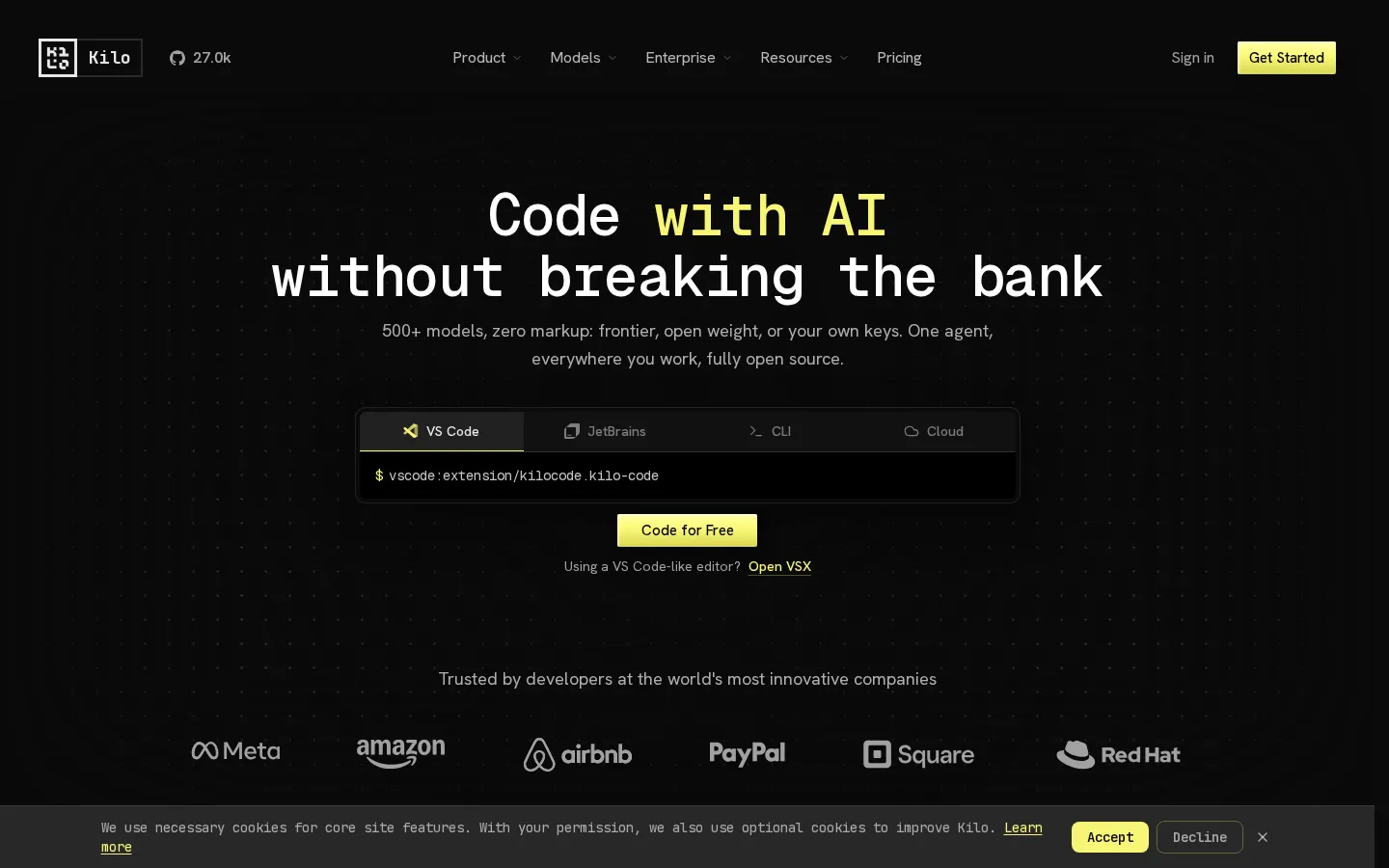
Kilo Code is an open-source AI coding agent that works across VS Code, JetBrains, CLI, and cloud environments. It gives developers access to 500+ models through one agent, with zero markup on provider rates, and offers specialized modes for coding, architecture planning, debugging, and code review, plus Auto Model routing to control costs.
What is Kilo Code?
Kilo Code is an open-source AI coding agent that helps developers write, refactor, debug, and ship production code across the tools they already use. It installs as an extension in VS Code and JetBrains IDEs, runs as a CLI agent, and extends into cloud agents and code review workflows, so the same agent follows you across every coding surface. One of its defining features is model flexibility: Kilo Code connects to more than 500 models from over 60 providers, including frontier models like Claude Opus 4.8, GPT-5.5, and Gemini 3.5, open-weight models, and free experimental options. Users can bring their own API keys, use local models, route through Kilo Gateway, or subscribe to Kilo Pass for bonus credits, and the platform advertises exact provider rates with zero markup. The agent ships with specialized modes: Code Mode for writing and refactoring, Architect Mode for planning complex features before code is written, Debug Mode for tracing errors and suggesting fixes, and cloud agent and code review capabilities for team workflows. Auto Model routing classifies each session and picks an Efficient, Frontier, or Free model strategy so developers can balance capability against cost without micromanaging model selection. Kilo Code is fully open source under the Kilo-Org organization on GitHub, which means transparent pricing, community contributions, and no vendor lock-in. The project positions itself against subscription coding assistants by emphasizing pay-as-you-go flexibility and the freedom to choose any model or provider. It is trusted by teams that want one agent everywhere they code, from solo developers to enterprises that need governance features like model and provider restrictions available on the Enterprise tier. The project's design philosophy centers on user control: there are no artificial ceilings on model choice, no requirement to buy bundled tokens, and no data lock-in, since the agent works with the models and providers you already trust. Kilo Code also ships an Auto Model system that classifies each session in real time and routes work to Efficient, Frontier, or Free model strategies, which is particularly valuable for teams that want frontier-level results on complex tasks while keeping routine requests on cheaper models. The open-source nature of the project means its roadmap is visible and community-driven, with regular releases covering new models, IDE improvements, and agent capabilities. Developers who prefer privacy can run local models entirely offline, while teams can centralize usage through Kilo Gateway for billing, logging, and governance. The product's blog tracks industry shifts such as metered pricing and model availability, positioning Kilo Code as an informed alternative to subscription-based assistants.
Kilo Code Core Features
500+ model support
Access frontier, open-weight, free, and local models from 60+ providers through a single agent.
Zero markup pricing
Pay exact provider rates through Kilo Gateway or bring your own API keys with no added cost.
Multiple agent modes
Code, Architect, and Debug modes let you switch contexts without switching tools.
Everywhere you code
The same open-source agent works in VS Code, JetBrains, CLI, and cloud environments.
Auto Model routing
Automatically picks Efficient, Frontier, or Free model strategies based on your budget and task.
Cloud agents and code review
Move from local coding to remote agents and team review workflows without changing tools.
Fully open source
Transparent code and pricing with an active community under the Kilo-Org GitHub organization.
Team and enterprise governance
Team management, model restrictions, and compliance controls on paid tiers.
Who is Kilo Code for?
Kilo Code is designed for developers and engineering teams who want an AI coding agent without being locked into one vendor or subscription. Solo developers and freelancers benefit from the free open-source tier, BYOK support, and the ability to use free or local models to keep costs near zero. Full-stack engineers can use Code Mode for everyday implementation and Architect Mode for planning complex features before writing code. Engineering teams and startups benefit from the Teams plan, which adds team management, shared context, and collaboration around cloud agents and code review. Technical leads and platform engineers can use Kilo Gateway and Auto Model routing to control model spend across the team, choosing frontier models only when the work demands them. Enterprises needing security and compliance can adopt the Enterprise tier with model and provider restrictions. Open-source contributors and AI enthusiasts appreciate that the entire agent is open source, with community-driven development and no artificial limits on which models can be used. Essentially, anyone who codes and wants a flexible, transparently priced AI assistant can use Kilo Code. Technical leads and engineering managers evaluating AI tooling for their organizations will appreciate the transparent pricing and governance options, since the cost of AI assistance becomes predictable and auditable. AI researchers and model enthusiasts can experiment with the latest frontier and experimental models without committing to a subscription, making the tool useful for benchmarking and side projects. Bootcamp students and self-taught programmers learning to code benefit from a free assistant that explains code and suggests improvements without cost barriers. Remote and distributed teams can share agents and context across cloud workflows, while contractors who bill by the hour can use Auto Model routing to keep overhead low. Finally, open-source maintainers can contribute directly to the Kilo Code codebase, extending the agent for their own needs and the wider community.
Kilo Code Use Cases
Write and refactor production code across your codebase with an agent that understands the full project.
Plan complex features with structured guidance before writing a single line of code.
Debug failing code by having the agent trace errors and suggest concrete fixes.
Route requests across free and frontier models to control monthly AI spend.
Run remote cloud agents and code reviews for team workflows.
Use Kilo Code in your terminal for scripting and automation without leaving the CLI.
Bring your own API keys to avoid subscription lock-in while using the agent.
Set up enterprise governance that restricts which models and providers the team can use.
Kilo Code Pros and Cons
Pros
- Open source with transparent, zero-markup pricing and no vendor lock-in.
- Access to 500+ models including the latest frontier and free options.
- One agent across VS Code, JetBrains, CLI, and cloud surfaces.
- Auto Model routing and BYOK make it one of the cheapest flexible coding agents.
Cons
- Self-serve model management can be overwhelming for developers who prefer a simple subscription.
- Setup requires choosing providers or keys, which adds initial configuration work.
- Newer than long-established rivals, so some enterprise features are still maturing.
FAQ About Kilo Code
Kilo Code Pricing
Freemium. Free and open source for individuals (free models, BYOK, or local); Teams $15/user/month; Enterprise custom. Optional Kilo Pass $19/month and Pro $49/month for credits.
Check official pricingFree & Open Source
Free or local models, BYOK, and Kilo Gateway free routing.
Teams
Team management on top of Free, with 14-day free trial.
Kilo Pass
Monthly AI credit subscription with bonus credits.
Pro
Higher credit allowances for heavier usage.
Enterprise
Security, compliance, and governance controls.
Kilo Code Alternatives
Kitool.AI
Kitool.AI is an AI coding workspace that puts Claude Code and Codex behind one account and one API key. It offers transparent usage-based billing, a model plaza with per-million-token prices, and routing that can cost less than paying each vendor directly. Configure it once in VS Code, JetBrains, or the terminal on macOS, Windows, or Linux.

claude-mem
claude-mem keeps structured project memory outside the chat. An open-source engine captures decisions, discoveries, and fixes locally, while CMEM Pro adds hosted observation, cloud sync, and a private MCP link. Recall synced notes from Claude Code, Cursor, Codex, Gemini CLI, Windsurf, or ChatGPT, or keep everything local-first on your own machine.
GetLayers
GetLayers is Textura's library of design foundations for AI coding workflows. Browse templates, motion sections, 3D scenes, backgrounds, and gradients, then copy structured prompts into your preferred assistant. Paid plans include commercial licensing, while Full Stack adds source files and private Discord support. Full Stack Lifetime also connects the library directly to compatible assistants through MCP.