
PostHog
PostHog is a product analytics platform that helps teams understand and improve their products with product analytics, web analytics, session replay, feature flags, A/B experiments, surveys, error tracking, and a data warehouse. It adds AI-native capabilities including AI observability for LLM apps, a PostHog AI assistant, and Replay Vision for AI-powered session search. More than 90 percent of companies use PostHog for free, with transparent usage-based pricing after the free tier and self-hosted open-source options.
What is PostHog?
PostHog is an all-in-one product analytics platform designed to take a product from idea to product-market fit and beyond, with more than ten integrated products. Core analytics tools include product analytics for events and funnels, web analytics for traffic, session replay to watch user sessions, feature flags for gradual rollouts, A/B experiments, surveys, error tracking, and a data warehouse with data pipelines. Its AI-native products include AI observability for monitoring LLM applications, the PostHog AI assistant that answers product questions conversationally, and Replay Vision which uses AI to search session recordings. The pricing model is transparent and usage-based: the free tier includes one million events, five thousand recordings, one million feature flag requests, and other generous limits, with over ninety percent of companies staying free. After the free tier, prices reduce with scale, and users can set billing limits per product. PostHog is also open source with an MIT-licensed self-hosted version, and the company explicitly states it aims to match the cheapest competitor for each product at every scale. This combination of breadth, generosity, and AI features has made PostHog one of the most widely adopted analytics platforms for modern product teams. PostHog was founded with an emphasis on openness and transparency, publishing its pricing, roadmap, and even internal metrics publicly. The platform supports both cloud and self-hosted deployment, with SDKs for major frameworks and languages and a large library of apps and integrations for connecting product data to other tools. Its feature-flag system integrates with experiments so teams can roll out and measure changes in one workflow. The company maintains an active community, extensive documentation, and an open-source repository, and it regularly ships new products such as Inbox for collaboration and Workflows for automation, keeping the platform in constant evolution. PostHog also supports team collaboration features and a vibrant community ecosystem.
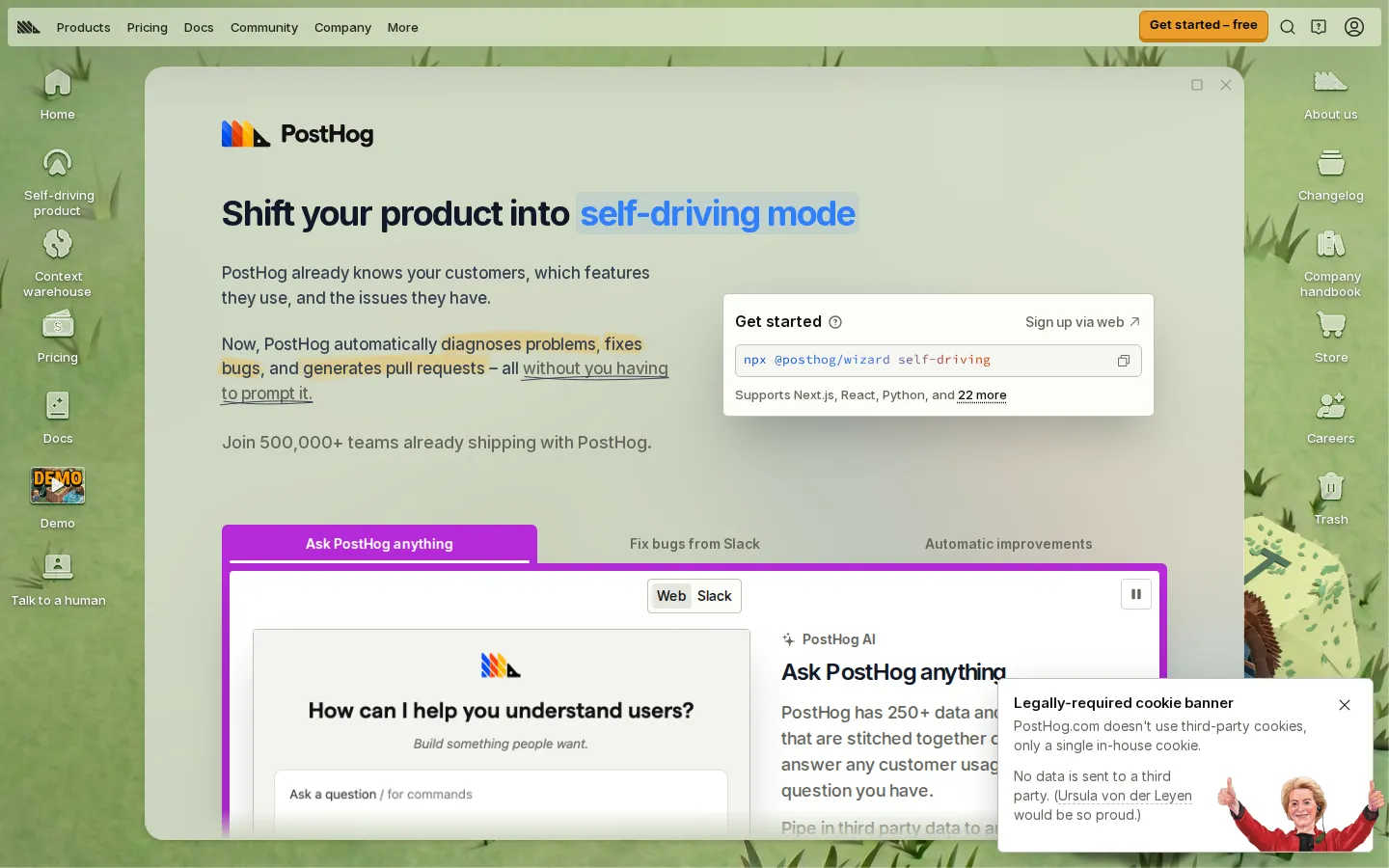
PostHog Core Features
Product analytics
Track events, funnels, trends, and retention with a generous free tier of 1M events monthly.
Session replay
Watch real user sessions to understand behavior and debug issues, with 5K free recordings.
Feature flags and experiments
Roll out features gradually and run A/B tests billed with flags.
Surveys and error tracking
Collect in-product feedback and monitor exceptions with 100K free errors.
Data warehouse and pipelines
Query product data alongside other sources with 1M free rows plus free historical imports.
AI observability
Monitor LLM calls, costs, and quality for AI-powered products, with 100K free events.
PostHog AI assistant
Ask conversational questions about your product data, with 500 free credits monthly.
Replay Vision
Use AI to search session recordings by content, with 2,500 free credits monthly.
Who is PostHog for?
PostHog serves product managers, engineers, data analysts, and growth teams at startups and scale-ups who need product analytics without complex enterprise contracts. Engineers use session replay and error tracking to debug issues, product managers run experiments and surveys to validate features, and data teams use the warehouse and pipelines to combine product data with other sources. Teams building AI features use AI observability to monitor LLM calls, costs, and quality, while the PostHog AI assistant helps analyze product data conversationally. Marketing and web teams use web analytics and Replay Vision to understand traffic and user behavior. The generous free tier makes it a favorite of early-stage companies, while unlimited team members and transparent pricing appeal to larger organizations. Open-source users can self-host the MIT-licensed platform, and agencies building products for multiple clients can upgrade for more projects. Agencies and consultants use PostHog to instrument multiple client products under one account, while open-source teams self-host it for full data control. Growth engineers appreciate the ability to set billing limits per product, and AI product teams rely on AI observability to track model costs and quality. The active community, documentation, and template library lower the learning curve for newcomers, and the transparent pricing model removes the sales friction typical of analytics vendors.
PostHog Use Cases
Analyze user funnels and retention to find where activation drops off in your product.
Watch session replays to debug confusing onboarding flows and UI issues.
Run A/B experiments on pricing pages and feature launches with statistical rigor.
Monitor LLM application costs, latency, and response quality with AI observability.
Ask the PostHog AI assistant to summarize user behavior trends conversationally.
Search thousands of session recordings with Replay Vision to find specific user actions.
Self-host the open-source version for full control over data in regulated environments.
PostHog Pros and Cons
Pros
- Generous free tier covers more than 90% of companies with no credit card required.
- All-in-one suite replaces multiple point tools for analytics, replay, flags, and experiments.
- AI-native features like LLM observability and Replay Vision are included in the platform.
- Transparent usage-based pricing with billing limits and scale-based rate reductions.
- Open-source core with MIT license allows self-hosting.
Cons
- Usage-based pricing can grow unpredictably for very high-volume products.
- The breadth of features creates a learning curve for new teams.
- Self-hosted setup requires infrastructure knowledge and maintenance effort.
FAQ About PostHog
PostHog Pricing
Freemium: generous free tier (1M events, 5K recordings monthly), then transparent usage-based pricing that reduces with scale.
Check official pricingFree
1M events, 5K recordings, 1M flag requests, 1 project, 1-year retention
Usage-based
Pay for usage beyond free tier, prices reduce with scale, billing limits per product
PostHog Alternatives

Trooly
Trooly is an AI-native qualitative research platform. It writes the research plan, screens and recruits participants, moderates one-on-one multimodal voice interviews, and synthesizes transcripts into themed reports. Product and research teams can bring their own users at $10 per interview, or let Trooly recruit from a network of 180M+ respondents, with every interview quality-checked before delivery.

Vert
Vert is a computer-vision parking operations platform for property managers, municipalities and parking operators. It pairs smartphone-based automatic license plate recognition with digital permits, guest registration, hourly and monthly payments, violation ticketing, appeals and reporting in one branded system. Teams scan plates on foot or by vehicle, check infractions against live permit and payment records, and issue digital or printed notices without separate camera hardware.

MapGO
How far is this point from the sea? From the nearest border? Which country, region and district are it in? MapGO answers those in one click.